1 Quantum Operator Algebras (QOA)
Quantum operator algebras in quantum field theories are defined as the algebras of observable
operators, and as such, they are also related to the von Neumann algebra; quantum operators are
usually defined on Hilbert spaces, or in some QFTs on Hilbert space bundles or other similar
families of spaces.
Note. representations of Banach ∗-algebras, that are also defined on Hilbert spaces, are related
to C∗-algebra representations which provide a useful approach to defining quantum
space-times.
Quantum Operator Algebras in Quantum Field Theories: QOAs in QFTs Examples of
quantum operators are: the Hamiltonian operator (or Schrödinger operator), the position and
momentum operators, Casimir operators, Unitary operators, spin operators, and so on. The
observable operators are also self-adjoint. More general operators were recently defined, such as
Progogine’s superoperators. Another development in quantum theories is the introduction of
Frechét nuclear spaces or ‘rigged’ Hilbert spaces (Hilbert bundles). The following sections define
several types of quantum operator algebras that provide the foundation of modern quantum field
theories in mathematical physics.
1.1 Quantum Groups, Quantum Operator Algebras and Related Symmetries.
Quantum theories adopted a new lease of life post 1955 when von Neumann beautifully
re-formulated quantum mechanics (QM) and Quantum theories (QT) in the mathematically
rigorous context of Hilbert spaces and operator algebras defined over such spaces. From a current
physics perspective, von Neumann’ s approach to quantum mechanics has however done much
more: it has not only paved the way to expanding the role of symmetry in physics, as for example
with the Wigner-Eckhart theorem and its applications, but also revealed the fundamental
importance in Quantum physics of the state space geometry of quantum operator algebras-
Mathematical definitions
Definitions:
- Von Neumann Algebra
- Hopf Algebra
- Groupoids
- Haar systems associated to Measured Groupoids or Locally Compact Groupoids.
.
1.2 Von Neumann Algebra
Let ℋ denote a complex (separable) Hilbert space. A von Neumann algebra 𝒜 acting on ℋ is a
subset of the algebra of all bounded operators ℒ(ℋ) such that:
- (i) 𝒜 is closed under the adjoint operation (with the adjoint of an element T denoted
by T∗).
- (ii) 𝒜 equals its bicommutant, namely:
If one calls a commutant of a set 𝒜 the special set of bounded operators on ℒ(ℋ) which commute
with all elements in 𝒜, then this second condition implies that the commutant of the commutant of
𝒜 is again the set 𝒜.
On the other hand, a von Neumann algebra 𝒜 inherits a unital subalgebra structure from ℒ(ℋ)
and, according to the first condition in its definition, a ∗-subalgebra structure. The bicommutant
theorem states that 𝒜 is a von Neumann algebra if and only if 𝒜 is a ∗-subalgebra of
ℒ(ℋ) that is closed in the weak operator topology, the smallest topology for which the
maps
are continuous for all ξ,η ∈ℋ. Here ⟨⋅,⋅⟩ denotes the inner product on ℋ. For a treatment of
the geometry of the state spaces of quantum operator algebras, see Alfsen and Schultz
(2003).
1.2.1 Hopf algebra
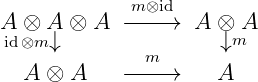
First, a unital associative algebra consists of a linear space A together with two linear
maps
satisfying the conditions
This first condition can be seen in terms of a commuting diagram :
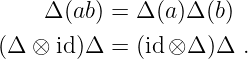
Next suppose we consider ‘reversing the arrows’, and take an algebra A equipped with a linear
homorphisms Δ : A→A ⊗ A, satisfying, for a,b ∈ A :
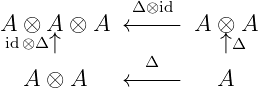
We call Δ a comultiplication, which is said to be coasociative in so far that the following diagram
commutes
There is also a counterpart to η, the counity map 𝜀 : A→ℂ satisfying
A bialgebra (A,m, Δ,η,𝜀) is a linear space A with maps m, Δ,η,𝜀 satisfying the above
properties.
Now to recover anything resembling a group structure, we must append such a bialgebra with an
antihomomorphism S : A→A, satisfying S(ab) = S(b)S(a), for a,b ∈ A . This map is defined
implicitly via the property :
We call S the antipode map. A Hopf algebra is then a bialgebra (A,m,η, Δ,𝜀) equipped with an
antipode map S .
Commutative and noncommutative Hopf algebras form the backbone of quantum ‘groups’ and are
essential to the generalizations of symmetry. Indeed, in most respects a quantum ‘group’ is
identifiable with a Hopf algebra. When such algebras are actually associated with proper groups of
matrices there is considerable scope for their representations on both finite and infinite dimensional
Hilbert spaces.
1.2.2 Groupoids
Recall that a groupoid G is, loosely speaking, a small category with inverses over its set of objects
X = Ob(G) . One often writes Gxy for the set of morphisms in G from x to y . A topological
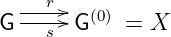
groupoid consists of a space G, a distinguished subspace G(0) = Ob(G) ⊂ G, called the space of
objects of G, together with maps
called the range and source maps respectively, together with a law of composition
such that the following hold :
- s(γ1 ∘ γ2) = r(γ2) , r(γ1 ∘ γ2) = r(γ1) , for all (γ1,γ2) ∈ G(2) .
- s(x) = r(x) = x , for all x ∈ G(0) .
- γ ∘ s(γ) = γ , r(γ) ∘ γ = γ , for all γ ∈ G .
- (γ1 ∘ γ2) ∘ γ3 = γ1 ∘ (γ2 ∘ γ3) .
- Each γ has a two–sided inverse γ−1 with γγ−1 = r(γ) , γ−1γ = s(γ) . Furthermore,
only for topological groupoids the inverse map needs be continuous.
It is usual to call G(0) = Ob(G) the set of objects of G . For u ∈ Ob(G), the set of arrows
u→u forms a group Gu, called the isotropy group of G at u.
Thus, as is well kown, a topological groupoid is just a groupoid internal to the category of
topological spaces and continuous maps. The notion of internal groupoid has proved significant in
a number of fields, since groupoids generalise bundles of groups, group actions, and
equivalence relations. For a further study of groupoids we refer the reader to Brown
(2006).
Several examples of groupoids are:
- locally compact groups, transformation groups, and groups in general;
- equivalence relations;
- tangent bundles;
- the tangent groupoid;
- holonomy groupoids for foliations;
- Poisson groupoids;
- graph groupoids.
As a simple, helpful example of a groupoid, consider (b) above. Thus, let R be an equivalence
relationhttps://physicslibrary.org/encyclopedia/Bijective.html on a set X. Then R is a groupoid
under the following operations: (x,y)(y,z) = (x,z), (x,y)−1 = (y,x). Here, G0 = X, (the diagonal
of X × X ) and r((x,y)) = x,s((x,y)) = y.
So R2 =  . When R = X × X, R is called a trivial
groupoid. A special case of a trivial groupoid is R = Rn =
. When R = X × X, R is called a trivial
groupoid. A special case of a trivial groupoid is R = Rn = 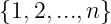 ×
×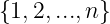 . (So
every i is equivalent to every j). Identify (i,j) ∈ Rn with the matrix unit eij. Then the
groupoid Rn is just matrix multiplication except that we only multiply eij,ekl when
k = j, and (eij)−1 = e
ji. We do not really lose anything by restricting the multiplication,
since the pairs eij,ekl excluded from groupoid multiplication just give the 0 product in
normal algebra anyway. For a groupoid Glc to be a locally compact groupoid means
that Glc is required to be a (second countable) locally compact Hausdorff space, and
the product and also inversion maps are required to be continuous. Each Glcu as well
as the unit space Glc0 is closed in G
lc. What replaces the left Haar measure on Glc is
a system of measures λu (u ∈ G
lc0), where λu is a positive regular Borel measure on
Glcu with dense support. In addition, the λu ’s are required to vary continuously (when
integrated against f ∈ Cc(Glc)) and to form an invariant family in the sense that for
each x, the map y
. (So
every i is equivalent to every j). Identify (i,j) ∈ Rn with the matrix unit eij. Then the
groupoid Rn is just matrix multiplication except that we only multiply eij,ekl when
k = j, and (eij)−1 = e
ji. We do not really lose anything by restricting the multiplication,
since the pairs eij,ekl excluded from groupoid multiplication just give the 0 product in
normal algebra anyway. For a groupoid Glc to be a locally compact groupoid means
that Glc is required to be a (second countable) locally compact Hausdorff space, and
the product and also inversion maps are required to be continuous. Each Glcu as well
as the unit space Glc0 is closed in G
lc. What replaces the left Haar measure on Glc is
a system of measures λu (u ∈ G
lc0), where λu is a positive regular Borel measure on
Glcu with dense support. In addition, the λu ’s are required to vary continuously (when
integrated against f ∈ Cc(Glc)) and to form an invariant family in the sense that for
each x, the map y xy is a measure preserving homeomorphism from Glcs(x) onto
Glcr(x). Such a system
xy is a measure preserving homeomorphism from Glcs(x) onto
Glcr(x). Such a system  is called a left Haar system for the locally compact groupoid
Glc.
is called a left Haar system for the locally compact groupoid
Glc.
This is defined more precisely next.
1.2.3 Haar systems for locally compact topological groupoids
Let
be a locally compact, locally trivial topological groupoid with its transposition into transitive
(connected) components. Recall that for x ∈ X, the costar of x denoted CO∗(x) is defined as the
closed set ⋃
{G(y,x) : y ∈ G}, whereby
is a principal G(x0,y0)–bundle relative to fixed base points (x0,y0) . Assuming all relevant sets are
locally compact, then following Seda (1976), a (left) Haar system on G denoted (G,τ) (for later
purposes), is defined to comprise of i) a measure κ on G, ii) a measure μ on X and iii) a
measure μx on CO∗(x) such that for every Baire set E of G, the following hold on setting
Ex = E ∩ CO∗(x) :
- x
 μx(Ex) is measurable.
- κ(E) = ∫
xμx(Ex) dμx .
- μz(tEx) = μx(Ex), for all t ∈ G(x,z) and x,z ∈ G .
The presence of a left Haar system on Glc has important topological implications: it requires that
the range map r : Glc → Glc0 is open. For such a G
lc with a left Haar system, the vector space
Cc(Glc) is a convolution ∗–algebra, where for f,g ∈ Cc(Glc),
with involution
One has C∗(G
lc) to be the enveloping C∗–algebra of C
c(Glc) (and also representations
are required to be continuous in the inductive limit topology). Equivalently, it is the
completion of πuniv(Cc(Glc)) where πuniv is the universal representation of Glc. For example, if
Glc = Rn , then C∗(G
lc) is just the finite dimensional algebra Cc(Glc) = Mn, the span of the
eij’s.
There exists (e.g. [63, p. 91]) a measurable Hilbert bundlehttps://physicslibrary.org/encyclopedia/MonoidalBicategory.html
(Glc0,ℋ,μ) with
and a Glc-representation L on ℋ. Then, for every pair ξ,η of square-integrable sections of ℋ, the
function
is required to be ν–measurable. The representation Φ of Cc(Glc) is then given by
The triple (μ,ℋ,L) is called a measurable Glc–Hilbert bundle.
References
[1] E. M. Alfsen and F. W. Schultz: Geometry of State Spaces of Operator Algebras,
Birkhäuser, Boston–Basel–Berlin (2003).
[2] I. Baianu : Categories, Functors and Automata Theory: A Novel Approach to
Quantum Automata through Algebraic–Topological Quantum Computations., Proceed.
4th Intl. Congress LMPS, (August-Sept. 1971).
[3] I.C. Baianu, N. Boden and D. Lightowlers.1981. NMR Spin–Echo Responses of
Dipolar–Coupled Spin–1/2 Triads in Solids., J. Magnetic Resonance, 43:101–111.
[4] I. C. Baianu, J. F. Glazebrook and R. Brown.: A Non–Abelian, Categorical Ontology
of Spacetimes and Quantum Gravity., Axiomathes 17,(3-4): 353-408(2007).
[5] F.A. Bais, B. J. Schroers and J. K. Slingerland: Broken quantum symmetry and
confinement phases in planar physics, Phys. Rev. Lett. 89 No. 18 (1–4): 181-201 (2002).
[6] J.W. Barrett.: Geometrical measurements in three-dimensional quantum gravity.
Proceedings of the Tenth Oporto Meeting on Geometry, Topology and Physics (2001).Intl.
J. Modern Phys. A 18 , October, suppl., 97–113 (2003)
[7] M. Chaician and A. Demichev: Introduction to Quantum Groups, World Scientific
(1996).
[8] Coleman and De Luccia: Gravitational effects on and of vacuum decay., Phys. Rev.
D 21: 3305 (1980).
[9] A. Connes: Noncommutative Geometry, Academic Press 1994.
[10] L. Crane and I.B. Frenkel. Four-dimensional topological quantum field theory, Hopf
categories, and the canonical bases. Topology and physics. J. Math. Phys. 35 (no. 10):
5136-5154 (1994).
[11] W. Drechsler and P. A. Tuckey: On quantum and parallel transport in a Hilbert
bundle over spacetime., Classical and Quantum Gravity, 13:611–632 (1996). doi:
10.1088/0264–9381/13/4/004
[12] V. G. Drinfel’d: Quantum groups, In Proc. Int. Cong. of Mathematicians, Berkeley
1986, (ed. A. Gleason), Berkeley, 798–820 (1987).
[13] G. J. Ellis: Higher dimensional crossed modules of algebras, J. of Pure Appl. Algebra
52 (1988), 277–282.
[14] P.. I. Etingof and A. N. Varchenko, Solutions of the Quantum Dynamical
Yang-Baxter Equation and Dynamical Quantum Groups, Comm.Math.Phys., 196:
591-640 (1998)
[15] P. I. Etingof and A. N. Varchenko: Exchange dynamical quantum groups, Commun.
Math. Phys. 205 (1): 19–52 (1999)
[16] P. I. Etingof and O. Schiffmann: Lectures on the dynamical Yang–Baxter equations,
in Quantum Groups and Lie Theory (Durham, 1999), pp. 89-129, Cambridge University
Press, Cambridge, 2001.
[17] B. Fauser: A treatise on quantum Clifford Algebras. Konstanz, Habilitationsschrift.
arXiv:math.QA/0202059 (2002).
[18] B. Fauser: Grade Free product Formulae from Grassman–Hopf Gebras. Ch. 18
in R. Ablamowicz, Ed., Clifford Algebras: Applications to Mathematics, Physics and
Engineering, Birkhäuser: Boston, Basel and Berlin, (2004).
[19] J. M. G. Fell.:The Dual Spaces of C*–Algebras, Transactions of the American
Mathematical Society, 94: 365–403 (1960).
[20] F.M. Fernandez and E. A. Castro.: (Lie) Algebraic Methods in Quantum Chemistry
and Physics., Boca Raton: CRC Press, Inc (1996).
[21] R. P. Feynman: Space–Time Approach to Non–Relativistic Quantum Mechanics,
Reviews of Modern Physics, 20: 367–387 (1948). [It is also reprinted in (Schwinger 1958).]
[22] A. Fröhlich, Non-Abelian Homological Algebra. I. Derived functors and satellites.,
Proc. London Math. Soc. (3), 11: 239–252 (1961).
[23] Gel’fand, I. and Naimark, M., 1943, On the Imbedding of Normed Rings into the
Ring of Operators in Hilbert Space, Recueil Mathématique [Matematicheskii Sbornik]
Nouvelle Série, 12 [54]: 197–213. [Reprinted in C∗-algebras: 1943–1993, in the series
Contemporary Mathematics, 167, Providence, R.I. : American Mathematical Society,
1994.]
[24] R. Gilmore: “Lie Groups, Lie Algebras and Some of Their Applications.”, Dover
Publs., Inc.: Mineola and New York, 2005.
[25] P. Hahn: Haar measure for measure groupoids., Trans. Amer. Math. Soc. 242:
1–33(1978).
[26] P. Hahn: The regular representations of measure groupoids., Trans. Amer. Math.
Soc. 242:34–72(1978).
[27] R. Heynman and S. Lifschitz. 1958. “Lie Groups and Lie Algebras”., New York and
London: Nelson Press.
[28] C. Heunen, N. P. Landsman, B. Spitters.: A topos for algebraic quantum theory,
(2008). arXiv:0709.4364v2 [quant-ph].