In Newtonian mechanics, work is intimately related to force, as is momentum. The very definition
of force involved time rate of change of momentum. Work is the integral of a differential consisting
of the product of force by a differential element of the displacement of its point of application
or of the particle upon which it is acting. Because both force and displacement are
vectors, one must specify clearly what kind of product is involved in the differential of
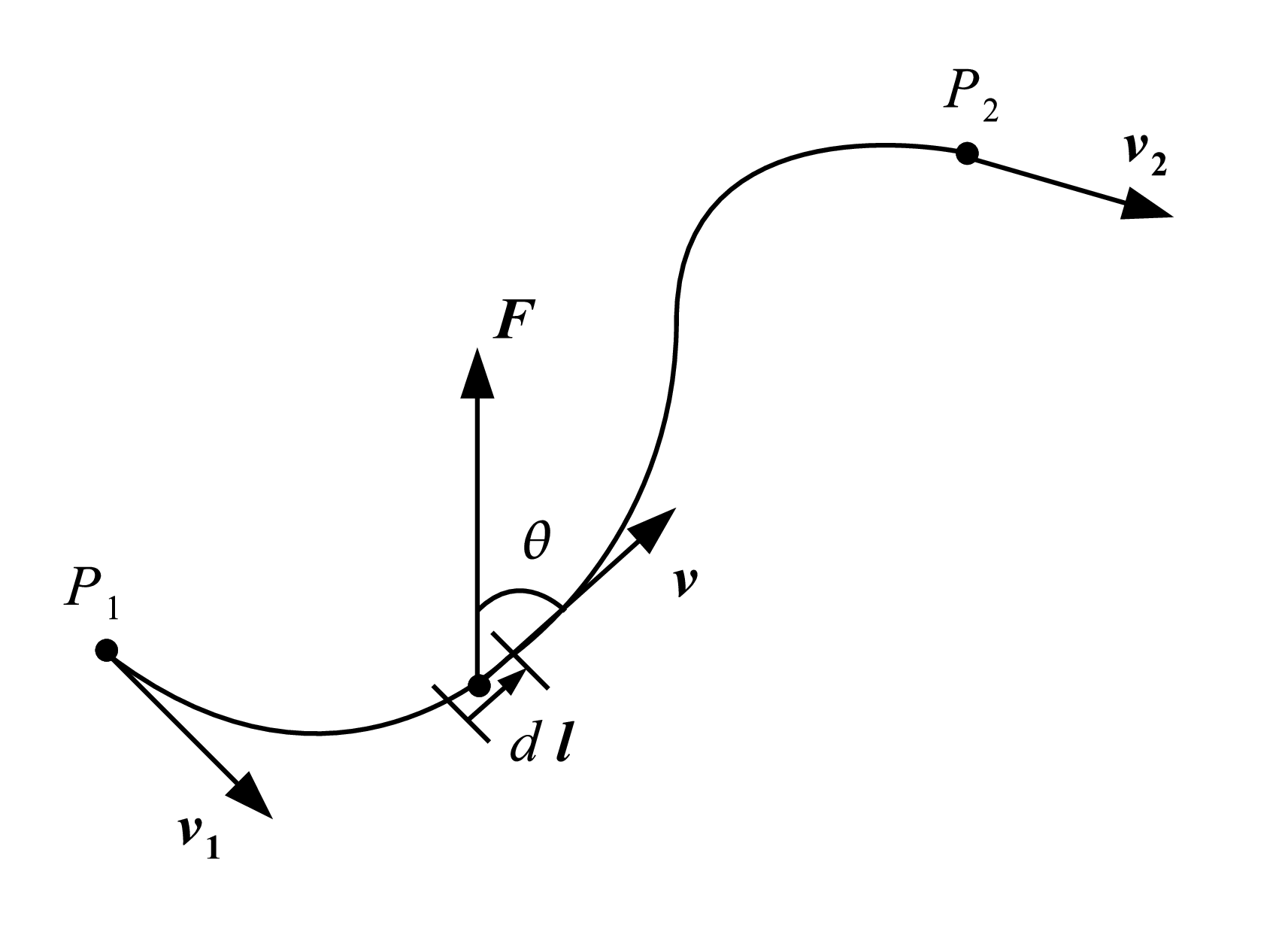
work, dW. If dl is the differential displacement (along) its path) of the particle P, upon
which force F is acting (or to which F is applied), we define the corresponding of work
done by F to be their scalar product. Thus by the definition of work, its differential
is
The total work done by F while the particle upon which it acts moves along its path from any
point P1 to any other point P2 on the the path (as in figure) is
combing with Eq. 1
where Ft is the (scalar) component of F tangent to the path in the direction of motion. This is
called the line integral of the force along the path of the particle to which it is applied; it is a
scalar. Employing P1 and P2 to represent the limits of integration merely means that for the lower
limit we substitute whatever values the variables involved may have at point P1, while for the
upper limit we substitute their values at P2. It may be noted that (by the definition of work)
no work can be done by any centripetal force (=man) or by any force exerted by any
smooth surface which remains at rest in our inertial system of coordinates, though these
forces may be very large and important in producing accelerations and determining
paths.
The units of work commonly are specified in terms of the corresponding units of force and
displacement. Thus the foot-pound (ft-lb) is defined to be the Work Done by a Force of one pound
acting through a distance of one foot in its own direction. The work done by a force of one dyne
acting through a distance of one centimeter in its own direction is called an erg, usually,
rather than a dyne-centimeter. Likewise, the newton-meter is called the joule (= 107
ergs).
If a force F acts upon a rigid body which rotates about a fixed axis, being applied at a point
distant r from the axis, the differential work done by it on the body during rotation through the
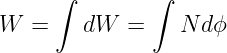
differential angle dϕ is dW = Ftr(rdϕ), since in this case Ft = Ftr and dl = rdϕ. But rFtr = N is
the magnitude of the moment of F about the axis of rotation. Hence the work done by a torque N
(whether moment of a force or of a couple) during rotation of a body to which it is applied,
is
The differential work Ndϕ done by the torque is positive provided dϕ s in the sense in which N
tends to produce rotation. It should be noted that Ftr is Normal both to r and to the axis of
rotation, and is thus tangent to the path of its point of application.
0.1 References
[1] Broxon, James W. ”Mechanics” New York, Appleton-Century-Crofts., Inc., 1960.
This entry is a derivative of the Public domain work [1].