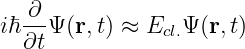
In order to form the wave equation of a particle in a potential V (r), we operate at first
under the conditions of the ‘geometrical optics approximation’ and seek to form an
equation of propagation for a wave packet Ψ(r,t) moving in accordance with the de Broglie
theory.
The center of the packet travels like a classical particle whose position, momentum, and energy we
shall designate by rcl., pcl., and Ecl., respectively. These quantities are connected by the
relation
H(rcl.,pcl.) is the classical Hamiltonian. We suppose that V (r) does not depend upon the time
explicitly (conservative system), although this condition is not absolutely necessary for the present
argument to hold. Consequently Ecl. remains constant in time, while rcl. and pcl. are
well-defined functions of t. Under the approximate conditions considered here, V (r)
remains practically constant over a region of the order of the size of the wave packet;
therefore
On the other hand, if we restrict ourselves to time intervals sufficiently short so that the relative
variation of pcl. remains negligible, Ψ(r,t) may be considered as a superposition of plane waves of
the type
whose frequencies are in the neighborhood of Ecl.∕ℏ and whose wave vectors lie close to pcl.∕ℏ.
Therefore
and taking the divergence of this last express ion, one obtains
combining the relations (2),(3), and (4) and making use of equation (1), we obtain
The wave packet Ψ(r,t) satisfies - at least approximately - a wave equation of the type we are
looking for. We are very naturally led to adopt this equation as the wave equation of a
particle in a potential, and we postulate that in all generality, even when the conditions
for the ‘geometrical optics’ approximation are not fulfilled, the wave Ψ satisfies the
equation
It is the Schrödinger equation for a particle in a potential V (r).
[1] Messiah, Albert. ”Quantum mechanics: volume I.” Amsterdam, North-Holland Pub. Co.; New
York, Interscience Publishers, 1961-62.
This entry is a derivative of the Public domain work [1].