0.1 Wave Equations
Describe the propagation of a wide variety of periodic signals, ’perturbations’, or waves
through either a medium or vacuum in terms of certain types of differential equations.
There are a large number of such wave equations ranging from classical to quantum,
and then to relativistic QFT and gravitational ones. Examples of waves are extremely
numerous, and include: elastic waves (for example, vibrations, sound, ultrasound, sea waves,
ground waves – as in an earthquake, etc.), electromagnetic waves (including: radio waves,
Light, X-rays, γ-rays, and so on), plasma waves, spin waves, gravitational waves, and so
on.
Furthermore, every quantum ‘particle’ has an associated, ’de Broglie wave’, which is called the
wave-particle duality in quantum theory; for example, electrons, protons, neutrons, quarks,
neutrinos, and all other sub-atomic or elementary ‘particles’ have their ’own’ associated waves
whose wavelength is inversely proportional to their energy (viz. de Broglie). The waves are
represented as solutions of such differential equations, often with specified boundary conditons;
thus a wave has both an amplitude and a phase.
Thus, any oscillation has a resulting, or corresponding wave that propagates; alternatively, a wave
can also be represented as a continuous sequence of local oscillations of a propagating field. The
intensity of the propagated signal or field is proportional to the square of the amplitude of the
wave, whereas the phase can be thought of as the time interval that has elapsed from the beginning
of the wave propagation to the point in space where its phase is determined or measured.
There are two basic types of waves: longitudinal (for example, in an elastic medium
such as sounds and sea waves)–that are propagating via longitudinal oscillations of
particles in the elastic medium which occur along the direction of propagation of the wave
front, or transversal waves (for example, electromagnetic) that can also propagate in
vacuum.
Because of the periodic nature of the waves and of their propagation, Wave Superposition is
readily analyzed in terms of either Fourier series or integrals. General solutions of the wave
equations are thus usually expressed in terms of Fourier series whose components are
‘monochromatic’ (single- frequency) waves.
0.2 Examples of Differential Wave Equations
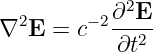
- Transverse electrical wave, with varying vector field E, travelling at a constant speed
c:
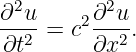
- The wave equation in one dimension is
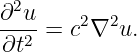
- “The wave equation in n dimensions is
where u is a function of the location variables x1,x2,…,xn, and time t. Here, ∇2 is
the Laplacian with respect to the location variables, which in Cartesian coordinates is
given by ∇2 =  +
+  +
+  +
+  ”, on line
- The Schrödinger equation for a quantum system has the general form: