0.1 Key data
Let us recall the basic notion that a topological space consists of a set X and a ‘topology’ on X
where the latter gives a precise but general sense to the intuitive ideas of ‘nearness’ and
‘continuity’. Thus the initial task is to axiomatize the notion of ‘neighborhood’ and
then consider a topology in terms of open or of closed sets, a compact-open topology,
and so on (see Brown, 2006). In any case, a topological space consists of a pair (X,𝒯 )
where 𝒯 is a topology on X. For instance, suppose an open set topology is given by the
set 𝒰 of prescribed open sets of X satisfying the usual axioms (Brown, 2006 Chapter
2).
0.2 Definition of Variable Topology
Now, to speak of a variable open-set topology one might conveniently take in this case a family of
sets 𝒰λ of a system of prescribed open sets, where λ belongs to some indexing set Λ. The system of
open sets may of course be based on a system of contained neighbourhoods of points where one
system may have a different geometric property compared say to another system (a system of
disc-like neighbourhoods compared with those of cylindrical-type).
Definition 0.1. In general, we may speak of a topological space with a varying topology as
a pair (X,𝒯λ) where λ ∈ Λ is an index set.
Examples A straightforward example of a network system with variable topology is that of a
family of graphs generated over a fixed set of vertices by changing the graph edges or connections
between its vertices.
The idea of a varying topology has been introduced to describe possible topological distinctions in
bio-molecular organisms through stages of development, evolution, neo-plasticity, etc. This is
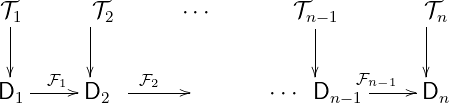
indicated schematically in the diagram below where we have an n-stage dynamic evolution
(through complexity) of categories Di where the vertical arrows denote the assignment of
topologies 𝒯i to the class of objects of the Di along with functors ℱi : Di→Di+1, for
1 ≤ i ≤ n − 1 :
In this way a variable topology can be realized through such n-levels of complexity of the
development of an organism.
Another example is that of cell/network topologies in a categorical approach involving concepts
such as the free groupoid over a graph (Brown, 2006). Thus a varying graph system clearly induces
an accompanying system of variable groupoids. As suggested by Golubitsky and Stewart (2006),
symmetry groupoids of various cell networks would appear relevant to the physiology of animal
locomotion as one example.