We take a system with a total of 3N ≡ n Cartesian coordinates of which ν are independent. We
denote Cartesian coordinates by the same letter xi, understanding by this symbol all the
coordinates x,y,z; this means that i varies from 1 to 3N, that is, from 1 to n. The generalized
coordinates we denote by qα (l ≤ α ≤ ν). Since the generalized coordinates completely specify the
position of their system, xi are their unique functions:
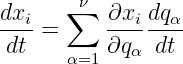
From this it is easy to obtain an expression for the Cartesian components of velocity.
Differentiating the function of many variables xi(…qα) with respect to time, we have
In the subsequent derivation we shall often have to perform summations with respect to all the
generalized coordinates qα, and double and triple sums will be encountered. In order to save space
we will use Einstein summation.
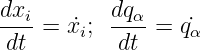
The total derivative with respect to time is usually denoted by a dot over the corresponding
variable:
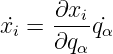
In this notation, the velocity (1) in abbreviated form becomes:
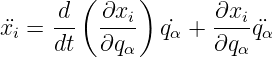
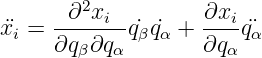
Differentiating this with respect to time again, we obtain an expression for the Cartesian
components of acceleration:
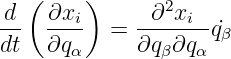
The total derivative in the first term is written as usual:
The Greek symbol over which the summation is performed is deonted by the letter β to avoid
confusion with the symbol α, which denotes the summation in the expression for velocity (2). Thus
we obtain the desired expression for xi:
The first term on the right-hand side contains a double summation with respect to α and
β.
0.1 References
[1] Kompaneyets, A. ”Theoretical physics.” Foreign Languages Publishing House, Moscow,
1961.
This entry is a derivative of the Public domain work [1]