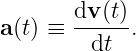
The acceleration of an object is the time derivative of its velocity. Like velocity, acceleration can
therefore be considered either as a vector quantity or as a scalar quantity. Acceleration is usually
denoted by the symbol a, by v (the time derivative of the velocity) or by ẍ (the second time
derivative of the position). We can write the definition of acceleration (in vector form) as
follows:
The SI unit of acceleration is m∕s2 (metres per second per second, or metres per second squared).
Another unit of acceleration is g, defined as g = 9.80665 m∕s2; this is approximately the
acceleration due to gravity at the surface of the Earth at a latitude of 45∘.
In addition to acceleration as the time derivative (instantaneous rate of change) of velocity, the
average acceleration, or the change of velocity Δv over a specified period of time Δt, can also be
defined:
In classical mechanics, acceleration is caused by forces. If a total force F acts on an object with
constant mass m, the object undergoes an acceleration a as described by Newton’s second
law:
In contrast to velocity, which depends on the observer’s system of reference, acceleration can be
called an absolute quantity, in the sense that two observers moving with constant velocity with
respect to each other perceive the same acceleration.