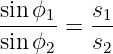
Snell’s law describes the relationship between an incident ray of Light and that of the refracted ray
of light at the boundary of two uniform materials. When light goes from one medium to
another, Snell’s law says that the ratio of the sines of the angles between the Normal to
the interface and the rays in the two media equals the ratio of the speeds in the two
media
The ratio of the speeds of light in any 3 media is called the index of refraction of the second
medium relative to the first
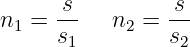
The ratio of the speeds of light in a vacuum to the speed in a given medium is called the absolute
index of refraction of the medium. If s is the speed of light in a vacuum and s1 and s2 are the
speed of light in the two media, then the absolute indexes of refraction for the two media
are
Combining equations (2) and (3), Snell’s law can be written in terms of the absolute indexes of
refraction
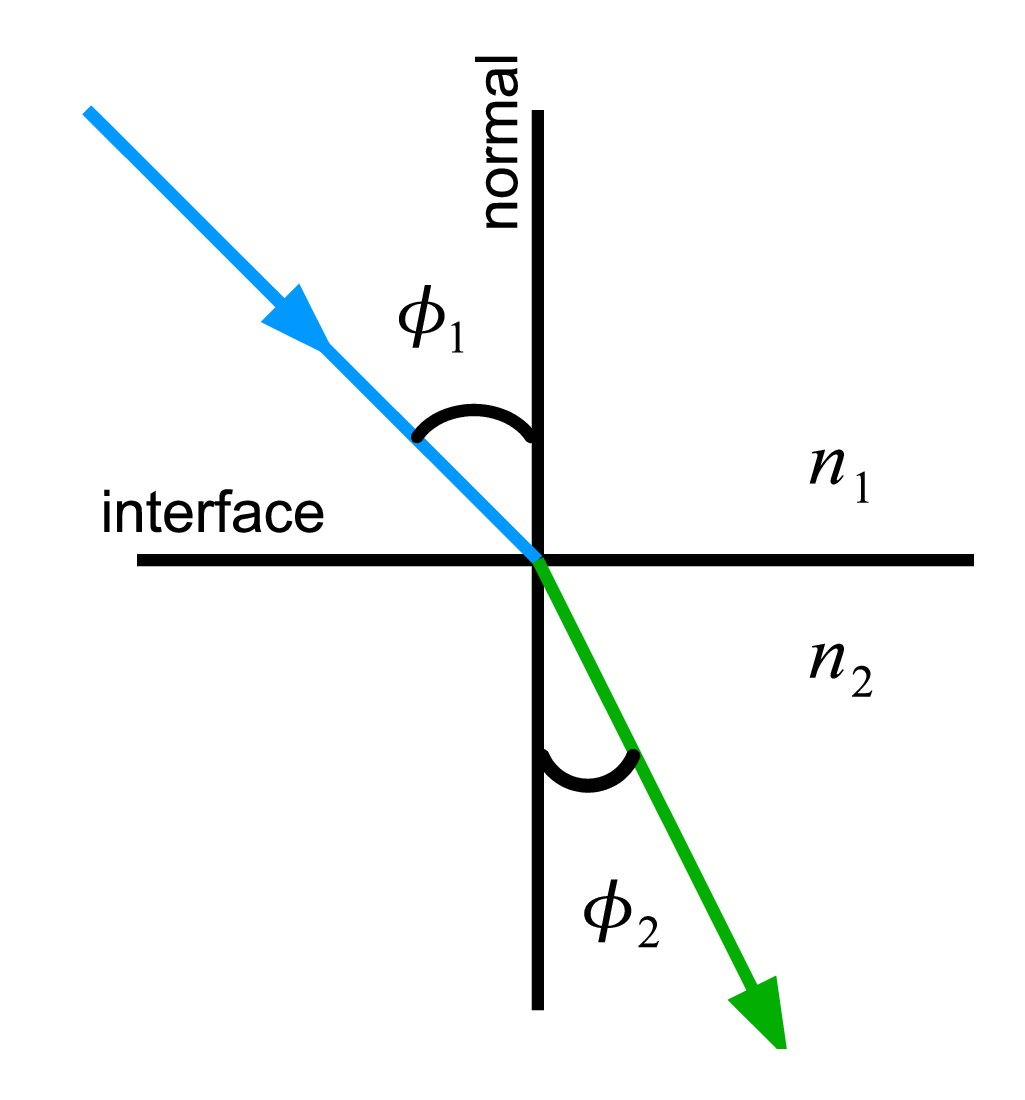
Figure 1. Snell’s law.
References
[1] Ferry, Ervin S., A Handbook of Physics Measurements. Vol 1. Stanhope Press, Boston,
1918.
This entry is a derivative of the Public domain work [1]