Physics Library
 An open source physics library
Encyclopedia | Forums | Docs | Random | Template Test |  
Login
create new user
Username:
Password:
forget your password?
Main Menu
Sections

Meta

Talkback

Downloads

Information
scalar triple product (Definition)

Scalar Triple Product

The scalar triple product is

$\displaystyle \boxed{[\mathbf{u},\mathbf{v},\mathbf{w}] =(\mathbf{u}\times\mathbf{v})\cdot\mathbf{w}.} \tag{1} $
Its absolute value equals the volume of the parallelepiped generated by the three vectors:

$\displaystyle V=\vert[\mathbf{u},\mathbf{v},\mathbf{w}]\vert. $
Its sign records orientation relative to a right-handed basis.
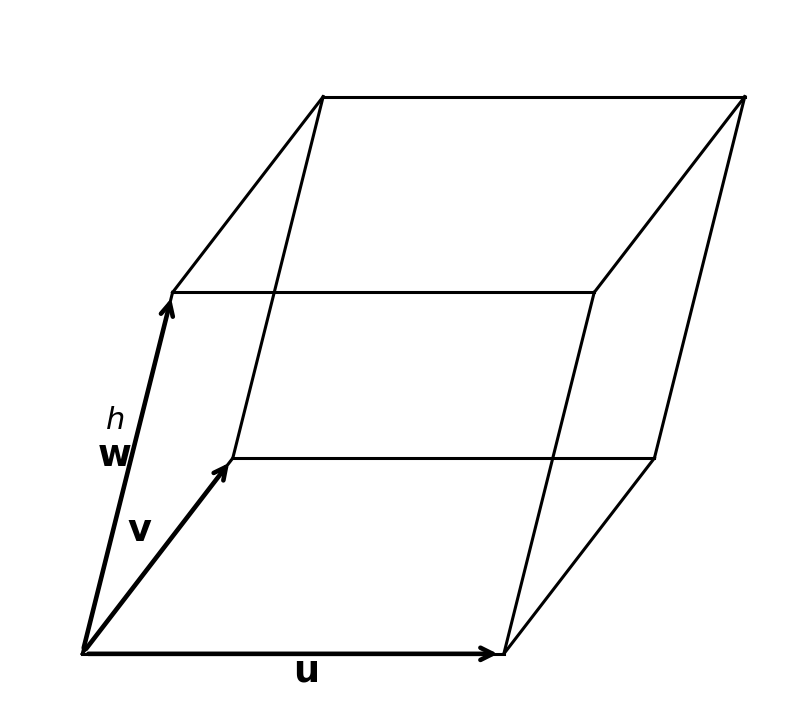
Image brand_fig_18
Figure 18, modernized: scalar triple product as oriented parallelepiped volume.

The scalar triple product is invariant under cyclic permutation:

$\displaystyle (\mathbf{u}\times\mathbf{v})\cdot\mathbf{w} =(\mathbf{v}\times\mathbf{w})\cdot\mathbf{u} =(\mathbf{w}\times\mathbf{u})\cdot\mathbf{v}, $
and changes sign under exchange of any two vectors.

In Cartesian components,

$\displaystyle \boxed{ (\mathbf{u}\times\mathbf{v})\cdot\mathbf{w}= \begin{vmatrix} u_x&u_y&u_z\ v_x&v_y&v_z\ w_x&w_y&w_z \end{vmatrix}.} \tag{2} $
Therefore nonzero vectors $\mathbf{u},\mathbf{v},\mathbf{w}$ are coplanar exactly when their scalar triple product vanishes.

Example 1: volume

For

$\displaystyle A=(-3,1,2),\ B=(-1,0,-2),\ C=(2,1,4),\ D=(2,-3,1), $
Brand obtains

$\displaystyle (\overrightarrow{AB}\times\overrightarrow{AC})\cdot \overrightarrow{AD}=81. $
Thus the parallelepiped volume is $81$, and the tetrahedron volume is $81/6=13.5$.

Example 2: line-plane intersection

If a line is

$\displaystyle \mathbf r=\mathbf{r}_A+\lambda\mathbf d $
and a plane through $C,D,E$ has normal

$\displaystyle \mathbf n=(\mathbf r_D-\mathbf r_C)\times (\mathbf r_E-\mathbf r_C), $
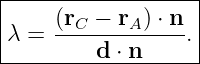
then the intersection parameter is

$\displaystyle \boxed{\lambda= \frac{(\mathbf r_C-\mathbf{r}_A)\cdot\mathbf n} {\mathbf d\cdot\mathbf n}.} $
For Brand's data $A=(1,2,1)$, $B=(2,1,2)$, $C=(0,-4,4)$, $D=(2,-2,2)$, $E=(4,1,2)$, this gives $\lambda=2$ and

$\displaystyle P=(3,0,3). $

Modern notation references

The notation and terminology in this modernized article follow standard present-day mechanics and vector-analysis usage, particularly:
  1. J. R. Taylor, Classical Mechanics, University Science Books, 2005.
  2. D. Kleppner and R. Kolenkow, An Introduction to Mechanics, 2nd ed., Cambridge University Press, 2014.
  3. H. Goldstein, C. Poole, and J. Safko, Classical Mechanics, 3rd ed., Addison–Wesley, 2002.

Source

This article is a modernized restatement of the corresponding Public Domain article in Louis Brand, Vectorial Mechanics, John Wiley & Sons, New York, 1930, Chapter I, “Vector Algebra.” The original 1930 edition is the source basis.



"scalar triple product" is owned by bloftin.
(view preamble)
View style:
See Also: cross product algebra and applications, cross product, dot product algebra and geometric applications, dot product, vector product, centroids and weighted position vectors, Cartesian components and direction cosines, scalar component and vector projection on an Axis, vectors in space, vectors in a plane, vector subtraction and position vectors, negative of a vector, equality of vectors, vector, vector algebra, vector addition, point division and position vectors, summary of vector algebra


Cross-references: mechanics, parameter, vectors, volume
There is 1 reference to this object.

This is version 3 of scalar triple product, born on 2026-08-21, modified 2026-08-21.
Object id is 1081, canonical name is ScalarTripleProduct.
Accessed 69 times total.

Classification:
Physics Classification02. (Mathematical methods in physics)
Pending Errata and Addenda
None.
Discussion
Style: Expand: Order:

No messages.

Interact
rate | post | correct | update request | add derivation | add example | add (any)