0.1 Lie Algebra of a Quantum Harmonic Oscillator
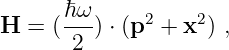
One wishes to solve the time-independent Schrödinger equation of motion in order to determine
the stationary states of the quantum harmonic oscillator which has a quantum Hamiltonian of the
form:
where X and P are, respectively, the coordinate and conjugate momentum operators. X and P
satisfy the Heisenberg commutation/’uncertainty’ relations
where the identity operator I is employed to simplify notation. A simpler, equivalent form of
the above Hamiltonian is obtained by defining physically dimensionless coordinate and
momentum:
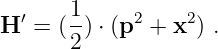
With these new dimensionless operators, x and p, the quantum Hamiltonian takes the
form:
which in units of ℏ ⋅ ω is simply:
The commutator of x with its conjugate operator p is simply [x,p] = i .
Next one defines the superoperators SHx = [H,x] = −i⋅p, and SHp = [H,p] = i⋅x that will lead to
new operators that act as generators of a Lie algebra for this quantum harmonic oscillator. The
eigenvectors Z of these superoperators are obtained by solving the equation SH ⋅ Z = ζZ,
where ζ are the eigenvalues, and Z can be written as (c1 ⋅ x + c2 ⋅ p) . The solutions
are
Therefore, the two eigenvectors of SH can be written as:
respectively for ζ = ±1 . For c1 = √2 one obtains normalized operators H,a and a† that generate
a 4–dimensional Lie algebra with commutators:
The term a is called the annihilation operator and the term a† is called the creation operator. This
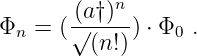
Lie algebra is solvable and generates after repeated application of a† all the eigenvectors of the
quantum harmonic oscillator:
The corresponding, possible eigenvalues for the energy, derived then as solutions of the
Schrödinger equations for the quantum harmonic oscillator are:
The position and momentum eigenvector coordinates can be then also computed by iteration from
(finite) matrix representations of the (finite) Lie algebra, using, for example, a simple computer
programme to calculate linear expressions of the annihilation and creation operators. For example,
one can show analytically that:
One can also show by introducing a coordinate representation that the eigenvectors of the
harmonic oscillator can be expressed as Hermite polynomials in terms of the coordinates. In the
coordinate representation the quantum Hamiltonian and bosonic operators have, respectively, the
simple expressions:
The ground state eigenfunction normalized to unity is obtained from solving the simple first-order
differential equation aΦ0(x) = 0 and which leads to the expression:
By repeated application of the creation operator written as
one obtains the n-th level eigenfunction:
where Hen(x) is the Hermite polynomial of order n . With the special generating function of the
Hermite polynomials
one obtains explicit analytical relations between the eigenfunctions of the quantum harmonic
oscillator and the above special generating function:
Such applications of the Lie algebra, and the related algebra of the bosonic operators as defined
above are quite numerous in theoretical physics, and especially for various quantum field carriers
in QFT that are all bosons. (Please note also the additional examples of special ‘Lie’
superalgebras for gravitational and other fields, related to hypothetical particles such as
gravitons and Goldstone quanta that are all bosons of different spin values and ‘Penrose
homogeneity’).
In the interesting case of a two-mode bosonic quantum system formed by the tensor (direct)
product of one-mode bosonic states: ∣m,n >:= ∣m > ⊗∣n >, one can generate a 3–dimensional Lie
algebra in terms of Casimir operators. Finite– dimensional Lie algebras are far more tractable, or
easier to compute, than those with an infinite basis set. For example, such a Lie algebra
as the 3–dimensional one considered above for the two-mode, bosonic states is quite
useful for numerical computations of vibrational (IR, Raman, etc.) spectra of two–mode,
diatomic molecules, as well as the computation of scattering states. Other perturbative
calculations for more complex quantum systems, as well as calculations of exact solutions
by means of Lie algebras have also been developed (see for example Fernandez and
Castro,1996).


![[X,P ] = iℏI ,](https://images.physicslibrary.org/cache/objects/296/make4ht/QuantumHarmonicOscillatorAndLieAlgebra1x.png)



![[H, a] = − a , [H, a†] = a† , and [a,a†] = I .](https://images.physicslibrary.org/cache/objects/296/make4ht/QuantumHarmonicOscillatorAndLieAlgebra7x.png)

![k
[a,xk] = (√--) ⋅ (xk−1) .
2](https://images.physicslibrary.org/cache/objects/296/make4ht/QuantumHarmonicOscillatorAndLieAlgebra10x.png)
![1 d2 2
H = (2) ⋅ [− dx2-) + (x )] ,
1 d
a = (√--) ⋅ (x +---) ,
2 dx
1 d
a† = (√2-) ⋅ (x − dx-) .](https://images.physicslibrary.org/cache/objects/296/make4ht/QuantumHarmonicOscillatorAndLieAlgebra11x.png)




