Luminosity: Definition, Physical Meaning, and Measurement
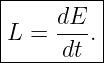
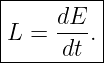
Luminosity is the rate at which an object emits energy.
It is one of the most important intrinsic quantities in astronomy because it describes
the source itself rather than how bright the source happens to look from a particular
distance.
For a star, galaxy, accretion disk, nebula, or other radiating object, luminosity answers the
question:
How much energy leaves the source per unit time?
The basic definition is
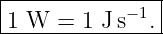
The SI unit of luminosity is the watt:
Thus luminosity is physically a power.
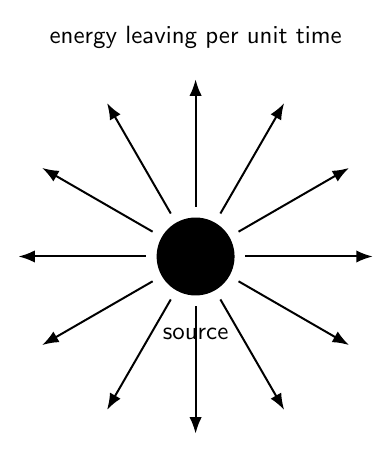
Figure 1. Luminosity measures the rate at which energy leaves a source. It is a power, not an
apparent brightness.
1 Average luminosity and instantaneous luminosity
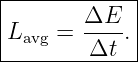
If an object emits an energy ΔE during a time interval Δt, its average luminosity is
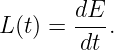
In the limit of a very short time interval,
For a stable main-sequence star, the luminosity may change only slowly.
For a flare, supernova, pulsating star, or accreting object, the luminosity can vary strongly with
time.
2 Luminosity is not flux
Luminosity and flux are related, but they are not the same quantity.
Luminosity describes the total power emitted by the source.
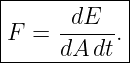
Flux describes the power received per unit area at the observer:
Its SI unit is
A very luminous star can have a small observed flux if it is sufficiently far away.
A less luminous star can have a large observed flux if it is nearby.
This distinction is fundamental.
3 The inverse square relation
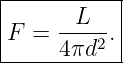
Suppose the source radiates isotropically and the radiation propagates freely.
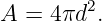
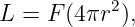
At distance d, the emitted power has spread over the surface of a sphere of area
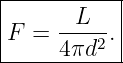
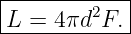
Therefore
Equivalently,
Equation (5) is the inverse square law for radiative flux.
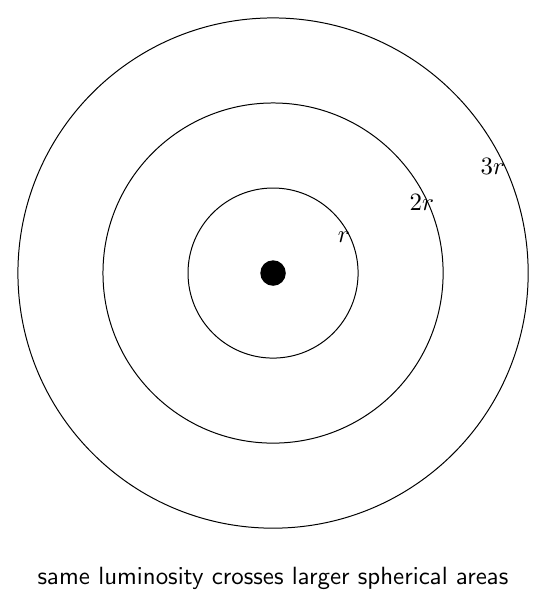
Figure 2. For isotropic emission, the same luminosity crosses every enclosing sphere while the
surface area grows as distance squared.
4 A conservation-law view
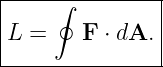
Luminosity can also be defined as the total outward radiative energy flow through a closed surface
surrounding the source.
In vector form,
If the flux is purely radial and has the same magnitude everywhere on a sphere,
which immediately gives Equation (5).
This formulation makes the physics clear:
5 When the inverse square law needs modification
Equation (5) assumes:
- isotropic emission,
- no absorption between source and observer,
- no scattering into or out of the line of sight,
- a Euclidean geometric setting appropriate to the problem.
Real astronomical sources can violate these assumptions.
Examples include:
- beamed jets,
- accretion disks viewed at different inclinations,
- dust extinction,
- interstellar absorption,
- gravitational lensing,
- cosmological redshift and expansion.
For an anisotropic source, one may define an isotropic-equivalent luminosity,
but this need not equal the true total radiated power.
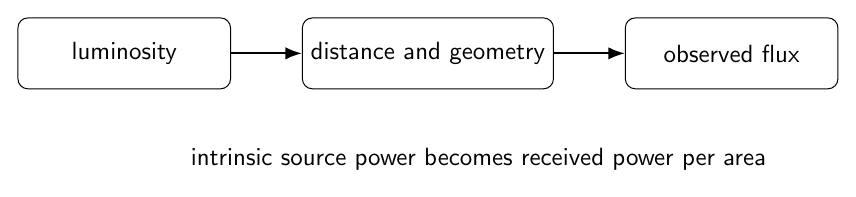
Figure 3. Luminosity is intrinsic to the source, while observed flux also depends on distance and
the propagation path.
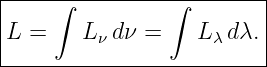
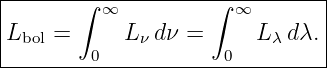
6 Bolometric luminosity
The bolometric luminosity is the total luminosity integrated over all wavelengths or
frequencies:
For stars, “luminosity” often means bolometric luminosity unless a bandpass is stated.
An optical luminosity, ultraviolet luminosity, X-ray luminosity, or radio luminosity refers only to a
specified part of the spectrum.
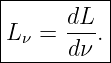
7 Spectral luminosity
The luminosity per unit frequency is
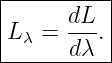
Its SI unit is
The luminosity per unit wavelength is
Its SI unit is
Since
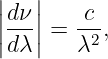
the same physical energy interval must satisfy
Because
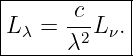
we obtain
The numerical value of a spectral luminosity therefore depends on whether the spectrum is
expressed per unit frequency or per unit wavelength.
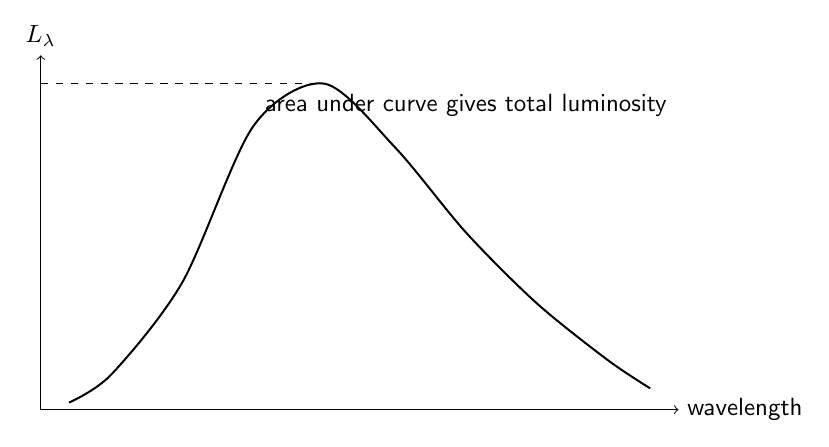
Figure 4. Spectral luminosity distributes the total radiated power over wavelength or frequency.
The integral over the complete spectrum gives bolometric luminosity.
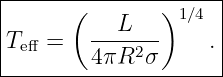
8 Stellar luminosity and the Stefan-Boltzmann law
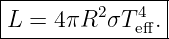
For a spherical star of radius R, the surface area is
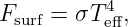
The effective temperature Teff is defined so that the total radiative flux leaving each square meter
of stellar surface is
where σ is the Stefan-Boltzmann constant.
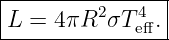
Multiplying surface flux by stellar surface area gives
This equation is one of the central relations in stellar astrophysics.
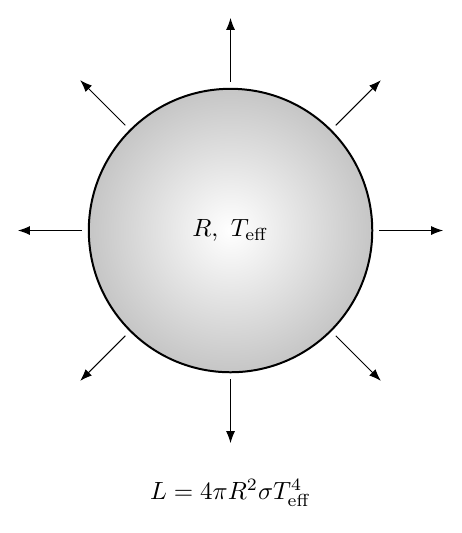
Figure 5. Stellar luminosity is the surface radiative flux multiplied by the total area of the stellar
photosphere.
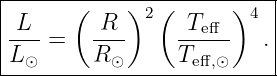
9 Solar-unit form
Divide Equation (13) by the corresponding solar relation:
The constants cancel, giving
This form is often more convenient than the SI expression.
The IAU nominal solar luminosity is
The IAU nominal solar radius is
and the nominal solar effective temperature is
Nominal values are exact conversion constants and should be distinguished from continually
improved measurements of the physical Sun.
10 Effective temperature is defined by luminosity
A real stellar spectrum is not a perfect blackbody.
Nevertheless, the effective temperature is defined through
Thus Teff is the temperature a blackbody of the same radius would need to radiate the same total
luminosity.
11 Luminosity and magnitude
Astronomy often uses logarithmic magnitudes instead of luminosities.
For bolometric absolute magnitude,
Relative to the Sun,
With the commonly used solar bolometric magnitude near
a star ten times more luminous than the Sun has a bolometric absolute magnitude 2.5 magnitudes
smaller.
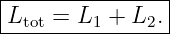
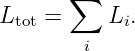
12 Luminosity of an unresolved binary
Energy output adds linearly.
For two stars,
More generally,
This matters whenever a binary is unresolved.
An observer who interprets the total light as coming from one star can infer an incorrect
luminosity, radius, or position on the Hertzsprung-Russell diagram.
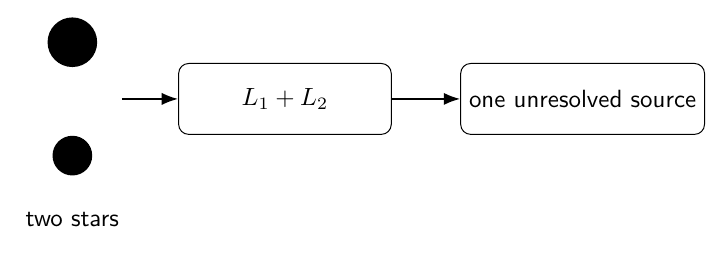
Figure 6. The luminosities of unresolved binary components add, so the system can appear more
luminous than either star individually.
13 Equal-luminosity binary
If
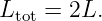
then
The magnitude difference between the unresolved pair and one component is
| ΔM | = −2.5 log 102 | (20)
|
| ≈−0.753 mag. | (20) |
Thus an unresolved equal-luminosity binary lies about 0.75 magnitudes above either component in
a luminosity-sensitive magnitude diagram.
14 How stellar luminosity is measured
A simplified observational chain is:
- measure the spectral energy distribution or broadband fluxes;
- correct for instrumental response;
- correct for extinction where necessary;
- estimate the bolometric flux received at Earth;
- determine the distance;
- use L = 4πd2F
bol.
The difficult parts are often not the inverse square equation itself.
They are:
- distance uncertainty,
- extinction,
- incomplete wavelength coverage,
- bolometric correction,
- unresolved companions,
- variability.
15 Bolometric correction
A photometric band measures only part of a star’s output.
A bolometric correction converts a band-limited magnitude into an estimate of bolometric
magnitude.
For example,
The bolometric correction depends on stellar temperature, gravity, composition, and the adopted
photometric system.
It should not be treated as a universal constant.
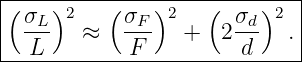
16 Uncertainty from flux and distance
If
and d and F are independent, first-order uncertainty propagation gives
The factor of two shows why distance precision is so important.
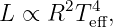
17 Uncertainty from radius and temperature
For
independent first-order errors give
The fourth power makes luminosity strongly sensitive to effective temperature.
18 Luminosity, flux, intensity, and radiant intensity
Several related words should remain distinct.
18.1 Luminosity
is total emitted power.
18.2 Flux
is power crossing unit area.
18.3 Specific intensity
Specific intensity describes radiation per projected area per solid angle and usually per frequency
or wavelength interval.
It contains directional information that flux has already integrated over.
18.4 Radiant intensity
Radiant intensity in radiometry is power per solid angle,
It should not be confused with astronomical specific intensity.
19 Common mistakes
- Calling observed flux “luminosity” without applying a distance.
- Forgetting the factor 4π in the isotropic flux-luminosity relation.
- Using distance in parsecs directly in an SI calculation without conversion.
- Treating optical luminosity as bolometric luminosity.
- Mixing Lν and Lλ without the Jacobian factor.
- Interpreting effective temperature as a statement that the stellar spectrum is a perfect
blackbody.
- Forgetting that unresolved component luminosities add.
- Treating magnitude differences as linear luminosity differences.
- Ignoring extinction when inferring luminosity from observed flux.
- Ignoring distance uncertainty in luminosity error budgets.
- Applying the isotropic relation to strongly beamed emission without qualification.
20 Connections to binary star physics
Luminosity appears repeatedly in the PhysicsLibrary binary star sequence.
In BIN02 it enters through fluxes, magnitudes, colors, and unresolved systems.
In eclipsing binaries, eclipse depths constrain luminosity and surface-brightness ratios.
In unresolved binaries,
In stellar-evolution work, accurately measured binary masses and radii can be compared with
predicted luminosities and effective temperatures.
Luminosity is therefore both a basic radiative quantity and a bridge between observation and
stellar physics.
21 Summary
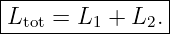
Luminosity is emitted energy per unit time:
For isotropic radiation,
For a star,
Spectral luminosities satisfy
For an unresolved binary,
The key conceptual distinction is:
References
References
[1] B. W. Carroll and D. A. Ostlie, An Introduction to Modern Astrophysics, 2nd ed.,
Cambridge University Press, 2017.
[2] G. B. Rybicki and A. P. Lightman, Radiative Processes in Astrophysics, Wiley, 1979.
[3] International Astronomical Union, Resolution B3 on Recommended Nominal
Conversion Constants for Selected Solar and Planetary Properties, 2015.
[4] International Astronomical Union, Resolution B2 on Recommended Zero Points for
the Absolute and Apparent Bolometric Magnitude Scales, 2015.




















![L [W ]](https://images.physicslibrary.org/cache/objects/1428/make4ht/Luminosity43x.png)
![F [W m −2]](https://images.physicslibrary.org/cache/objects/1428/make4ht/Luminosity44x.png)