0.1 Definitions of Grassmann-Hopf Algebras, Their Dual Co-Algebras, Gebras, Grassmann–Hopf
Algebroids and Gebroids
Let V be a (complex) vector space, dim 𝒞V = n, and let {e0,e1,…,} with identity e0 ≡ 1, be the
generators of a Grassmann (exterior) algebra
subject to the relation eiej + ejei = 0 . Following Fauser (2004) we append this algebra
with a Hopf structure to obtain a ‘co–gebra’ based on the interchange (or ‘tangled
duality’https://physicslibrary.org/encyclopedia/GroupoidSymmetries.html):
This leads to a tangle duality between an associative (unital algebra) 𝒜 = (A,m), and an
associative (unital) ‘co–gebra’ 𝒞 = (C, Δ) :
- the binary product A ⊗ A
 A, and
- the coproduct C
 C ⊗ C
C ⊗ C
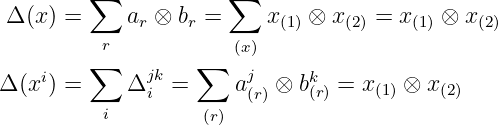
, where the Sweedler notation (Sweedler, 1996), with respect to an arbitrary basis is
adopted:
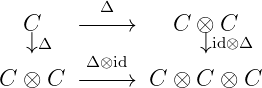
Here the Δijk are called ‘section coefficients’. We have then a generalization of associativity to
coassociativity:
inducing a tangled duality between an associative (unital algebra 𝒜 = (A,m), and an associative
(unital) ‘co–gebra’ 𝒞 = (C, Δ) . The idea is to take this structure and combine the Grassmann
algebra (Λ∗V,∧) with the ‘co-gebra’ (Λ∗V, Δ
∧) (the ‘tangled dual’) along with the Hopf algebra
compatibility rules: 1) the product and the unit are ‘co–gebra’ morphisms, and 2) the coproduct
and counit are algebra morphisms.
Next we consider the following ingredients:
- the graded switch τ(A ⊗ B) = (−1)∂A∂BB ⊗ A
- the counit 𝜀 (an algebra morphism) satisfying (𝜀 ⊗ id)Δ = id = (id ⊗ 𝜀)Δ
- the antipode S .
The Grassmann-Hopf algebra H thus consists of–is defined by– the septet H = (Λ∗V,∧,id,𝜀,τ,S) .
Its generalization to a Grassmann-Hopf algebroid is straightforward by considering a groupoid G,
and then defining a H∧− Algebroid as a quadruple (GH, Δ,𝜀,S) by modifying the Hopf algebroid
definition so that H = (Λ∗V,∧,id,𝜀,τ,S) satisfies the standard Grassmann-Hopf algebra axioms
stated above. We may also say that (HG, Δ,𝜀,S) is a weak C*-Grassmann-Hopf algebroid when
H∧ is a unital C*-algebra (with 1). We thus set 𝔽 = ℂ . Note however that the tangled-duals of
Grassman-Hopf algebroids retain both the intuitive interactions and the dynamic diagram
advantages of their physical, extended symmetry representations exhibited by the Grassman-Hopf
al/gebras and co-gebras over those of either weak C*- Hopf algebroids or weak Hopf C*-
algebras.
References
[1] E. M. Alfsen and F. W. Schultz: Geometry of State Spaces of Operator Algebras,
Birkhäuser, Boston–Basel–Berlin (2003).
[2] I. Baianu : Categories, Functors and Automata Theory: A Novel Approach to
Quantum Automata through Algebraic–Topological Quantum Computations., Proceed.
4th Intl. Congress LMPS, (August-Sept. 1971).
[3] I. C. Baianu, J. F. Glazebrook and R. Brown.: A Non–Abelian, Categorical Ontology
of Spacetimes and Quantum Gravity., Axiomathes 17,(3-4): 353-408(2007).
[4] I.C.Baianu, R. Brown J.F. Glazebrook, and G. Georgescu, Towards Quantum
Non–Abelian Algebraic Topology, (2008).
[5] F.A. Bais, B. J. Schroers and J. K. Slingerland: Broken quantum symmetry and
confinement phases in planar physics, Phys. Rev. Lett. 89 No. 18 (1–4): 181–201 (2002).
[6] J.W. Barrett.: Geometrical measurements in three-dimensional quantum gravity.
Proceedings of the Tenth Oporto Meeting on Geometry, Topology and Physics (2001).
Intl. J. Modern Phys. A 18 , October, suppl., 97–113 (2003)
[7] M. Chaician and A. Demichev: Introduction to Quantum Groups, World Scientific
(1996).
[8] Coleman and De Luccia: Gravitational effects on and of vacuum decay., Phys. Rev.
D 21: 3305 (1980).
[9] L. Crane and I.B. Frenkel. Four-dimensional topological quantum field theory, Hopf
categories, and the canonical bases. Topology and physics. J. Math. Phys. 35 (no. 10):
5136–5154 (1994).
[10] W. Drechsler and P. A. Tuckey: On quantum and parallel transport in a Hilbert
bundle over spacetime., Classical and Quantum Gravity, 13:611-632 (1996). doi:
10.1088/0264–9381/13/4/004
[11] V. G. Drinfel’d: Quantum groups, In Proc. Int. Congress of Mathematicians,
Berkeley, 1986, (ed. A. Gleason), Berkeley, 798-820 (1987).
[12] G. J. Ellis: Higher dimensional crossed modules of algebras, J. of Pure Appl. Algebra
52: 277-282 (1988), .
[13] P.. I. Etingof and A. N. Varchenko, Solutions of the Quantum Dynamical
Yang-Baxter Equation and Dynamical Quantum Groups, Comm.Math.Phys., 196:
591-640 (1998).
[14] P. I. Etingof and A. N. Varchenko: Exchange dynamical quantum groups, Commun.
Math. Phys. 205 (1): 19-52 (1999)
[15] P. I. Etingof and O. Schiffmann: Lectures on the dynamical Yang–Baxter equations,
in Quantum Groups and Lie Theory (Durham, 1999), pp. 89-129, Cambridge University
Press, Cambridge, 2001.
[16] B. Fauser: A treatise on quantum Clifford Algebras. Konstanz, Habilitationsschrift.
arXiv.math.QA/0202059 (2002).
[17] B. Fauser: Grade Free product Formulae from Grassmann–Hopf Gebras. Ch. 18
in R. Ablamowicz, Ed., Clifford Algebras: Applications to Mathematics, Physics and
Engineering, Birkhäuser: Boston, Basel and Berlin, (2004).
[18] J. M. G. Fell.: The Dual Spaces of C*–Algebras., Transactions of the American
Mathematical Society, 94: 365–403 (1960).
[19] F.M. Fernandez and E. A. Castro.: (Lie) Algebraic Methods in Quantum Chemistry
and Physics., Boca Raton: CRC Press, Inc (1996).
[20] R. P. Feynman: Space–Time Approach to Non–Relativistic Quantum Mechanics,
Reviews of Modern Physics, 20: 367–387 (1948). [It is also reprinted in (Schwinger 1958).]
[21] A. Fröhlich: Non-Abelian Homological Algebra. I.Derived functors and satellites.,
Proc. London Math. Soc., 11(3): 239–252 (1961).
[22] R. Gilmore: Lie Groups, Lie Algebras and Some of Their Applications., Dover Publs.,
Inc.: Mineola and New York, 2005.
[23] P. Hahn: Haar measure for measure groupoids., Trans. Amer. Math. Soc. 242:
1–33(1978).
[24] P. Hahn: The regular representations of measure groupoids., Trans. Amer. Math.
Soc. 242:34–72(1978).
[25] R. Heynman and S. Lifschitz. 1958. Lie Groups and Lie Algebras., New York and
London: Nelson Press.
[26] C. Heunen, N. P. Landsman, B. Spitters.: A topos for algebraic quantum theory,
(2008)
arXiv:0709.4364v2 [quant–ph]