GRE Physics Companion: Polar Coordinate Particle Kinematics
This companion is designed for rapid review after M01-10. The fastest approach is usually to
identify which polar quantities are zero before substituting numbers.
1 Fast triage
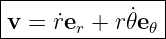
Memorize the structure, not isolated terms:
and
Then eliminate terms using the motion description. For a fixed radius, the first and second time
derivatives of r are zero. For constant angular speed, the angular acceleration is zero. For pure
radial motion, the angular rate is zero.
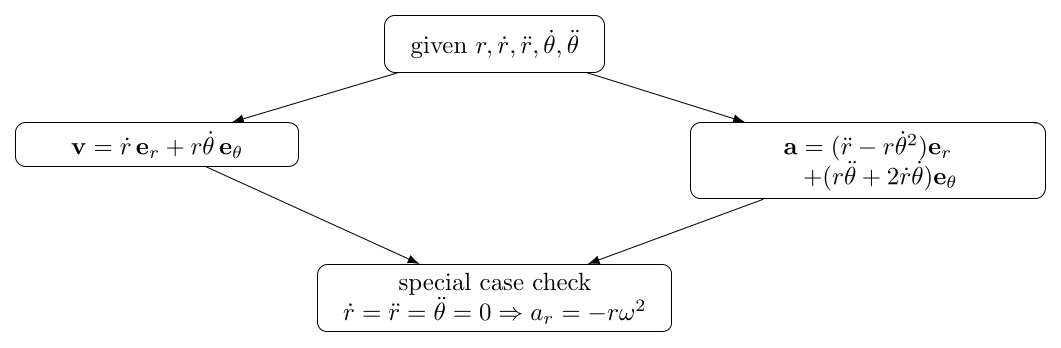
Figure 1. GRE speed triage for polar kinematics. Substitute only after identifying which radial
and angular derivatives vanish.
2 Common traps
The polar unit vectors are not fixed Cartesian vectors. Even with constant r, velocity is generally
nonzero because er changes direction.
The transverse quantity equal to radius times angular rate is a linear speed; angular rate alone is
not.
The radial centripetal term points inward.
The mixed transverse term can survive even when the angular speed is constant.
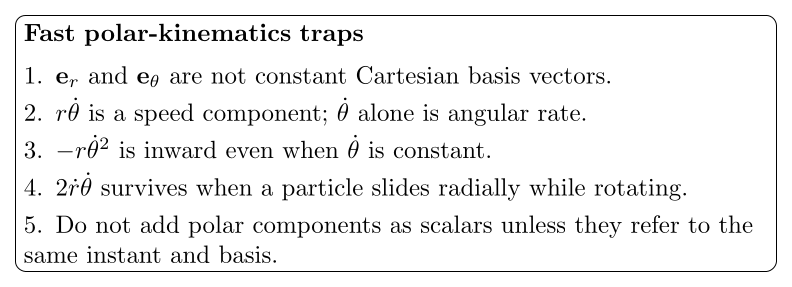
Figure 2. Common polar kinematics traps: forgetting the moving basis, omitting the factor of
radius in transverse speed, losing the inward sign, and dropping the mixed radial angular
acceleration term.
3 Worked GRE example 1: fixed radius
A particle moves at fixed radius r = 3 m with angular speed 4 rad/s and angular acceleration 2
rad/s2. Find the polar acceleration components.
Because r is fixed,
Therefore
and
Hence
4 Worked GRE example 2: radial sliding at constant angular speed
At an instant, r = 2 m, the radial speed is 1.5 m/s, the second time derivative of r is zero, and the
angular speed is constant at ω = 3 rad/s. Find the transverse acceleration.
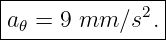
Since 𝜃 = 0,
Thus
The term is nonzero even though the angular speed is constant.
5 GRE speed questions
- A particle moves on a circle of radius R with constant angular speed ω. Its radial
acceleration is (A) 0 (B) +Rω2 (C) −Rω2 (D) −2Rω2.
- At an instant, r = 2 m, the radial speed is 1 m/s, the angular speed is 3 rad/s, and
both the radial second derivative and angular acceleration are zero. The transverse
acceleration is (A) 0 (B) 3 (C) 6 (D) 18 m/s2.
6 Answers and rationales
- C. Fixed radius uniform circular motion gives ar = −Rω2.
- C. The mixed transverse term gives a𝜃 = 2(1)(3) = 6 m/s2.
References
[1] PhysicsLibrary, M01-10, Polar Coordinate Particle Kinematics.
[2] J. R. Taylor, Classical Mechanics, University Science Books, 2005.

![[parent]](https://images.physicslibrary.org/images/uparrow.png)