
|
|
|
|||||||
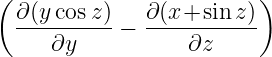
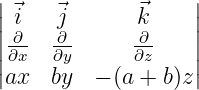
For the rotor (curl) of the field we obtain ∇×U =  Thus we can write 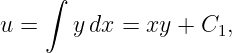 where C1 may depend on y or z. Differentiating this result with respect to y and comparing to the second condition, we get 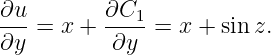 Accordingly,  where C2 may depend on z. So  Differentiating this result with respect to z and comparing to the third condition yields  This means that C2 is an arbitrary constant. Thus the form  expresses the required potential function. Example 2. This is a particular case in ℝ2:
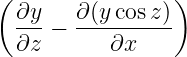
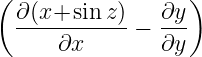
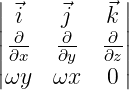
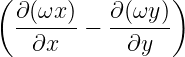
Now, ∇×U = Therefore there exists a potential field u with U = ∇u. We deduce successively:  Thus we get the result  which corresponds to a particular case in ℝ2. Example 3. Given
The rotor is now ∇×U = 

 Differentiating (1) and (2) with respect to z and using (3) give 
 We substitute (1′) and (2′) again into (1) and (2) and deduce as follows: 
 putting (1′′), (2′′) into (1), (2) then gives us  whence, by comparing, C1 = C2 = C, so that by (3), the expression h(x,y) and u itself have been found, that is,  Unlike Example 1, the last two examples are also solenoidal, i.e. ∇⋅U = 0, which physically may
be interpreted as the continuity equation of an incompressible fluid flow. Example 4. An additional example of a lamellar field would be  with a differentiable function v : ℝ → ℝ; if v is a constant, then U is also solenoidal. "examples of lamellar field" is owned by pahio. This object's parent. Cross-references: lamellar field, continuity equation, solenoidal, function, curl, scalar, vector field This is version 1 of examples of lamellar field, born on 2009-04-18. Object id is 653, canonical name is ExamplesOfLamellarField. Accessed 1666 times total. Classification:
|
|
|
|
Pending Errata and AddendaNone.
|
DiscussionNo messages.
|
Interact |
![[parent]](https://images.physicslibrary.org/images/uparrow.png)
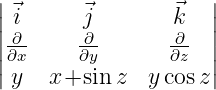 =
= 
 =
= 
 =
=