Example 5.6
The Doppler Effect
We can use the doppler effect equation to calculate the radial velocity of an object if
we know three things: the speed of light, the original (unshifted) wavelength of the
Light emitted, and the difference between the wavelength of the emitted light and the
wavelength we observe. For particular absorption or emission lines, we usually know
exactly what wavelength the line has in our laboratories on Earth, where the source of
light is not moving. We can measure the new wavelength with our instruments at the
telescope, and so we know the difference in wavelength due to Doppler shifting. Since the
speed of light is a universal constant, we can then calculate the radial velocity of the
star.
A particular emission line of hydrogen is originally emitted with a wavelength of 656.3 nm from a
gas cloud. At our telescope, we observe the wavelength of the emission line to be 656.6 nm. How
fast is this gas cloud moving toward or away from Earth?
Solution
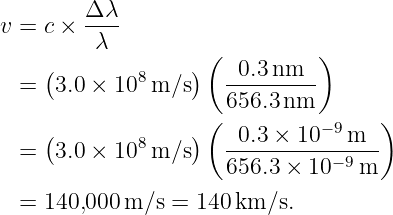
Because the light is shifted to a longer wavelength (redshifted), we know this gas cloud is moving
away from us. The speed can be calculated using the Doppler shift formula:
Check Your Learning
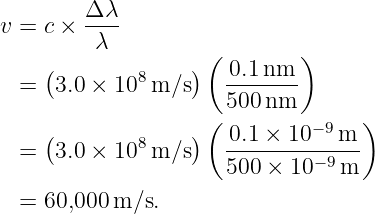
Suppose a spectral line of hydrogen, normally at 500 nm, is observed in the spectrum of a star to
be at 500.1 nm. How fast is the star moving toward or away from Earth?
Answer:
Because the light is shifted to a longer wavelength, the star is moving away from us:
Its speed is 60,000 m/s.
Attribution
Access for free at openstax.org.
Bibliography
This example is a derivative work of the original 2022 CC BY 4.0 release identified in
[1].
[1] Andrew Fraknoi, David Morrison, and Sidney Wolff, “Example 5.6: The Doppler Effect,” in “5.6
The Doppler Effect,” Astronomy 2e. Houston, Texas: OpenStax, March 9, 2022. Original digital
ISBN 978-1-951693-50-3. Original textbook content licensed under the Creative Commons
Attribution 4.0 International License (CC BY 4.0), except where otherwise noted. Changes:
converted to LaTeX and separated from its parent section as a standalone PhysicsLibrary example.
Access for free at openstax.org.

![[parent]](https://images.physicslibrary.org/images/uparrow.png)