Euler Angles: Tait Bryan Angles
Tait Bryan angles are Euler Angle coordinates in which the three successive rotation axes are all
different.
For an intrinsic sequence
the Tait Bryan condition is
Thus each coordinate axis appears exactly once.
Tait Bryan angles are common in aerospace, navigation, robotics, vehicle dynamics, and computer
graphics because one of the six sequences often admits an intuitive physical interpretation such as
yaw, pitch, and roll.
The best-known case is intrinsic 3-2-1 yaw pitch roll.
1 Passive intrinsic convention
PhysicsLibrary uses passive coordinate transformations.
For a fixed physical vector,
For intrinsic i-j-k with first, second, and third angles (α,β,γ),
The sequence digits describe the chronological intrinsic rotation axes.
The rightmost matrix acts first on a coordinate column.
2 Why there are six Tait Bryan sequences
Because all three axes must be used exactly once, a Tait Bryan sequence is simply a permutation
of the three coordinate axes.
There are therefore
possible sequences.
They are
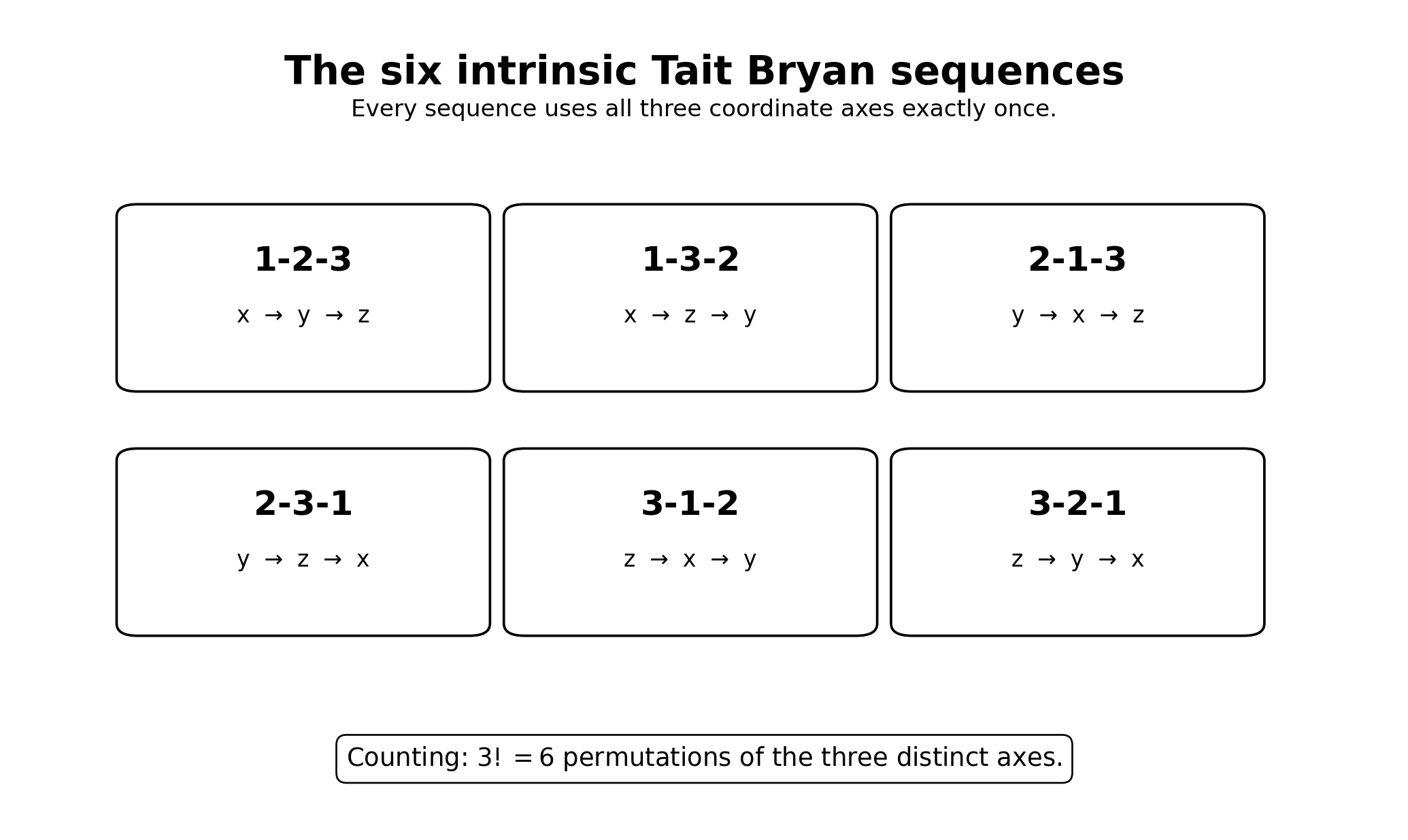
Figure. The six standard intrinsic Tait Bryan sequences. Each is one permutation of the
three distinct coordinate axes.
3 The six passive intrinsic products
Applying the universal intrinsic composition rule gives:
|
|
| Sequence | Passive intrinsic product |
|
|
| 1-2-3 | C3(γ)C2(β)C1(α) |
|
|
| 1-3-2 | C2(γ)C3(β)C1(α) |
|
|
| 2-1-3 | C3(γ)C1(β)C2(α) |
|
|
| 2-3-1 | C1(γ)C3(β)C2(α) |
|
|
| 3-1-2 | C2(γ)C1(β)C3(α) |
|
|
| 3-2-1 | C1(γ)C2(β)C3(α) |
|
|
These are not six unrelated formulas. They are six substitutions into the same frame-chain
rule.
4 Tait Bryan versus proper Euler angles
The distinction between the two Euler sequence families is purely geometric.
A Tait Bryan sequence uses three different axes:
A proper Euler sequence returns to the first axis:
Thus 3-2-1 is Tait Bryan, while 3-1-3 is proper Euler.
This difference determines the form of the middle-angle singularity.
5 Principal angle ranges
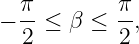
A common principal branch for every Tait Bryan sequence is
and
The middle angle is therefore restricted to a half-turn interval centered at zero.
On this principal branch,
6 The universal Tait Bryan singularity
All six Tait Bryan sequences become singular when
Thus the singular middle angles are
At those configurations, the first and third physical rotation axes become collinear.
The physical orientation remains completely well defined.
The singularity belongs only to the Tait Bryan coordinate chart.
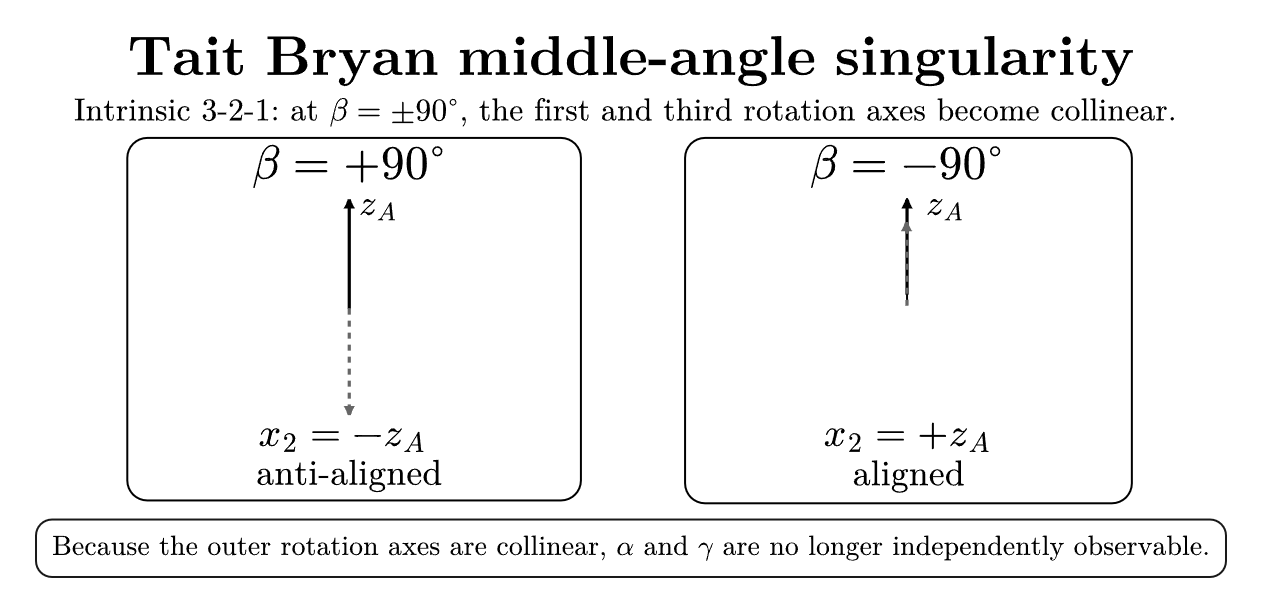
Figure. For intrinsic 3-2-1, the third rotation axis x2 becomes collinear with the first
rotation axis zA when β = ±90∘. The same geometric mechanism occurs in every Tait
Bryan sequence after relabeling the axes.
7 Why the outer angles become coupled
Away from the singularity, a Tait Bryan orientation has three locally independent coordinates.
At
the first and third rotation axes are the same physical line.
Two rotations about the same physical line cannot be distinguished independently from the final
orientation.
Therefore α and γ become coupled.
For intrinsic 3-2-1, this is the familiar gimbal-lock configuration at
The term “gimbal lock” is descriptive of a mechanical gimbal system, but the underlying
mathematical issue is a coordinate singularity of the chosen Euler chart.
8 Aerospace yaw pitch roll
The most common aerospace Tait Bryan sequence is intrinsic
PhysicsLibrary identifies
where
The passive DCM is
Using
and similarly for 𝜃 and ψ, multiplication gives
9 Inverse extraction for intrinsic 3-2-1
Let
On the nonsingular principal branch,
and
These equations are valid when
Near the singularity, a numerical implementation should switch to an explicitly chosen
singular-case convention rather than dividing by a vanishing quantity.
10 Alternative names and notation
Tait Bryan angles are also called Cardan angles in some literature.
The phrases roll pitch yaw and yaw pitch roll are also used, but those names must be handled
carefully.
They do not by themselves specify:
- intrinsic or extrinsic axes;
- active or passive transformation;
- map direction;
- exact axis order.
For this reason PhysicsLibrary always states the sequence explicitly.
11 Tait Bryan angles are coordinates, not a vector
A triple
is a set of nonlinear orientation coordinates.
It is not an ordinary geometric three-vector.
In general,
does not represent exact finite rotation composition.
Likewise,
is not generally the exact relative attitude.
Finite relative orientation should be computed through DCM or quaternion composition.
12 Equivalent extrinsic description
For any Tait Bryan sequence,
For aerospace 3-2-1,
The final orientation is the same, but the geometric description of the axes is different.
13 Passive quaternion equivalent
For positive passive frame rotations,
Thus a generic intrinsic Tait Bryan sequence satisfies
For intrinsic 3-2-1,
The quaternion and DCM must agree:
14 Numerical example
Take the aerospace angles
Then
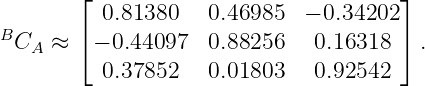
gives approximately
The matrix satisfies
and
to numerical precision.
Applying the inverse extraction formulas recovers the principal angles (ψ,𝜃,ϕ) = (30∘, 20∘, 10∘).
15 When Tait Bryan angles are useful
Tait Bryan coordinates are especially useful when:
- a particular axis sequence has direct physical meaning;
- the operating region stays away from the middle-angle singularity;
- human-readable orientation coordinates are important;
- angle limits are naturally specified in yaw, pitch, roll, or an equivalent sequence;
- initial and final conditions are given in a standard engineering sequence.
They are often best used as display or interface coordinates even when the internal attitude state is
propagated with a quaternion or DCM.
16 When another representation is preferable
A quaternion or DCM is usually preferable for internal propagation when:
- the motion may approach or cross β = ±90∘;
- repeated finite composition is required;
- gyroscope angular rates directly drive the state;
- differentiability across a large attitude range is important;
- numerical optimization or estimation must avoid coordinate singularities.
The problem is not that Tait Bryan angles are physically incorrect.
The issue is that one minimal coordinate chart cannot remain nonsingular over all of
SO(3).
17 Common mistakes
- Treating “yaw pitch roll” as a complete convention declaration.
- Assuming every source uses intrinsic 3-2-1.
- Confusing the Tait Bryan family with proper Euler sequences.
- Using ϕ,𝜃,ψ as generic first, second, and third angles for all six sequences.
- Forgetting that the middle-angle singularity occurs at cos β = 0.
- Interpreting gimbal lock as a physical loss of orientation.
- Subtracting finite Tait Bryan triples to compute exact relative attitude.
- Copying an active-vector formula into a passive coordinate-map implementation
without transposition or sign conversion.
18 Verification checks
Any Tait Bryan sequence implementation should pass the following checks.
- Zero angles give the identity matrix.
- Each single-angle reduction gives the correct passive elementary matrix.
- The matrix is orthogonal:
- The determinant is positive:
- The reverse coordinate map is the transpose.
- A DCM-to-Euler round trip recovers the selected principal branch away from
singularity.
- The DCM agrees with the corresponding passive quaternion.
19 Summary
Tait Bryan angles are the six Euler angle sequences that use all three coordinate axes exactly
once:
For every intrinsic Tait Bryan sequence,
Their universal middle-angle singularity is
For aerospace intrinsic 3-2-1,
with singularity at
Tait Bryan angles provide compact, physically intuitive local coordinates, but they remain
a sequence-dependent coordinate chart rather than a global vector representation of
orientation.
The next article, Euler Angles: proper Euler angles, develops the complementary six sequences in
which the first and third axis labels are the same.
20 References and further reading
Henderson gives the classic NASA engineering tabulation of Euler angle sequences, including the
Tait Bryan cases.
Diebel provides a unified comparison of Euler angles, DCMs, quaternions, and rotation
vectors.
Goldstein, Poole, and Safko provide classical mechanics context for Euler coordinates and rigid
body orientation.
SciPy’s rotation interface explicitly distinguishes intrinsic and extrinsic Euler sequence
strings.
References
[1] D. M. Henderson, Euler Angles, Quaternions, and Transformation Matrices: Working
Relationships, JSC-12960, NASA Johnson Space Center, 1977. NASA Technical Reports
Server
[2] J. Diebel, “Representing Attitude: Euler Angles, Unit Quaternions, and Rotation
Vectors,” Stanford University, 2006. Online PDF
[3] H. Goldstein, C. Poole, and J. Safko, Classical Mechanics, 3rd ed., Addison Wesley,
2002. Publisher search
[4] SciPy Developers, “Rotation.from_euler,” SciPy documentation. SciPy Euler rotation
documentation
License
Unless otherwise noted, this PhysicsLibrary entry is intended for release under the Creative
Commons Attribution ShareAlike 4.0 International license.