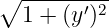
|
|
|
|||||||
under the constraint
where both path integrals are taken along some curve c. Using a Lagrange multiplier λ, the task changes to the free problem
The Euler–Lagrange differential equation, the necessary condition for the preceding functional to give an extremal c, reduces to the Beltrami identity  where a is a constant of integration. After solving this equation for the derivative y′ and separating variables, we get 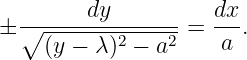 This may become clearer by writing u := y − λ; then 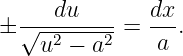 Choose the new constant of integration b such that x = b when u = a. Then 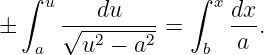 We can write two equivalent results:  Thus  Adding these equations eliminates the square roots and gives  or
This is the sought form of the equation of the chain curve. The constants λ, a, and b can then be determined by requiring the curve to pass through the given points P1 and P2. References
"equation of catenary via calculus of variations" is owned by pahio. This object's parent. Cross-references: chain curve, square, identity, path integrals, centre of mass This is version 3 of equation of catenary via calculus of variations, born on 2010-04-18, modified 2026-09-05. Object id is 852, canonical name is EquationOfCatenaryViaCalculusOfVariations. Accessed 2271 times total. Classification:
|
|
|
|
Pending Errata and Addenda
|
DiscussionNo messages.
|
Interact |
![[parent]](https://images.physicslibrary.org/images/uparrow.png)