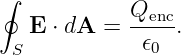
Electromagnetic Waves, Antennas, and RF: Gauss’s Law
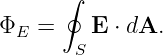
EM06 introduced electric flux through a closed surface,
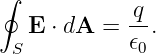
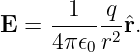
For a sphere centered on a point charge, the Coulomb field gave the striking result
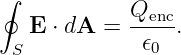
independent of the sphere’s radius. Gauss’s Law generalizes that result to every closed surface and
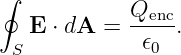
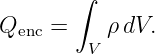
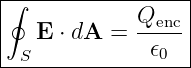
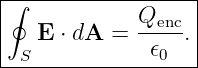
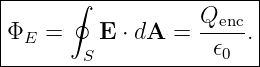
every charge distribution:
Here Qenc means the net charge enclosed by the closed surface. Positive and negative enclosed
charges contribute algebraically.
Gauss’s law is one of Maxwell’s equations. Its great practical power comes from combining a
universal physical law with symmetry. The law itself is always true, but solving for the
Electric Field from it is easy only when the geometry lets the flux integral simplify
[1, 2, 3, 5].
1 Closed surfaces and enclosed charge
A Gaussian surface is not a physical membrane. It is an imaginary closed surface chosen to help
analyze an electric field.
For every closed surface, the area vector points outward:
Gauss’s law relates the net outward electric flux to the total charge enclosed by that
surface:
Charge outside the surface can change the electric field at points on the surface, but it contributes
zero net flux through the complete closed surface.
1.1 What does not matter to the right-hand side
The right-hand side depends only on enclosed charge. It does not depend on:
- the size of the Gaussian surface,
- the shape of the Gaussian surface,
- where an enclosed charge sits inside the surface,
- charges located outside the surface.
These facts concern the total flux. They do not imply that the field magnitude is constant over an
arbitrary surface.
2 The centered point charge revisited
Consider a point charge q and choose a spherical Gaussian surface of radius r centered on the
charge.
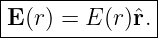
The electric field is radial:
The outward area vector is also radial:
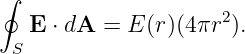
Therefore,
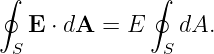
Because E is constant everywhere on the sphere,
The area of a sphere is 4πr2, so
| ΦE | = E(4πr2) | (10)
|
| = 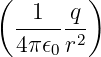 (4πr2) (4πr2) | (11)
|
| =  . . | (12) |
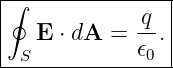
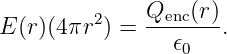
Thus,
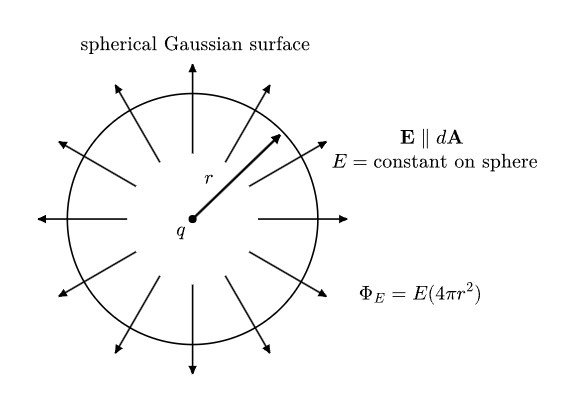
Figure. For spherical symmetry, the electric field is radial and has the same magnitude
everywhere on a sphere centered on the charge. This makes the flux integral reduce to
E(4πr2).
3 Gauss’s law is always true; symmetry makes it useful
Gauss’s law does not require symmetry. However, suppose we try to use it to solve for
E:
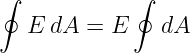
To pull E outside the integral, we usually need to know that its magnitude is constant
over the relevant part of the surface. We also need to know the angle between E and
dA.
The most useful symmetry classes are:
- spherical symmetry,
- cylindrical symmetry,
- planar symmetry.
Each symmetry suggests a Gaussian surface whose shape matches the field geometry.
4 Spherical symmetry
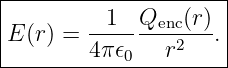
For a spherically symmetric charge distribution, the field at distance r from the center must point
radially and its magnitude can depend only on r:
Choose a sphere of radius r. Then
Gauss’s law gives
Therefore,
The important quantity is the charge enclosed within radius r.
5 Example 1: field outside a uniformly charged sphere
Suppose a sphere of radius R contains total charge Q distributed spherically symmetrically. Find
the field for r > R.
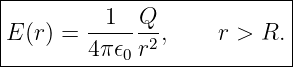
A Gaussian sphere of radius r > R encloses the full charge:
Therefore,
Outside the distribution, the field has the same form as that of a point charge Q at the
center.
6 Example 2: field inside a uniformly charged solid sphere
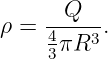
Let a solid sphere of radius R carry total charge Q uniformly throughout its volume. Its volume
charge density is
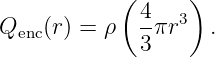
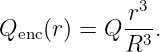
For r < R, the Gaussian sphere encloses only the charge inside radius r:
Substituting the density,
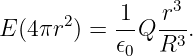
Gauss’s law gives
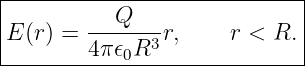
Hence
Inside a uniformly charged solid sphere, the field grows linearly with radius.
7 Cylindrical symmetry
Now consider an ideal infinite line of charge with constant linear charge density λ:
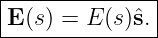
By cylindrical symmetry, the electric field must point radially away from the line and depend only
on the perpendicular distance s from the line:
Choose a cylindrical Gaussian surface of radius s and length L, coaxial with the line
charge.
On the curved side, E is parallel to the outward normal, so
On the two flat end caps, the normals point along the cylinder axis while the field points radially
sideways. Therefore,
on the caps.
The curved area is
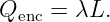
The enclosed charge is
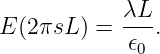
Gauss’s law becomes
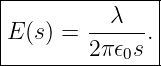
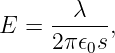
Therefore,
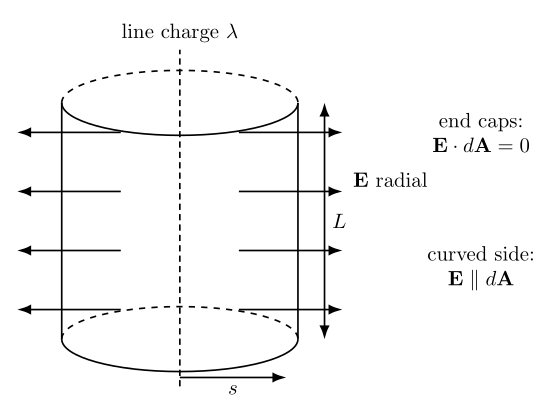
Figure. For an ideal infinite line charge, a coaxial cylindrical Gaussian surface matches the
symmetry. Flux passes through the curved side, while the end-cap flux is zero.
8 Example 3: numerical field of an ideal line charge
Let
and evaluate the field at
Using
we obtain approximately
For positive λ, the field points radially away from the line.
9 Planar symmetry
Consider an ideal infinite sheet with uniform surface charge density σ:
Symmetry requires the electric field to be perpendicular to the sheet. The magnitude must be the
same on both sides.
Choose a thin cylindrical pillbox whose flat faces have area A and lie parallel to the
sheet.
There is no flux through the curved side because the field is tangent to that surface. The field is
perpendicular to both flat caps, so each cap contributes
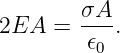
The total flux is therefore
The enclosed charge is
Gauss’s law gives
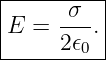
Thus,
Unlike the point-charge field and the line-charge field, the ideal infinite-sheet field does not
decrease with distance.
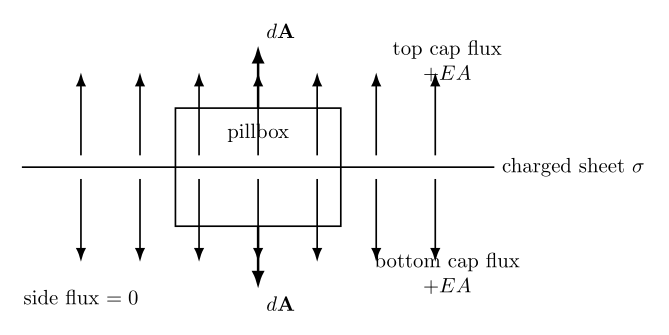
Figure. For an ideal infinite charged sheet, a pillbox Gaussian surface matches planar
symmetry. Only the two flat caps contribute to the flux.
10 Example 4: field of two oppositely charged infinite sheets
Suppose two parallel infinite sheets carry equal and opposite surface charge densities +σ and
−σ.
Each sheet produces magnitude
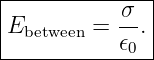
Between the sheets, the two fields point in the same direction and add:
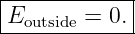
Outside the pair, the two fields point in opposite directions and cancel:
This idealized result is the basis for the approximately uniform field between large parallel
capacitor plates away from their edges.
11 Choosing a useful Gaussian surface
A Gaussian surface is useful when symmetry lets us answer two questions in advance:
- What direction must E point?
- On what parts of the surface is the field magnitude constant?
A useful rule of thumb is:
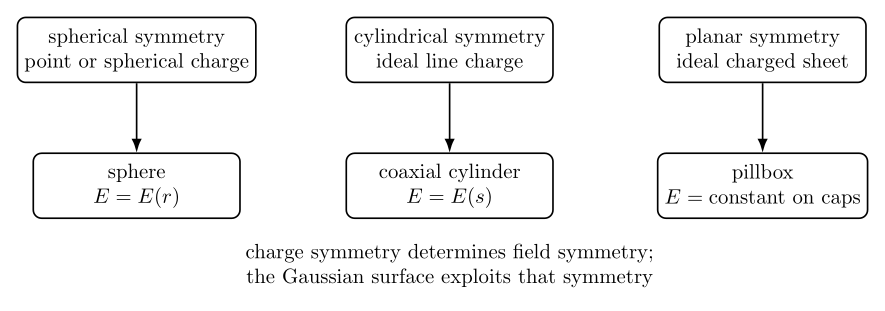
Figure. Match the Gaussian surface to the symmetry of the charge distribution: sphere for
spherical symmetry, coaxial cylinder for cylindrical symmetry, and pillbox for planar
symmetry.
12 A Gaussian surface does not create symmetry
One of the most common mistakes is to choose a convenient sphere or cylinder around an
asymmetric charge distribution and then assume the field must be constant on that
surface.
The logic is the opposite:
Choosing a sphere does not make an asymmetric electric field spherically symmetric.
13 Example 5: why Gauss’s law may not solve for the field
Suppose a single point charge lies off-center inside a spherical Gaussian surface.
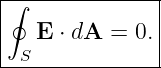
Gauss’s law still gives
However, the field magnitude is not constant over the sphere and the field is not everywhere
normal to the spherical surface. Therefore the integral cannot be simplified to
Gauss’s law gives the total flux immediately, but it does not by itself give the field at each point on
that sphere.
14 External charges and zero net flux
Consider a closed surface containing no charge:
Gauss’s law says
This does not mean
on the surface. External charges may produce a substantial electric field. Their field lines enter the
surface somewhere and leave elsewhere so that the signed flux cancels.
15 Example 6: uniform external field through a closed box
Place a closed rectangular box in a uniform electric field
The right face has outward normal +x and contributes positive flux
The left face has outward normal −x and contributes
The other four faces have zero flux. Thus
This is consistent with
16 From the integral law to the differential law
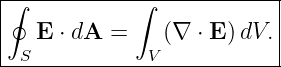
EM03 introduced divergence as local outward flux per unit volume. The divergence theorem
states
Gauss’s law gives
If the charge density is ρ(r), then
Therefore,
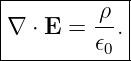
Because this must hold for arbitrary volumes,
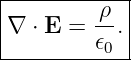
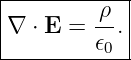
This is the differential form of Gauss’s law.
17 Physical meaning of the differential form
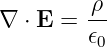
The equation
says that electric charge is a local source or sink of the electric field.
Where
the divergence is positive. Where
the divergence is negative. In a charge-free region,
so
This last equation will become especially important when electromagnetic waves are studied in
source-free space.
18 Example 7: infer charge density from divergence
Suppose an electric field in a region is
where a is a constant.
The divergence is
| ∇⋅ E | =  + +  + +  | (69)
|
| = a + a + a | (70)
|
| = 3a. | (71) |
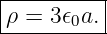
Using differential Gauss law,
Therefore,
19 Integral and differential forms describe the same law
The two forms are
and
The integral form relates a complete closed surface to the total charge inside it. The differential
form describes the same physics locally, point by point.
The divergence theorem connects them.
20 Common mistakes
20.1 Assuming Gauss’s law requires symmetry
It does not. Gauss’s law is always true. Symmetry is required only if we want the flux integral to
simplify enough to solve easily for the field.
20.2 Using total charge instead of enclosed charge
The right-hand side is
not the total charge everywhere in the problem.
20.3 Assuming zero flux means zero field
A closed surface can have
while the field is nonzero everywhere on the surface.
20.4 Forgetting the outward normal
For closed surfaces, dA always points outward.
20.5 Pulling E outside the integral without justification
The step
requires E to be constant over the relevant surface region.
20.6 Choosing a Gaussian surface first and inventing symmetry afterward
The charge distribution determines the symmetry. The Gaussian surface should be chosen to
exploit that existing symmetry.
21 Why Gauss’s law matters later in this series
Gauss’s law is not merely a shortcut for electrostatics. It is one of Maxwell’s equations:
Later, in source-free space,
so electromagnetic waves satisfy
This condition helps explain why freely propagating plane electromagnetic waves are
transverse.
The same surface-integral language also reappears in magnetic flux, Faraday’s law, electromagnetic
energy flow, antenna apertures, and radiated power.
Summary
The essential results of EM07 are:
- Gauss’s law is
- It is valid for every closed surface.
- Symmetry is not required for the law to be true, but it is usually required to solve easily for
E.
- Spherical symmetry suggests a spherical Gaussian surface.
- Cylindrical symmetry suggests a coaxial cylindrical Gaussian surface.
- Planar symmetry suggests a pillbox Gaussian surface.
- Charge outside a Gaussian surface contributes zero net flux through that complete
surface.
- The differential form is
- The divergence theorem connects the integral and differential forms.
The next lesson, EM08, introduces electric current and current density, moving from static charge
toward the sources that will eventually generate magnetic fields and electromagnetic
radiation.
References
[1] David J. Griffiths, Introduction to Electrodynamics, 4th ed., Cambridge University
Press, 2017.
[2] Samuel J. Ling, Jeff Sanny, and William Moebs, University Physics, Volume 2,
OpenStax, 2016, sections on electric flux and Gauss’s law.
[3] Edward M. Purcell and David J. Morin, Electricity and Magnetism, 3rd ed.,
Cambridge University Press, 2013.
[4] Richard P. Feynman, Robert B. Leighton, and Matthew Sands, The Feynman Lectures
on Physics, Volume II, Addison-Wesley, 1964, chapters on electrostatics and Maxwell’s
equations.
[5] Massachusetts Institute of Technology, 8.02 Physics II: Electricity and Magnetism,
MIT OpenCourseWare, materials on electric flux and Gauss’s law.
[6] H. M. Schey, Div, Grad, Curl, and All That, 4th ed., W. W. Norton & Company,
2005.






![[λ] = C/m.](https://images.physicslibrary.org/cache/objects/1221/make4ht/ElectromagneticWavesGausssLaw24x.png)






![2
[σ ] = C/m .](https://images.physicslibrary.org/cache/objects/1221/make4ht/ElectromagneticWavesGausssLaw36x.png)