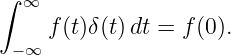
It is widely known that distributions play important roles in Dirac’s formulation of quantum
mechanics. An example of how the Dirac distribution arises in a physical, classical context is also
available online.
The Dirac delta δ(x) is a distribution, not an ordinary function. Its familiar symbolic properties
are
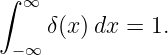
together with the normalization
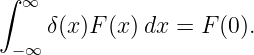
More generally, for a suitable test function F,
In n dimensions, the corresponding sifting property is
One can approximate the Dirac delta distribution by a family of normalized Gaussian functions
whose widths tend to zero. The limiting object is not an ordinary pointwise-defined function;
rather, the convergence is understood in the sense of distributions.
The Dirac delta, δ, can be defined rigorously as a linear functional on a suitable space of test
functions. Its action is
Equivalently, using pairing notation,
In the common formal notation this is written as
References
[1] L. Schwartz, Théorie des distributions, vols. 1–2, Hermann, Paris, 1950–1951.
[2] W. Rudin, Functional Analysis, McGraw–Hill Book Company, 1973.
[3] L. Hörmander, The Analysis of Linear Partial Differential Operators I: Distribution
Theory and Fourier Analysis, 2nd ed., Springer–Verlag, 1990.
[4] Originally from The Data Analysis Briefbook. The Data Analysis Briefbook



![δ[f] = f(0).](https://images.physicslibrary.org/cache/objects/847/make4ht/DiracsDeltaDistribution4x.png)