Coordinates of a Point
The position of a moving particle may be given at any time by giving its rectangular coordinates
x,y,z referred to a set of rectangular axes fixed in space. It may be given equally well by giving the
values of any three specified functions of x,y, and z, if from the values in question the
corresponding values of x,y, and z may be obtained uniquely. These functions may be used as
coordinates of the point, and the values of x,y, and z expressed explicitly in terms
of them serve as formulas for transformation from the rectangular system to the new
system.
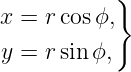
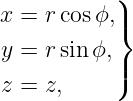
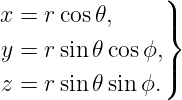
Familiar examples are polar coordinates in a plane, and cylindrical and spherical coordinates in
space, the formulas for transformation of coordinates being respectively
and
It is clear that the number of possible systems of coordinates is unlimited. It is also clear that if
the point is unrestricted in its motion, three coordinates are required to determine it. If it is
restricted to moving in a plane, since that plane may be taken as one of the rectangular coordinate
planes, two coordinates are required.
The number of independent coordinates required to fix the position of a particle moving under any
given conditions is called the number of degrees of freedom of the particle, and is equal to the
number of independent conditions required to fix the point.
Obviously these coordinates must be numerous enough to fix the position without ambiguity and
not so numerous as to render it impossible to change any one at pleasure without changing any of
the others and without violating the restrictions of the problem.
Source
William Elwood Byerly, An Introduction to the Use of Generalized Coördinates in mechanics and
Physics, Ginn and Company, 1916. Chapter I, “Introduction.”
The 1916 source work is in the public domain in the United States. This PhysicsLibrary
transcription converts the typography and equations.