Cartesian Components and Direction Cosines
Choose a right-handed orthonormal Cartesian basis
Every vector has the unique component form
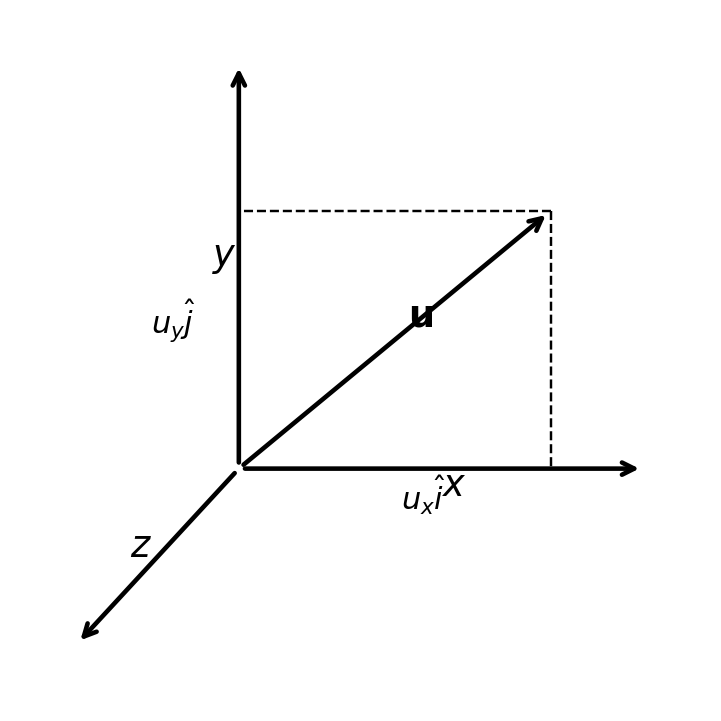
Figure 11, modernized: decomposition into Cartesian components.
For a point P = (x,y,z),
Hence
The magnitude is
If α,β,γ are the direction angles,
so
For planar vectors it is better numerically to use
rather than reconstructing the quadrant from tan 𝜃 = uy∕ux.
Source examples
For u = (−2, 1, 2),
with direction cosines (−2∕3, 1∕3, 2∕3).
If u = (5, 2) and v = (−3,−4), then
and 𝜃 = −45∘ (equivalently 315∘).
A line through P1 = (x1,y1,z1) parallel to ℓ = (a,b,c) can be written parametrically
as
or, when the denominators are nonzero,
Source problems
- Find u + v + w graphically and analytically for:
- ∥u∥ = 6,𝜃u = 60∘; ∥v∥ = 10,𝜃
v = 120∘; ∥w∥ = 8,𝜃
w = 270∘.
- Three unit vectors at 0∘, 120∘, 240∘.
- u = 2î + 3ĵ, v = −5î + 2ĵ, w = −ĵ.
- u = î, v = −ĵ, w = î −ĵ.
- Add
and find the resultant magnitude and direction cosines.
- Given A = (−1, 2,−1), B = (−3, 6, 6), C = (4, 3, 1), D = (0, 0, 2), find the length and
direction cosines of
 +
+  +
+  .
.
- Using the same points: find the point dividing AB in the ratio 2 : 1; find the centroid of
A,B,C; and show that the side midpoints of the skew quadrilateral ABCD form a
parallelogram.
- Prove
- Deduce
- Find the Cartesian equations of the line through A = (−2, 0, 2) and B = (2, 1,−3).
Modern notation references
The notation and terminology in this modernized article follow standard present-day mechanics
and vector-analysis usage, particularly:
- J. R. Taylor, Classical Mechanics, University Science Books, 2005.
- D. Kleppner and R. Kolenkow, An Introduction to Mechanics, 2nd ed., Cambridge
University Press, 2014.
- H. Goldstein, C. Poole, and J. Safko, Classical Mechanics, 3rd ed., Addison–Wesley,
2002.
Source
This article is a modernized restatement of the corresponding Public Domain article in Louis
Brand, Vectorial Mechanics, John Wiley & Sons, New York, 1930, Chapter I, “Vector Algebra.”
The original 1930 edition is the source basis.















