Calculus of Variations Examples: Fundamental Lemma Problems
This companion entry develops the Fundamental Lemma through calculation rather than another
theorem presentation. The exercises move from hypothesis checks to explicit counterexamples, then
to scalar and vector Euler–Lagrange-type integral identities and finally to the weak
almost-everywhere form.
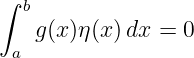
The convention throughout is that a statement of the form
for every admissible test function carries much more information than the same equality for one or
finitely many chosen functions.
1 Exercises
Exercise 1: Hypothesis audit
For each statement below, determine the strongest conclusion that follows and state which version
of the Fundamental Lemma is being used.
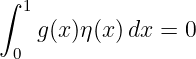
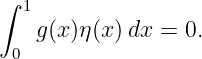
- g ∈ C([0, 1]) and
for every η ∈ Cc∞(0, 1).
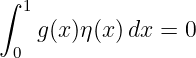
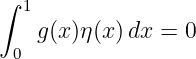
- g ∈ C([0, 1]) and
- g ∈ C([0, 1]) and
for every η ∈ C1([0, 1]) satisfying η(0) = η(1) = 0.
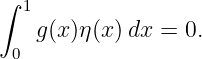
- g ∈ Lloc1(0, 1) and
for every η ∈ Cc∞(0, 1).
Exercise 2: One test function is not enough
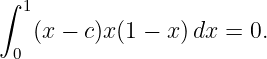
Let
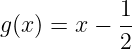
Find a nonzero linear function
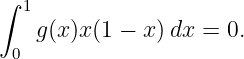
such that
Explain why this does not contradict the Fundamental Lemma.
Exercise 3: A weighted-square proof
Suppose g ∈ C1([0, 1]) and
for every η ∈ C1([0, 1]) satisfying η(0) = η(1) = 0. Without invoking the Fundamental Lemma by
name, choose a test function depending on g and prove directly that g ≡ 0.
Exercise 4: Recover a differential equation and solve it
Suppose y ∈ C2([0, 1]) satisfies
for every η ∈ Cc∞(0, 1), together with
Use the Fundamental Lemma to determine y(x).
Exercise 5: First variation to boundary-value problem
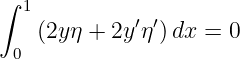
Let y ∈ C2([0, 1]) satisfy the fixed-endpoint stationarity identity
for every η ∈ C1([0, 1]) with η(0) = η(1) = 0. If
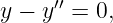
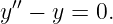
derive and solve the differential equation for y.
Exercise 6: Vector-valued Fundamental Lemma
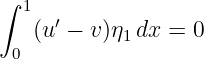
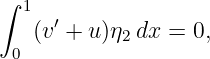
Let u,v ∈ C1([0, 1]) and suppose
for every pair (η1,η2) of smooth compactly supported test functions.
- Derive the coupled differential equations for u and v.
- Solve them subject to
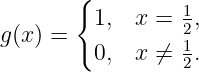
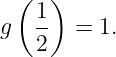
Exercise 7: Pointwise versus almost-everywhere equality
Define
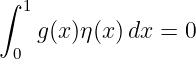
Show that
for every smooth compactly supported test function η. Why is the conclusion g = 0 almost
everywhere correct while the conclusion g = 0 at every point is false?
Exercise 8: Stationarity is not classification
Consider
on the fixed-endpoint class y(0) = y(1) = 0.
- Show that y∗(x) = 0 is stationary.
- Classify y∗ globally.
- Explain which part of the reasoning uses the Fundamental Lemma and which part does
not.
2 Solutions
Solution 1: Hypothesis audit
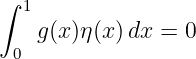
(a) The classical Fundamental Lemma applies directly. Since g is continuous and the integral
vanishes for every smooth compactly supported test function,
for every x ∈ (0, 1), and continuity extends the conclusion to the endpoints. Thus
(b) No such conclusion follows. This is one scalar orthogonality condition on an infinite-dimensional
set of possible g. A nonzero function can easily have zero weighted integral against a single chosen
test function. Exercise 2 constructs one explicitly.
(c) The fixed-endpoint corollary applies. Every function in Cc∞(0, 1) is also a C1 function that
vanishes at both endpoints, so the hypothesis includes the test class required by the Fundamental
Lemma. Therefore
(d) The weak Fundamental Lemma applies. The correct conclusion is
for almost every x ∈ (0, 1). Without additional regularity such as continuity, pointwise equality
everywhere cannot be inferred.
Solution 2: One test function is not enough
We require
Separate the two terms:
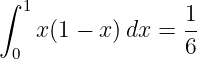
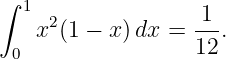
The required integrals are
and
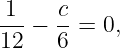
Therefore
so
Thus
is nonzero yet satisfies the given integral identity.
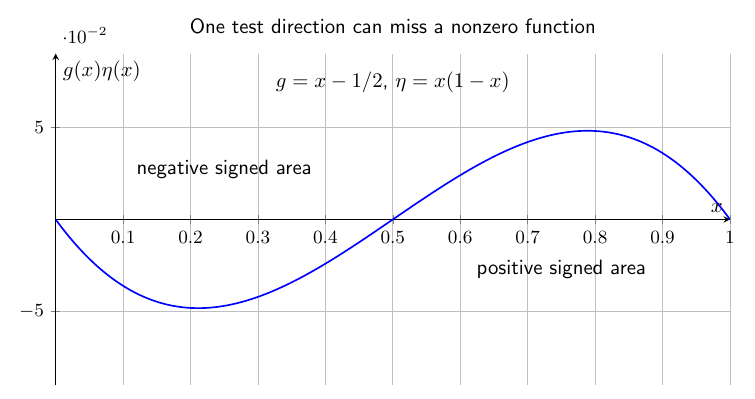
Figure. The product gη is negative on the left half of the interval and positive on the right
half. Its signed areas cancel. A single vanishing integral is therefore an orthogonality
statement, not a pointwise conclusion.
There is no contradiction with the Fundamental Lemma because the lemma assumes that the
integral vanishes for every test function in a sufficiently rich class, not for one chosen
η.
Solution 3: A weighted-square proof
Choose
Because g ∈ C1([0, 1]), this η belongs to C1([0, 1]), and
It is therefore an admissible test function. Substitution gives
For 0 < x < 1,
and g(x)2 ≥ 0. Hence the integrand is nonnegative. A continuous nonnegative function with zero
integral must vanish identically, so
for every x ∈ [0, 1]. On the open interval this implies
Continuity then gives g(0) = g(1) = 0. Therefore
This proof is efficient, but it relies on the test class being broad enough to allow a test function
constructed from g itself.
Solution 4: Recover a differential equation and solve it
Define
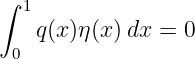
Since y ∈ C2, the function q is continuous. The hypothesis says
for every smooth compactly supported η. The Fundamental Lemma therefore gives
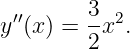
or
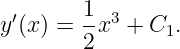
Integrating once,
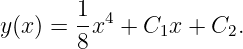
Integrating again,
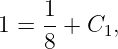
The condition y(0) = 0 gives C2 = 0. The condition y(1) = 1 gives
hence
Therefore
Solution 5: First variation to boundary-value problem
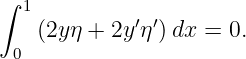
Begin with
Integrate the second term by parts:
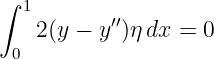
Since η(0) = η(1) = 0, the boundary term vanishes. Thus
for every fixed-endpoint test function. The Fundamental Lemma gives
or
The general solution is
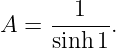
From y(0) = 0,
From y(1) = 1,
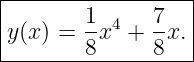
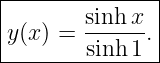
Hence
This exercise exhibits the complete chain that CV03 supports:
Solution 6: Vector-valued Fundamental Lemma
Because the test components are independently arbitrary, choose first
Then
for every scalar test function η1. Hence
Now choose
Then
so
Thus the coupled system is

Figure. A vector test function can be chosen with only one component active. The vector
integral identity therefore separates into scalar identities, to which the scalar Fundamental
Lemma is applied componentwise.
Differentiate u′ = v to obtain
so
Hence
Since v = u′,
The initial data u(0) = 1 and v(0) = 0 give
Therefore
Solution 7: Pointwise versus almost-everywhere equality
The function g differs from zero at only the single point x = 1∕2. Changing an integrand at
a set of measure zero does not change its integral. Therefore for every test function
η,
Nevertheless,
Thus pointwise equality everywhere is false. However, the set on which g is nonzero has measure
zero, so
This is exactly why the weak Fundamental Lemma concludes almost-everywhere equality for
locally integrable functions. Continuity is what upgrades that conclusion to pointwise equality in
the classical theorem.
Solution 8: Stationarity is not classification
For
the first variation is
At y∗ = 0,
so
for every admissible η. Thus y∗ = 0 is stationary.
For every admissible y,
At y = 0,
Therefore
The Fundamental Lemma is used when converting a stationary integral identity into a pointwise
differential equation. It does not classify a stationary function as a minimum or maximum.
Classification here comes from the sign of the functional itself.
3 Summary
The exercises reinforce four distinct lessons:
- the Fundamental Lemma requires a rich class of test functions;
- one or finitely many vanishing weighted integrals do not imply pointwise vanishing;
- scalar and vector integral identities become pointwise differential equations through
localization; and
- the weak theorem naturally gives almost-everywhere equality, while classification of
stationary curves requires additional arguments.

![[parent]](https://images.physicslibrary.org/images/uparrow.png)





![∫ 1
[(u′ − v)η1 + (v′ + u)η2]dx = 0
0](https://images.physicslibrary.org/cache/objects/1146/make4ht/CalculusOfVariationsExamplesFundamentalLemmaProblems13x.png)

![∫
1 ′ 2
J [y] = − y(x ) dx
0](https://images.physicslibrary.org/cache/objects/1146/make4ht/CalculusOfVariationsExamplesFundamentalLemmaProblems17x.png)

![g ≡ 0 on [0,1].](https://images.physicslibrary.org/cache/objects/1146/make4ht/CalculusOfVariationsExamplesFundamentalLemmaProblems19x.png)














![∫ 1 ∫ 1
2y′η′dx = [2y′η]10 − 2y′′η dx.
0 0](https://images.physicslibrary.org/cache/objects/1146/make4ht/CalculusOfVariationsExamplesFundamentalLemmaProblems46x.png)















![∫ 1 ′2
J [y ] = − y dx,
0](https://images.physicslibrary.org/cache/objects/1146/make4ht/CalculusOfVariationsExamplesFundamentalLemmaProblems71x.png)
![∫ 1
δJ[y;η] = − 2 y′η ′dx.
0](https://images.physicslibrary.org/cache/objects/1146/make4ht/CalculusOfVariationsExamplesFundamentalLemmaProblems72x.png)

![δJ [0;η] = 0](https://images.physicslibrary.org/cache/objects/1146/make4ht/CalculusOfVariationsExamplesFundamentalLemmaProblems74x.png)
![∫
1 ′2
J [y] = − y dx ≤ 0.
0](https://images.physicslibrary.org/cache/objects/1146/make4ht/CalculusOfVariationsExamplesFundamentalLemmaProblems75x.png)
![J [0 ] = 0.](https://images.physicslibrary.org/cache/objects/1146/make4ht/CalculusOfVariationsExamplesFundamentalLemmaProblems76x.png)
