0.1 Preliminary data for the definition of a C*-Clifford algebra
Given a general Hilbert space ℋ, one can define an associated C∗-Clifford algebra, Cl[ℋ], which
admits a canonical representation on ℒ(𝔽(ℋ)) the bounded linear operators on the Fock space
𝔽(ℋ) of ℋ, (as in Plymen and Robinson, 1994), and hence one has a natural sequence of maps
ℋ→Cl[ℋ]→ℒ(𝔽(ℋ)) .
The details and notation related to the definition of a C∗-Clifford algebra, are presented in the
following brief paragraph and diagram.
0.2 A non–commutative quantum observable algebra (QOA) is a Clifford algebra.
Definition 0.1. Let us briefly recall the notion of a Clifford algebra with the above notations
and auxiliary concepts. Consider first a pair (V,Q), where V denotes a real vector space and
Q is a quadratic form on V . Then, the Clifford algebra associated to V , denoted here as
Cl(V ) = Cl(V,Q), is the algebra over ℝ generated by V , where for all v,w ∈ V , the relations:
v ⋅ w + w ⋅ v = −2Q(v,w) , are satisfied; in particular, v2 = −2Q(v,v) .
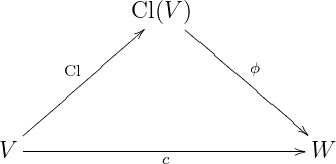
If W is an algebra and c : V →W is a linear map satisfying c(w)c(v)+c(v)c(w) = −2Q(v,w) ,
then there exists a unique algebra homomorphism ϕ : Cl(V )→W such that the diagram
Commutes. (It is in this sense that Cl(V ) is considered to be ‘universal’).
Then, with the above notation, one has the precise definition of the C∗-Clifford algebra as Cl[ℋ]
when
where V is a real vector space, as specified above.
Also note that the Clifford algebra is sometimes denoted as Cliff(Q,V ).