The nonlinear differential equation
 = f(x) + g(x)y + h(x)y2 = f(x) + g(x)y + h(x)y2 | | (1) |
is called the Riccati equation. If h(x) ≡ 0, it becomes a linear differential equation; if f(x) ≡ 0,
then it becomes a Bernoulli equation. There is no general method for integrating explicitely the
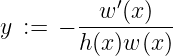
equation (1), but via the substitution
one can convert it to a second order homogeneous linear differential equation with non-constant
coefficients.
If one can find a particular solution y0(x), then one can easily verify that the substitution
y := y0(x) +  | | (2) |
converts (1) to
 + [g(x)+2h(x)y0(x)] w + h(x) = 0, + [g(x)+2h(x)y0(x)] w + h(x) = 0, | | (3) |
which is a linear differential equation of first order with respect to the function w = w(x).
Example. The Riccati equation
 = 3 + 3x2y − xy2 = 3 + 3x2y − xy2 | | (4) |
has the particular solution y := 3x. Solve the equation.
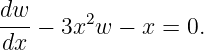
We substitute y := 3x +  to (4), getting
For solving this first order equation we can put w = uv, w′ = uv′ + u′v, writing the equation
as
| u ⋅ (v′− 3x3v) + u′v = x, | | (5) |
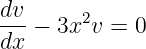
where we choose the value of the expression in parentheses equal to 0:
After separation of variables and integrating, we obtain from here a solution v = ex3, which is set
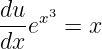
to the equation (5):
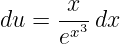
Separating the variables yields
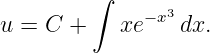
and integrating:
Thus we have
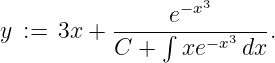
whence the general solution of the Riccati equation (4) is
It can be proved that if one knows three different solutions of Riccati equation (1),
then any other solution may be expressed as a rational function of the three known
solutions.

![[ ∫ ]
w = w (x) = uv = ex3 C + xe− x3 dx ,](https://images.physicslibrary.org/cache/objects/788/make4ht/RiccatiEquation211x.png)