differential propositional calculus(Definition)
A differential propositional calculus is a propositional calculus extended by a set of terms for
describing aspects of change and difference, for example, processes that take place in
a universe of discourse or transformations that map a source universe into a target
universe.
Contents
1 Casual introduction
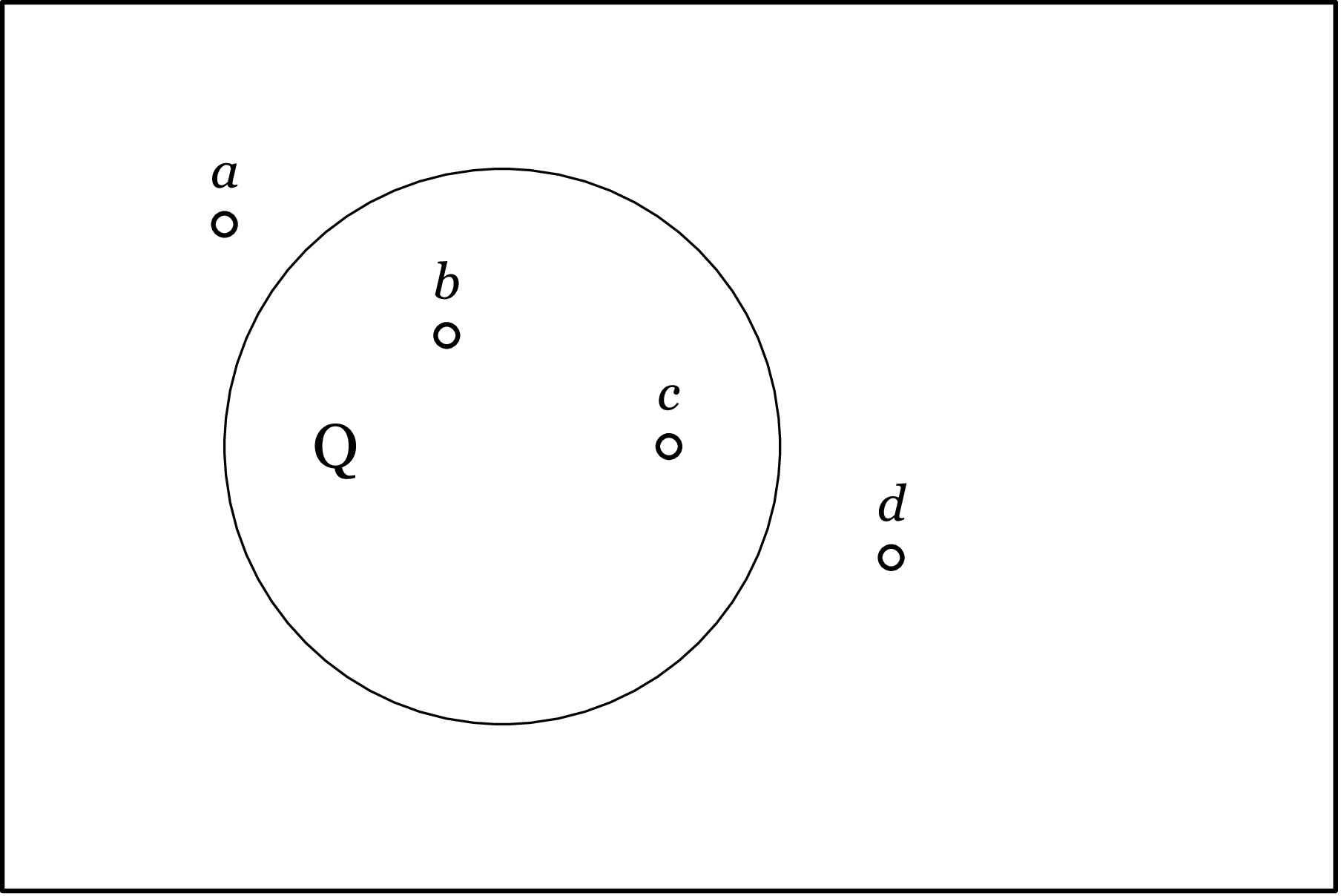
Consider the situation represented by the venn diagram in Figure 1.
 | | Figure 1. Local Habitations, And Names |
The area of the rectangle represents a universe of discourse, X. This might be a population of
individuals having various additional properties or it might be a collection of locations that various
individuals occupy. The area of the “circle” represents the individuals that have the property q or
the locations that fall within the corresponding region Q. Four individuals, a,b,c,d, are singled
out by name. It happens that b and c currently reside in region Q while a and d do
not.
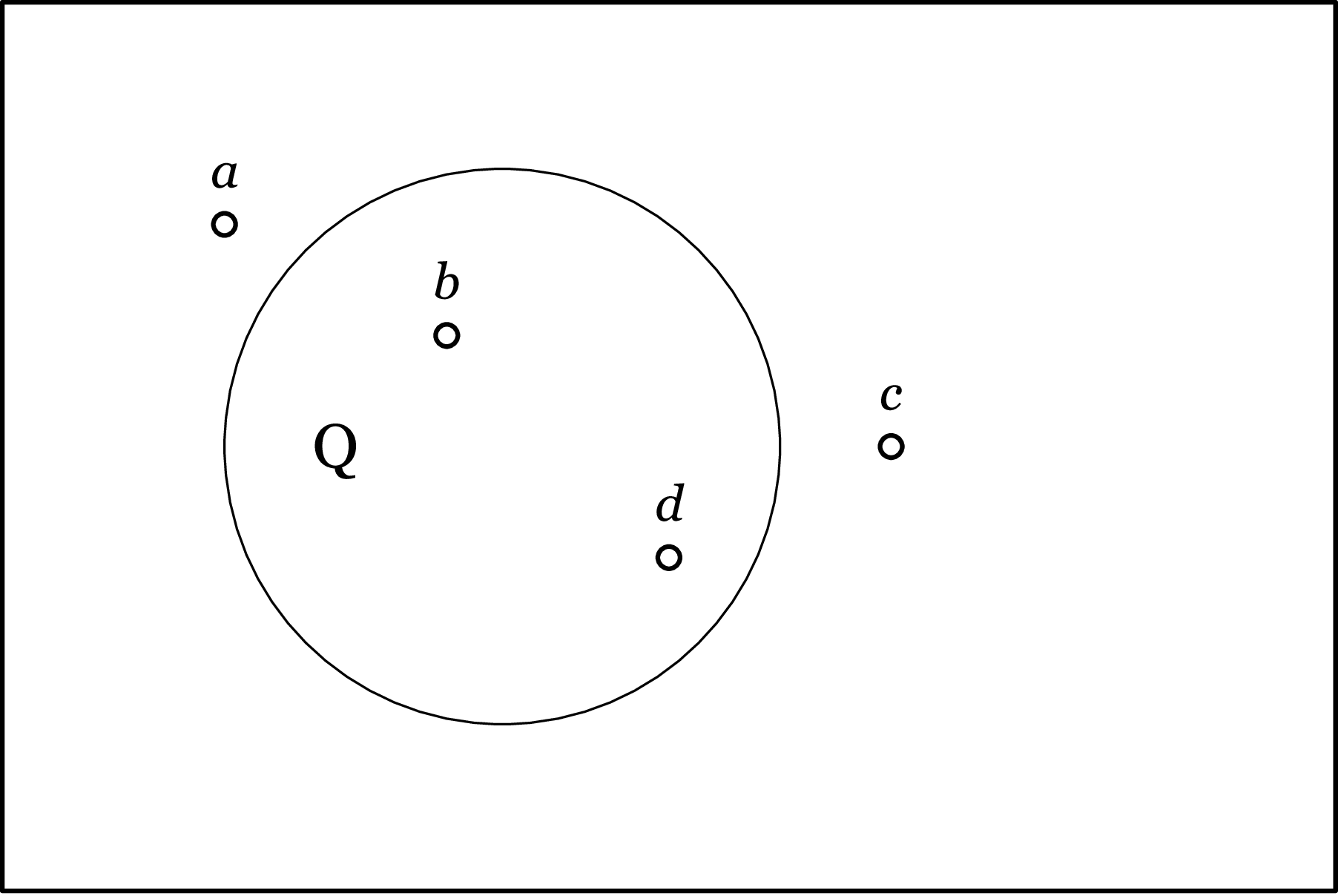
Now consider the situation represented by the venn diagram in Figure 2.
 | | Figure 2. Same Names, Different Habitations |
Figure 2 differs from Figure 1 solely in the circumstance that the object c is outside the region Q
while the object d is inside the region Q. So far, there is nothing that says that our
encountering these Figures in this order is other than purely accidental, but if we interpret the
present sequence of frames as a “moving picture” representation of their natural order in
a temporal process, then it would be natural to say that a and b have remained as
they were with regard to quality q while c and d have changed their standings in that
respect. In particular, c has moved from the region where q is true to the region where
q is false while d has moved from the region where q is false to the region where q is
true.
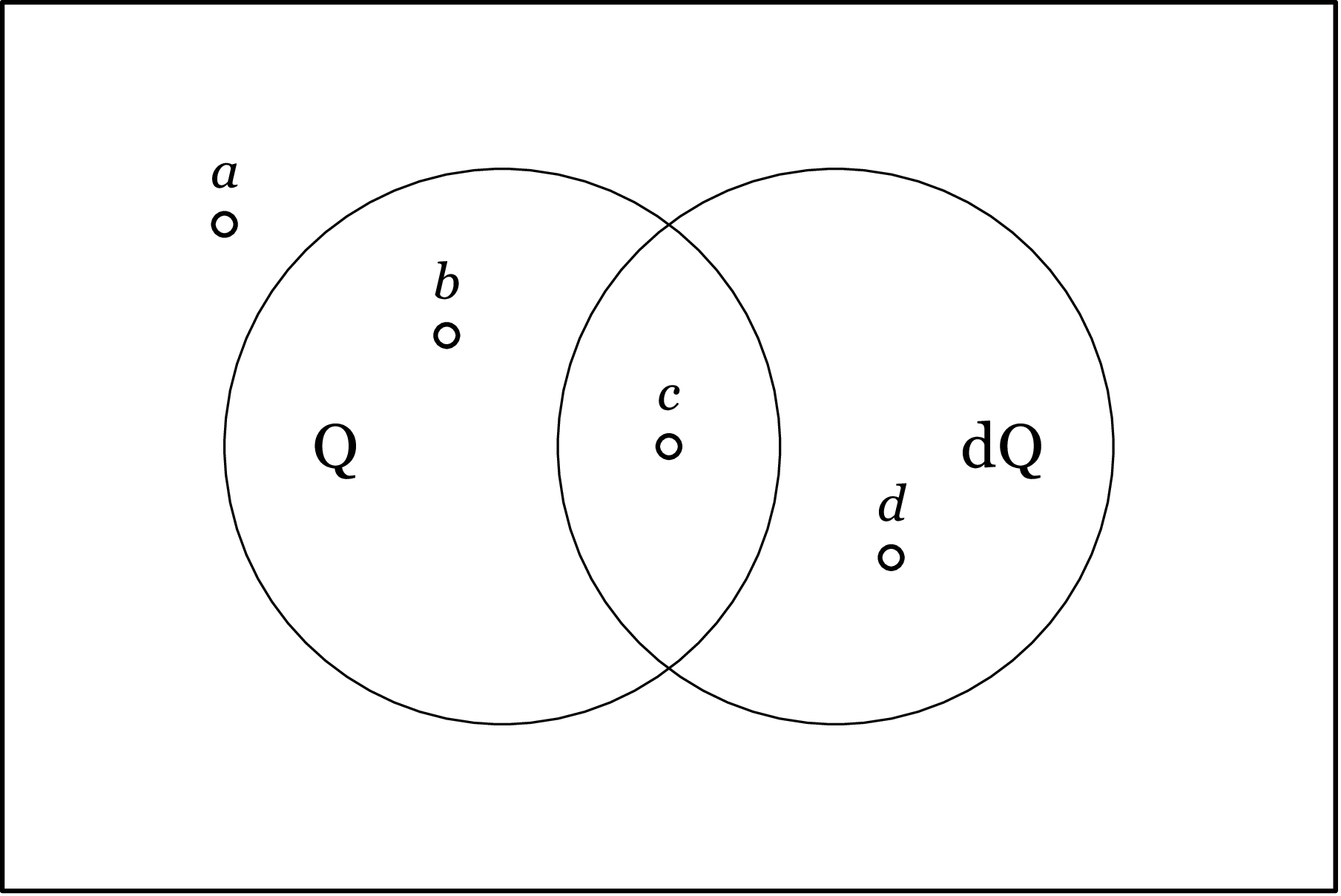
Figure 1′ reprises the situation shown in Figure 1, but this time interpolates a new quality
that is specifically tailored to account for the relation between Figure 1 and Figure
2.
 |
| Figure 1′. Back, To The Future |
This new quality, d q, is an example of a differential quality, since its absence or presence qualifies
the absence or presence of change occurring in another quality. As with any other quality, it is
represented in the venn diagram by means of a “circle” that distinguishes two halves of
the universe of discourse, in this case, the portions of X outside and inside the region
d Q.
Figure 1 represents a universe of discourse, X, together with a basis of discussion, {q}, for
expressing propositions about the contents of that universe. Once the quality q is given a name,
say, the symbol “q”, we have a basis for a formal language that is specifically cut out for discussing
X in terms of q, and this formal language is more formally known as the propositional calculus
with alphabet {“q”}.
In the context marked by X and {q} there are but four different pieces of information that
can be expressed in the corresponding propositional calculus, namely, the propositions:
false, ¬q, q, true. Referring to the sample of points in Figure 1, false holds of no points, ¬q holds
of a and d, q holds of b and c, and true holds of all points in the sample.
Figure 1′ preserves the same universe of discourse and extends the basis of discussion to a set of
two qualities, {q, d q}. In parallel fashion, the initial propositional calculus is extended by means
of the enlarged alphabet, {“q”, “ d q”}. Any propositional calculus over two basic propositions
allows for the expression of 16 propositions all together. Just by way of salient examples in the
present setting, we can pick out the most informative propositions that apply to each
of our sample points. Using overlines to express logical negation, these are given as
follows:
- q d q describes a
- q d q describes d
- q d q describes b
- q d q describes c
Table 3 exhibits the rules of inference that give the differential quality d q its meaning in
practice.
| Table 3. Differential Inference Rules | | | | | | | | | From | q | and | d q | infer | q | next. |
| | | | | | | | | From | q | and | d q | infer | q | next. |
| | | | | | | | | From | q | and | d q | infer | q | next. |
| | | | | | | | | From | q | and | d q | infer | q | next. |
| | | | | | | | | |
2 Cactus calculus
Table 4 outlines a syntax for propositional calculus based on two types of logical connectives, both
of variable k-ary scope.
- A bracketed list of propositional expressions in the form (e1,e2,…,ek−1,ek) indicates
that exactly one of the propositions e1,e2,…,ek−1,ek is false.
- A concatenation of propositional expressions in the form e1 e2 … ek−1 ek indicates
that all of the propositions e1,e2,…,ek−1,ek are true, in other words, that their logical
conjunction is true.
| Table 4. Syntax and Semantics of a Propositional Calculus
|
|
|
| | | | | | Expression | Interpretation | Other Notations |
|
|
| | | | | | | True | 1 |
|
|
| | | | | | ( ) | False | 0 |
|
|
| | | | | | x | x | x |
|
|
| | | | | | (x) | Not x | |
|
|
| | | | | | x y z | x and y and z | x ∧ y ∧ z |
|
|
| | | | | | ((x)(y)(z)) | x or y or z | x ∨ y ∨ z |
|
|
| | | | | | (x (y)) | | x ⇒ y |
|
|
| | | | | | (x,y) | x not equal to y |
x exclusive or y |
|
|
| |
|
|
| | | | | | ((x,y)) | x is equal to y |
x if and only if y |
|
|
| |
|
|
| | | | | | (x,y,z) | Just one of | x, y, z |
is false . | |
|
| |
|
|
| | | | | | ((x), (y), (z)) | Just one of | x, y, z |
is true . | | |
Partition all | into x, y, z. |
|
|
| |
|
|
| | | | | | Oddly many of |
x,y,z |
are true . | |
|
| x + y + z |
= | x y z |
∨ | x y′z′ |
∨ | x′y z′ |
∨ | x′y′z |
|
|
|
|
|
| | | | | | (w, (x), (y), (z)) | Partition w | into x, y, z. |
| | Genus w comprises |
species x,y,z. |
|
|
| w′x′y′z′ |
∨ | w x y′z′ |
∨ | w x′y z′ |
∨ | w x′y′z |
|
|
|
|
|
| | | | | | |
All other propositional connectives can be obtained through combinations of these two forms.
Strictly speaking, the concatenation form is dispensable in Light of the bracket form, but it is
convenient to maintain it as an abbreviation of more complicated bracket expressions.
The briefest expression for logical truth is the empty word, abstractly denoted 𝜀 or λ
in formal languages, where it forms the identity element for concatenation. It can be
given visible expression in this context by means of the logically equivalent expression
“(( ))”, or, especially if operating in an algebraic context, by a simple “1”. Also when
working in an algebraic mode, the plus sign “ + ” may be used for exclusive disjunction.
For example, we have the following paraphrases of algebraic expressions by bracket
expressions:
It is important to note that the last expressions are not equivalent to the triple bracket
(x,y,z).
For more information about this syntax for propositional calculus, see the entries on minimal
negation operators, zeroth order logic, and Table A1 in Appendix 1.
3 Formal development
The preceding discussion outlined the ideas leading to the differential extension of propositional
logic. The next task is to lay out the concepts and terminology that are needed to describe various
orders of differential propositional calculi.
3.1 Elementary notions
Logical description of a universe of discourse begins with a set of logical signs. For the sake of
simplicity in a first approach, assume that these logical signs are collected in the form of a finite
alphabet, 𝔄 = {“a1”,…, “an”}. Each of these signs is interpreted as denoting a logical feature, for
instance, a property that objects in the universe of discourse may have or a proposition about
objects in the universe of discourse. Corresponding to the alphabet 𝔄 there is then a set of logical
features, 𝒜 = {a1,…,an}.
A set of logical features, 𝒜 = {a1,…,an}, affords a basis for generating an n-dimensional universe of
discourse, written A∘ = [𝒜] = [a
1,…,an]. It is useful to consider a universe of discourse as a
categorical object that incorporates both the set of points A = ⟨a1,…,an⟩ and the set of
propositions A↑ = {f : A → 𝔹} that are implicit with the ordinary picture of a venn diagram on n
features. Accordingly, the universe of discourse A∘ may be regarded as an ordered pair (A,A↑)
having the type (𝔹n, (𝔹n → 𝔹)), and this last type designation may be abbreviated as
𝔹n +→ 𝔹, or even more succinctly as [𝔹n]. For convenience, the data type of a finite
set on n elements may be indicated by either one of the equivalent notations, [n] or
n.
Table 5 summarizes the notations that are needed to describe ordinary propositional calculi in a
systematic fashion.
| Table 5. Propositional Calculus : Basic Notation
|
|
|
| | | | | | | Symbol | Notation | Description | Type |
|
|
|
| | | | | | | 𝔄 | {“a1”,…, “an”} | Alphabet | [n] = n |
|
|
|
| | | | | | | 𝒜 | {a1,…,an} | Basis | [n] = n |
|
|
|
| | | | | | | Ai | {ai,ai} | dimension i | 𝔹 |
|
|
|
| | | | | | | A | ⟨𝒜⟩ | Set of cells, | 𝔹n |
| | | | | | | ⟨a1,…,an⟩ | coordinate tuples, | |
| | | | | | | {(a1,…,an)} | points, or vectors | |
| | | | | | | A1 ×… × An | in the universe | |
| | | | | | | ∏
i=1nA
i | of discourse | |
|
|
|
| | | | | | | A∗ | (hom : A → 𝔹) | Linear functions | (𝔹n)∗ 𝔹n 𝔹n |
|
|
|
| | | | | | | A↑ | (A → 𝔹) | boolean functions | 𝔹n → 𝔹 |
|
|
|
| | | | | | | A∘ | [𝒜] | Universe of discourse | (𝔹n, (𝔹n → 𝔹)) |
| | | | | | | (A,A↑) | based on the features | (𝔹n +→ 𝔹) |
| | | | | | | (A +→ 𝔹) | {a1,…,an} | [𝔹n] |
| | | | | | | (A, (A → 𝔹)) | | |
| | | | | | | [a1,…,an] | | |
|
|
|
| | | | | | | |
3.2 Special classes of propositions
A basic proposition, coordinate proposition, or simple proposition in the universe of discourse
[a1,…,an] is one of the propositions in the set {a1,…,an}.
Among the 22n propositions in [a
1,…,an] are several families of 2n propositions each that take on
special forms with respect to the basis {a1,…,an}. Three of these families are especially prominent
in the present context, the linear, the positive, and the singular propositions. Each family is
naturally parameterized by the coordinate n-tuples in 𝔹n and falls into n + 1 ranks, with a
binomial coefficient  giving the number of propositions that have rank or weight
k. giving the number of propositions that have rank or weight
k.
- The linear propositions, {ℓ : 𝔹n → 𝔹} = (𝔹n
 𝔹), may be expressed as sums: 𝔹), may be expressed as sums:
∑
i=1ne
i | = | e1 + … + en | where | ei = ai | or | ei = 0 | for i = 1 to n. | |
|
- The positive propositions, {p : 𝔹n → 𝔹} = (𝔹n
 𝔹), may be expressed as products: 𝔹), may be expressed as products:
∏
i=1ne
i | = | e1 ⋅… ⋅ en | where | ei = ai | or | ei = 1 | for i = 1 to n. | |
|
- The singular propositions, {x : 𝔹n → 𝔹} = (𝔹n
 𝔹), may be expressed as products: 𝔹), may be expressed as products:
∏
i=1ne
i | = | e1 ⋅… ⋅ en | where | ei = ai | or | ei = (ai) | for i = 1 to n. | |
|
In each case the rank k ranges from 0 to n and counts the number of positive appearances of the
coordinate propositions a1,…,an in the resulting expression. For example, for n = 3, the linear
proposition of rank 0 is 0, the positive proposition of rank 0 is 1, and the singular proposition of
rank 0 is (a1)(a2)(a3).
The basic propositions ai : 𝔹n → 𝔹 are both linear and positive. So these two kinds of propositions,
the linear and the positive, may be viewed as two different ways of generalizing the class of basic
propositions.
Finally, it is important to note that all of the above distinctions are relative to the choice of a
particular logical basis 𝒜 = {a1,…,an}. For example, a singular proposition with respect to the
basis 𝒜 will not remain singular if 𝒜 is extended by a number of new and independent features.
Even if one keeps to the original set of pairwise options {ai}∪{(ai)} to pick out a new basis, the
sets of linear propositions and positive propositions are both determined by the choice of basic
propositions, and this whole determination is tantamount to the purely conventional choice of a
cell as origin.
3.3 Differential extensions
An initial universe of discourse, A∘, supplies the groundwork for any number of further extensions,
beginning with the first order differential extension, E A∘. The construction of E A∘ can be
described in the following stages:
A proposition in a differential extension of a universe of discourse is called a differential proposition
and forms the analogue of a system of differential equations in ordinary calculus. With these
constructions, the first order extended universe E A∘ and the first order differential
proposition f : E A → 𝔹, we have arrived, in concept at least, at the foothills of differential
logic.
Table 6 summarizes the notations that are needed to describe the first order differential extensions
of propositional calculi in a systematic manner.
| Table 6. Differential Extension : Basic Notation
|
|
|
| | | | | | | Symbol | Notation | Description | Type |
|
|
|
| | | | | | | d 𝔄 | {“ d a1”,…, “ d an”} | Alphabet of differential symbols | [n] = n |
|
|
|
| | | | | | | d 𝒜 | {d a1,…, d an} | Basis of differential features | [n] = n |
|
|
|
| | | | | | | d Ai | { d ai, d ai} | Differential dimension i | 𝔻 |
|
|
|
| | | | | | | d A | ⟨d 𝒜⟩ | tangent space at a point: | 𝔻n |
| | | | | | | ⟨d a1,…, d an⟩ | Set of changes, | |
| | | | | | | {(d a1,…, d an)} | motions, steps, | |
| | | | | | | d A1 ×… × d An | tangent vectors | |
| | | | | | | ∏
i=1n d A
i | at a point | |
|
|
|
| | | | | | | d A∗ | (hom : d A → 𝔹) | Linear functions on d A | (𝔻n)∗ 𝔻n 𝔻n |
|
|
|
| | | | | | | d A↑ | (d A → 𝔹) | Boolean functions on d A | 𝔻n → 𝔹 |
|
|
|
| | | | | | | d A∘ | [d 𝒜] | Tangent universe | (𝔻n, (𝔻n → 𝔹)) |
| | | | | | | (d A, d A↑) | at a point of A∘, | (𝔻n +→ 𝔹) |
| | | | | | | (d A +→ 𝔹) | based on the | [𝔻n] |
| | | | | | | (d A, (d A → 𝔹)) | tangent features | |
| | | | | | | [d a1,…, d an] | {d a1,…, d an} | |
|
|
|
| | | | | | | |
"differential propositional calculus" is owned by Jon Awbrey.
(view preamble)
| Other names: |
differential extension of propositional calculus |
| Also defines: |
differential basis, differential extension, differential feature, differential inference, differential proposition, differential quality, differential variable, logical transformation, source universe, target universe, tangent universe, basic proposition, coordinate proposition, simple proposition, linear proposition, positive proposition, singular proposition |
Cross-references: tangent space, differential logic, system of differential equations, boolean functions, functions, vectors, dimension, concepts, disjunction, algebraic, identity, Light, conjunction, types, negation, propositions, relation, diagram, universe of discourse
There are 3 references to this object.
This is version 7 of differential propositional calculus, born on 2009-05-16, modified 2009-05-25.
Object id is 759, canonical name is DifferentialPropositionalCalculus.
Accessed 12765 times total.
Classification:
|


