
|
|
|
|||||||
in which p is a constant (non-negative if it is real), is called the Bessel’s equation. We derive its general solution by trying the series form
due to Frobenius. Since the parameter r is indefinite, we may regard a0 as distinct from 0. We substitute (2) and the derivatives of the series in (1):  Thus the coefficients of the powers xr, xr+1, xr+2 and so on must vanish, and we get the system of equations
The last of those can be written  Because a0≠0, the first of those (the indicial equation) gives r2 − p2 = 0, i.e. we have the roots  Let’s first look the the solution of (1) with r = p; then k(2p + k)ak + ak−2 = 0, and thus 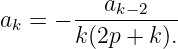 From the system (3) we can solve one by one each of the coefficients a1, a2, … and express them with a0 which remains arbitrary. Setting for k the integer values we get
(where m = 1, 2, …). Putting the obtained coefficients to (2) we get the particular solution
In order to get the coefficients ak for the second root r2 = −p we have to look after that  or r2 + k≠p = r1. Therefore  where k is a positive integer. Thus, when p is not an integer and not an integer added by
The power series of (5) and (6) converge for all values of x and are linearly independent (the ratio y1∕y2 tends to 0 as x →∞). With the appointed value 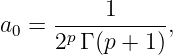 the solution y1 is called the Bessel function of the first kind and of order p and denoted by
Jp. The similar definition is set for the first kind Bessel function of an arbitrary order
p ∈ ℝ (and ℂ). For p  where J−p(x) = y2 with a0 = The explicit expressions for J±p are
which are obtained from (5) and (6) by using the last formula for gamma function. E.g. when p = ![1 [ ] ∘ ----( )
--x-2--- x2-- ---x4--- -----x6----- 2-- x3- x5-
y1 = √2-Γ ( 3) 1− 2⋅3+ 2⋅4⋅3⋅5 − 2⋅4 ⋅6⋅3⋅5 ⋅7 + − ... = πx x − 3! + 5! − + ... .
2](https://images.physicslibrary.org/cache/objects/682/make4ht/BesselEquation20x.png) Thus we get 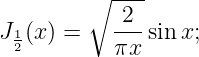 analogically (6) yields 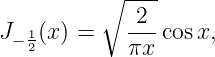 and the general solution of the equation (1) for p =  In the case that p is a non-negative integer n, the “+” case of (7) gives the solution  but for p = −n the expression of J−n(x) is (−1)nJ
n(x), i.e. linearly dependent of Jn(x).
It can be shown that the other solution of (1) ought to be searched in the form
y = Kn(x) = Jn(x) ln x + x−n ∑
k=0∞b
kxk. Then the general solution is y := C
1Jn(x) + C2Kn(x). Other formulae The first kind Bessel functions of integer order have the generating function F:
This function has an essential singularity at t = 0 but is analytic elsewhere in ℂ; thus F has the Laurent expansion in that point. Let us prove (8) by using the general expression 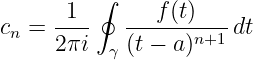 of the coefficients of Laurent series. Setting to this a := 0, f(t) := e  The paths γ and δ go once round the origin anticlockwise in the t-plane and ζ-plane, respectively.
Since the residue of ζ−m−n−1eζ in the origin is  This means that F has the Laurent expansion (8). By using the generating function, one can easily derive other formulae, e.g. the integral representation of the Bessel functions of integer order:  Also one can obtain the addition formula 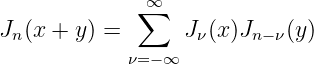 and the series representations of cosine and sine: 
 References
"Bessel equation" is owned by pahio. This object's parent. Cross-references: formula, function, gamma function, Bessel function, power series, system, powers, parameter, differential equation This is version 1 of Bessel equation, born on 2009-04-19. Object id is 682, canonical name is BesselEquation. Accessed 2166 times total. Classification:
|
|
|
|
Pending Errata and AddendaNone.
|
DiscussionNo messages.
|
Interact |
![[parent]](https://images.physicslibrary.org/images/uparrow.png)
 +
+  + (
+ (![(
| [r2 − p2]a = 0,
||| 2 0 2
||{ [(r + 1) − p ]a1 = 0,
[(r + 2)2 − p2]a2 + a0 = 0,
||
|||| ...
( [(r + k)2 − p2]ak + ak−2 = 0.](https://images.physicslibrary.org/cache/objects/682/make4ht/BesselEquation3x.png)

![[ 2 4 6 ]
1--x-----+ --------x---------− ------------x--------------+ − ...
2(2p+2 ) 2⋅4(2p+2 )(2p+4 ) 2⋅4⋅6(2p+2 )(2p+4 )(2p+6 )](https://images.physicslibrary.org/cache/objects/682/make4ht/BesselEquation8x.png)
 , we get
the second particular solution, gotten of (5) by replacing
, we get
the second particular solution, gotten of (5) by replacing ![[ 2 4 6 ]
----x----- ---------x----------- ---------------x----------------
1− 2(− 2p+2 )+ 2⋅4(− 2p+2 )(− 2p+4 )− 2⋅4⋅6(− 2p+2 )(− 2p+4 )(− 2p+6 )+ − ...](https://images.physicslibrary.org/cache/objects/682/make4ht/BesselEquation12x.png)

 .
.
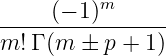

 the series in (5) gets the form
 is
is


 gives
gives
 =
=  , the residue theorem
gives
, the residue theorem
gives