Let
be a vector field in ℝ3 and let a be a portion of some surface in the vector field. Define one side
of a to be positive; if a is a closed surface, then the positive side must be the outer
surface of it. For any surface element da of a, the corresponding vectoral surface element
is
where n is the unit normal vector on the positive side of da.
The flux of the vector U through the surface a is the surface integral
Remark. One can imagine that U represents the velocity vector of a flowing liquid; suppose that
the flow is stationary, i.e. the velocity U depends only on the location, not on the time. Then the
scalar product U ⋅ da is the volume of the liquid flown per time-unit through the surface element
da; it is positive or negative depending on whether the flow is from the negative side to the positive
side or contrarily.
Example. Let U = xi + 2yj + 3zk and a be the portion of the plane x + y + x = 1 in the first
octant (x ≧ 0, y ≧ 0, z ≧ 0) with the positive normal away from the origin.
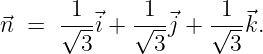
One has the constant unit normal vector:
The flux of U through a is
However, this surface integral may be converted to one in which a is replaced by its projection A
on the xy-plane, and da is then similarly replaced by its projection dA;
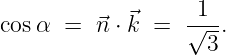
where α is the angle between the normals of both surface elements, i.e. the angle between n and
k:
Then we also express z on a with the coordinates x and y: