Physics Library
 An open source physics library
Encyclopedia | Forums | Docs | Random  

Heaviside formula

(Definition)

Let P(s) and Q(s) be polynomials with the degree of the former less than the degree of the latter.

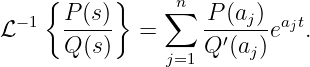
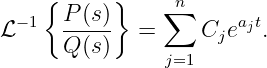
  • If all complex zeroes a1, a2, …, an of Q(s) are simple, then
        {      }    n
 − 1  P-(s)-    ∑   -P(aj)- ajt
ℒ     Q (s )  =     Q ′(aj) e  .
                j=1
    (1)

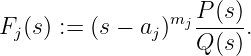
  • If the different zeroes a1, a2, …, an of Q(s) have multiplicities m1, m2, …, mn, respectively, define
                     mjP-(s)
Fj (s) := (s − aj) Q (s).

    Then

        {      }    n      mj−1  (k)    mj− 1− k
 − 1  P-(s-)    ∑    ajt∑    Fj--(aj)t--------
ℒ     Q (s )  =     e        k!(mj  − 1 − k)!.
                j=1     k=0
    (2)

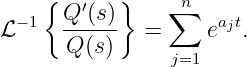
A special case of the Heaviside formula (1) is

    {   ′  }    ∑n
ℒ− 1  Q-(s)- =      eajt.
      Q (s)     j=1
(3)

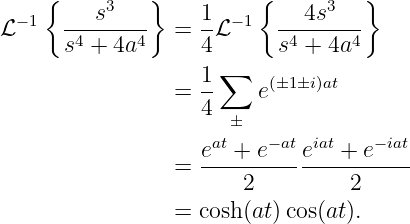
Example. Since the zeroes of the binomial s4 + 4a4 are s = (±1 ± i)a, we obtain

    {         }          {         }
  −1  ---s3---     1- −1   --4s3---
ℒ     s4 + 4a4   = 4ℒ      s4 + 4a4
                     ∑
                 = 1-    e(±1±i)at
                   4  ±
                    at   − at iat    −iat
                 = e--+-e----e--+--e----
                       2         2
                 = cosh(at)cos(at).
(4)

Proof of (1). Without loss of generality, suppose that Q(s) is monic. Therefore

Q (s) = (s − a1)(s − a2) ⋅⋅⋅(s − an ).
(5)

For j = 1, 2, …, n, write

Q (s) = (s − aj)Qj (s),
(6)

so that Qj(aj)≠0.

We have a partial fraction expansion of the form

P-(s)   --C1--    -C2---        --Cn---
Q (s) = s − a1 +  s − a2 + ⋅⋅ ⋅ + s − an,
(7)

with constants Cj. By linearity of the inverse Laplace transform,

    {      }     n
 − 1  P-(s-)    ∑       ajt
ℒ     Q (s )  =     Cje   .
                j=1
(8)

To determine the constants Cj, multiply the partial fraction expansion by s − aj. This gives

-P-(s-)                ∑   --Cν---
Qj (s) = Cj + (s − aj)    s − aν.
                      ν⁄=j
(9)

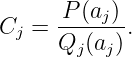
Setting s = aj gives

Cj =  P-(aj).
      Qj(aj)
(10)

Since

         d
Q ′(s) =  --((s − aj)Qj (s)) = Qj (s) + (s − aj)Q ′j(s),
         ds
(11)

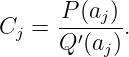
we have Q′(aj) = Qj(aj). Hence

Cj =  P-(aj).
      Q ′(aj)
(12)

Substituting these values into the inverse Laplace expansion yields formula (1).

References

[1]   K. Väisälä, Laplace-muunnos. Handout Nr. 163. Teknillisen korkeakoulun ylioppilaskunta, Otaniemi, Finland (1968).


"Heaviside formula" is owned by pahio.
(view preamble)
View style:

Cross-references: formula, Laplace transform

This is version 2 of Heaviside formula, born on 2009-04-17, modified 2026-09-05.
Object id is 644, canonical name is HeavisideFormula.
Accessed 1551 times total.

Classification:
Physics Classification: 02.30.Uu (Integral transforms)

Pending Errata and Addenda

None.

Discussion

No messages.

Interact