Here we repeat the arguments from the wave equation of a particle in a scalar potential
and extend it to a more general case where the potential V is an explicit function of
time, specifically a particle with charge e in an electromagnetic field derived from a
vector potential A(r,t) and a scalar potential ϕ(r,t). In the latter case, the classical
relation
must be replaced by the relation
Considerations of the behavior of wave packets on the ”geometrical optics” approximation lead us
to the wave equation
It is the Schrödinger equation of a charged particle in an electromagnetic field. On the right hand
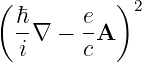
side of equation (3), the operator
designates the scalar product of the vector operator  ∇−
∇− A by itself; in other words, the function
which results from its action on Ψ is the sum of the expression
A by itself; in other words, the function
which results from its action on Ψ is the sum of the expression
and of two other expressions which are obtained from it by substituting y and z for x,
namely
In all of this one must realize that the components of the operator ∇ and those of the operator A
do not in general commute with each other.
The Schrödinger equation for a particle in a potential V (r),
and equation (3) are the generalizations of the wave equation of a free particle and the same
remarks apply to them. They are indeed linear, homogeneous, partial differential equations of the
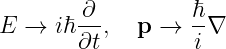
first order in the time. Furthermore, they can be deduced from the classical relations by the
correspondence relation
0.1 References
[1] Messiah, Albert. ”Quantum mechanics: volume I.” Amsterdam, North-Holland Pub. Co.; New
York, Interscience Publishers, 1961-62.
This entry is a derivative of the Public domain work [1].



![[ ( )2 ]
iℏ ∂-Ψ (r,t) = -1-- ℏ-∇ − eA + eϕ Ψ (r,t)
∂t 2m i c](https://images.physicslibrary.org/cache/objects/632/make4ht/WaveEquationOfAChargedAParticleInAnElectromagneticField2x.png)