0.1 Molecular sets and representations of chemical reactions
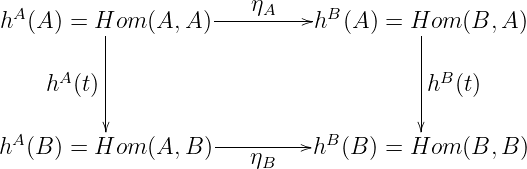
A uni-molecular chemical reaction is represented by the natural transformations η : hA→hB,
through the following commutative diagram:
with the states of molecular sets Au = a1,…,an and Bu = b1,…bn being represented by certain
endomorphisms in Hom(A,A) and Hom(B,B), respectively. In general, molecular sets MS are
defined as finite sets whose elements are molecules defined in terms of their molecular observables
that are specified next. One need to define first the concept of a molecular class variable. A
molecular class variable, or m.c.v is defined as a family of molecular sets [MS]i∈I, with I being an
indexing set, or class, defining the molecular range of variation of the m.c.v. Most applications in
Physics, Chemistry or Biochemistry require that I is a finite set, (that is, without any sub-classes).
A homomorphism of molecular sets Mt : MS → MS, with t ∈ T being real time values, is
defined as a time-dependent mapping or function MS(t) also called a Mt molecular
transformation.
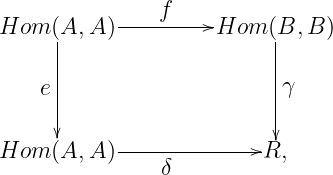
An m.c.v. observable of B, characterizing the products of chemical type “B” of a chemical reaction
is defined as a morphism:
where ℜ is the set or field of real numbers. This mcv-observable is subject to the following
commutativity conditions:
with c : Au∗→B
u∗, and A
u∗, B
u∗ being, respectively, specially prepared fields of states of the
molecular sets Au, and Bu within a measurement uncertainty range, Δ, which is determined by
Heisenberg’s uncertainty relation, or the commutator of the observable operators involved, such as
[A∗,B∗], associated with the observable A of molecular set A
u, and respectively, with the
obssevable B of molecular set Bu, in the case of a molecular set Au interacting with molecular set
Bu.
With these concepts and preliminary data one can now define the category of molecular sets and
their transformations as follows.
0.2 Category of molecular sets and their transformations
Definition 0.1. The category of molecular sets is defined as the category CM whose objects
are molecular sets MS and whose morphisms are molecular transformations Mt.
Remark 0.1. This is a mathematical representation of chemical reaction systems in terms
of molecular sets that vary with time (or msv’s), and their transformations as a result of
diffusion, collisions, and chemical reactions.
References
[1] Bartholomay, A. F.: 1960. Molecular Set Theory. A mathematical representation for
chemical reaction mechanisms. Bull. Math. Biophys., 22: 285-307.
[2] Bartholomay, A. F.: 1965. Molecular Set Theory: II. An aspect of biomathematical
theory of sets., Bull. Math. Biophys. 27: 235-251.
[3] Bartholomay, A.: 1971. Molecular Set Theory: III. The Wide-Sense Kinetics of
Molecular Sets ., Bulletin of Mathematical Biophysics, 33: 355-372.
[4] Baianu, I. C.: 1983, Natural Transformation Models in Molecular Biology., in
Proceedings of the SIAM Natl. Meet., Denver, CO.; Eprint at cogprints.org with No. 3675.
[5] Baianu, I.C.: 1984, A Molecular-Set-Variable Model of Structural and Regulatory
Activities in Metabolic and Genetic Networks FASEB Proceedings 43, 917.