
|
|
|
|||||||
One have to find for (1) a solution function u which satisfies the initial condition
and the boundary condition
For finding a simple solution of the differential equation (1) we try the form
whence the boundary condition reads
Substituting (4) in (1) and dividing this equation by XY T give the form
It’s easily understood that such a condition requires that the both addends of the left side and the right side ought to be constants:
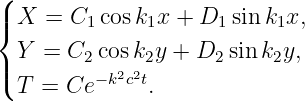
where k2 = k 12 + k 22. We soon explain why these constants are negative. Because the equations (7) may be written  the general solutions of these ordinary differential equations are
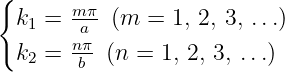
Now we remark that if the right side of the third equation (7) were +k2, then we had T = Cek2c2t which is impossible, since such a T and along with this also the temperature u = XY T would ascend infinitely when t →∞. And since, by symmetry, the right sides the two first equations (7) must have the same sign, also they must by (6) be negative. The two first boundary conditions (5) imply by (8) that C1 = C2 = 0, and then the two last conditions (5) require that  If we had D1 = 0 or D2 = 0, then X or Y would vanish identically, which cannot occur. Thus we have  whence only the eigenvalues
are possible for the obtained X and Y . Considering the equation k2 = k 12 + k 22 we may denote
for all m, n ∈ ℤ+. Altogether we have infinitely many solutions  of the equation (1), where the coefficients cmn are, for the present, arbitrary constants. These solutions fulfil the boundary condition (3). The sum of the solutions, i.e. the double series
provided it converges, is also a solution of the linear differential equation (1) and fulfils the boundary condition. In order to fulfil also the initial condition (2), one must have  But this equation presents the Fourier double sine series expansion of f(x, y) in the rectangle A, and therefore we have the expression
for the coefficients. The result of calculating the solution of our problem is the temperature function (10) with the formulae (9) and (11). References
"time-dependent example of heat equation" is owned by bloftin. [ full author list (2) ] This object's parent. Cross-references: ordinary differential equations, differential equation, heat equation, heat, two-dimensional, boundaries, function, temperature This is version 2 of time-dependent example of heat equation, born on 2007-08-10, modified 2007-08-10. Object id is 257, canonical name is TimeDependentExampleOfHeatEquation. Accessed 2918 times total. Classification:
|
|
|
|
Pending Errata and AddendaNone.
|
DiscussionNo messages.
|
Interact |
![[parent]](https://images.physicslibrary.org/images/uparrow.png)



 +
+  =
= 

 =
=  =
= 
 =
= 
![[( ) ( ) ]
m-π- 2+ n-π 2
a b](https://images.physicslibrary.org/cache/objects/257/make4ht/TimeDependentExampleOfHeatEquation16x.png)
 sin
sin 

 sin
sin 