
|
|
|
|||||||
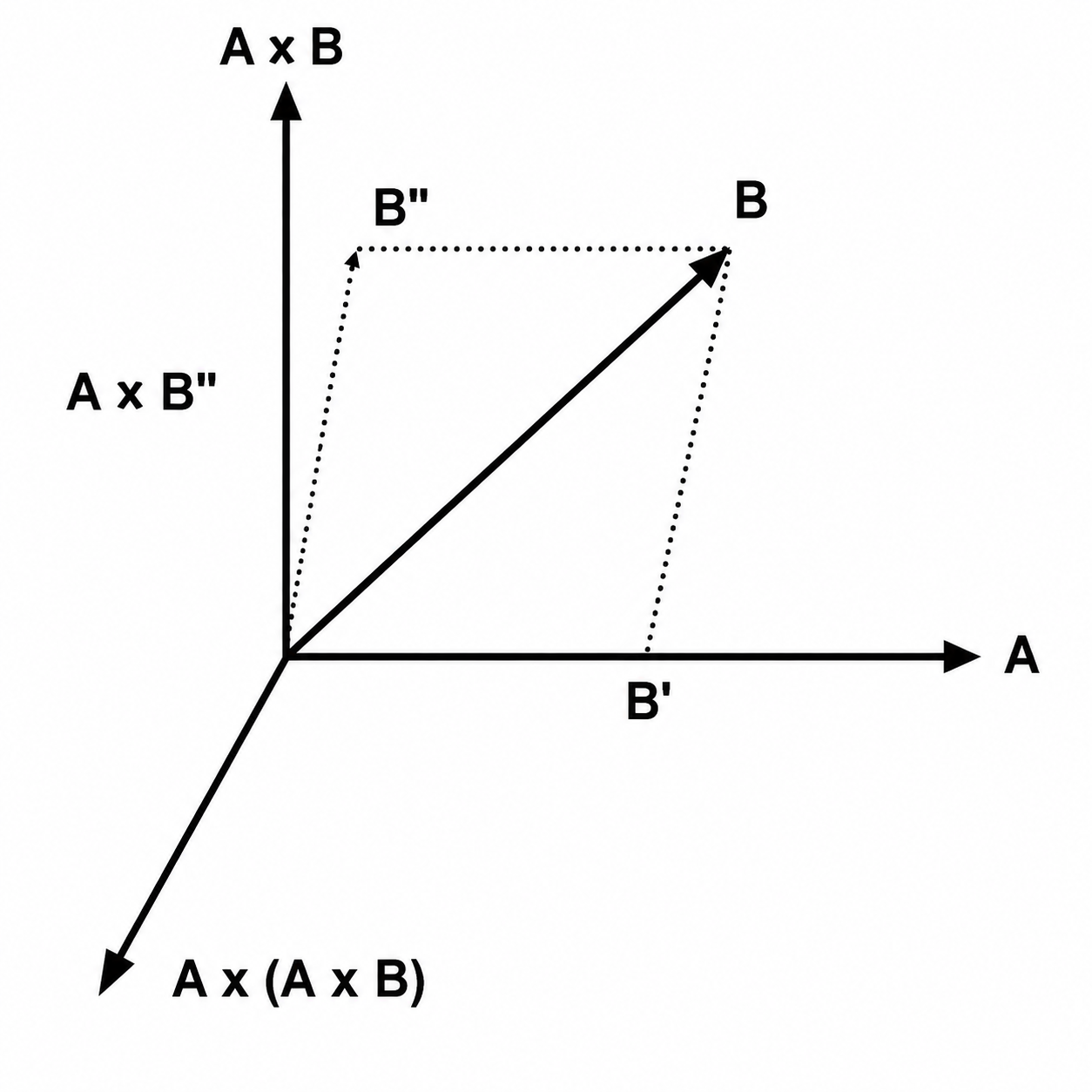
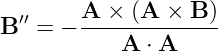
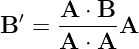
The component of B perpendicular to A has been expressed in terms of the vector triple product of A, A, and B. The component B′ parallel to A is found using the dot product as a projection and leads to
Hence
Next, consider the product when two of the vectors are the same. By equation (3)
Or
This proves the formula in case two vectors are the same.
1.2 Property I .The vector triple product A ×
 To prove this, express A in terms of the three non-coplanar vectors B, C, and
where a, b, c are scalar constants. Then
The vector product of any vector by itself is zero. Hence
 so
Using the relationship developed under the geometric interpretation
 with different vectors yields

 Hence
But from (1)

 using a property from the scalar triple product

 we get

 Substituting these values into (4)
Finally, noting that the dot product gives a scalar, we can use the Vector Identity  to get
The relation is therefore proved for any three vectors A, B and C and is often referred to as the BACK CAB rule.
1.3 Property II.From the three letters A, B, C by different arrangements, four allied products in each of which B and C are included in parentheses may be formed. These are



 As a vector product changes its sign whenever the order of two factors is interchanged, the above products evidently satisfy the equations
 The expansion for a vector triple product in which the parenthesis comes first may therefore be obtained directly from that already found when the parenthesis comes last.
 The formulas then become

 These reduction formulas are of such constant occurrence and great importance that they should be committed to memory.
1.4 References[1] Wilson, E. ”Vector Analysis.” Yale University Press, New Haven, 1913. "Vector Triple Product" is owned by bloftin.
This object's parent. Cross-references: work, domain, relation, Vector Identity, formula, dot product, unit vector, Light, scalar triple product, cross product, scalars, vector product, vectors There are 3 references to this object. This is version 8 of Vector Triple Product, born on 2006-07-24, modified 2026-08-22. Object id is 209, canonical name is VectorTripleProduct. Accessed 11577 times total. Classification:
|
|
|
|
Pending Errata and AddendaNone.
|
DiscussionNo messages.
|
Interact |
![[parent]](https://images.physicslibrary.org/images/uparrow.png)


 is perpendicular to
  . But
. But  is perpendicular to
the plane of
is perpendicular to
the plane of  , being perpendicular to
  must lie in the plane
of
must lie in the plane
of 

 must lie in the plane of

 lies in the plane
of
lies in the plane
of  is opposite to that of







 may be expressed as the sum of two terms
as
may be expressed as the sum of two terms
as
 .
.



![A × (B × C) = [(bB ⋅ C + cC ⋅ C )B − (bB ⋅ B + cC ⋅ B )C ]](https://images.physicslibrary.org/cache/objects/209/make4ht/VectorTripleProduct33x.png)

