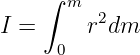
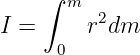
The moment of inertia of a body about an axis equals the sum of the products of the masses of the
particles of the body by the square of their distances from the axis. Thus if dm denotes an element
of mass of the body and r its distance from the axis then the following is the analytical statement
of the definition of moment of inertia:
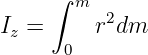
(1)
The integration which is involved in equation (1)is often simplified by a proper choice of the
element of mass. The choice depends upon the bounding surfaces of the body and the position of
the axis; therefore there is no general rule by which the most convenient element of
mass may be selected. There is one important point, however, which the student should
always keep in mind in selecting the element of mass, namely, the distances of the various
parts of the element of mass from the axis must not differ by more than infinitesimal
lengths.
The moment of inertia of a lamina about an axis which is perpendicular to its plane equals the sum
of the moments of inertia with respect to two rectangular axes which lie in the plane of the lamina
with their origin on the first axis.
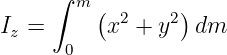
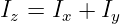
Suppose the lamina to be in the xy-plane, then the theorem states that the moment of inertia
about the z-axis equals the sum of the moments of inertia about the other two axes, that
is,
(2)
The following analysis explains itself.
It is evident from this theorem that when the lamina is rotated about the z-axis Ix and Iy change,
in general, but their sum remains constant.
Theorem II.
The moment of inertia of a body about any axis equals its moment of inertia about a parallel axis
through the center of massplus the product of the mass of the body by the square of the distance
between the two axes.
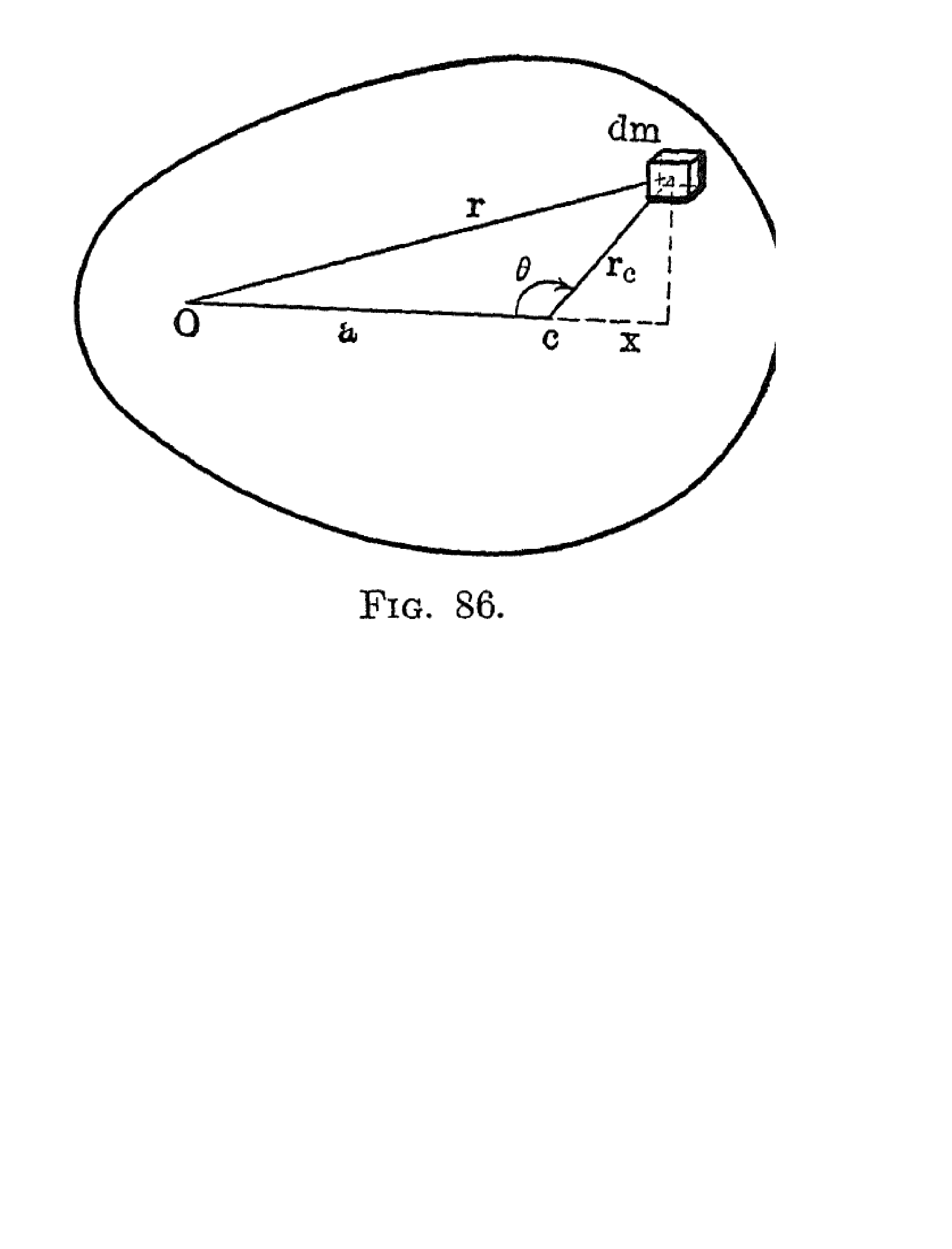
Let the axis be perpendicular to the plane of the paper and pass through the point O, Fig.
86.
Further let dm be any element of mass, r its distance from the axis through O, and rc its distance
from a parallel axis through the center of mass, C. We have
But by the definition of the center of mass ∫0mxdm = mx and in the present case the center of
mass is at the origin therefore x and consequently the last integral vanishes. Thus we
get
(3)
0.1 References
This article is a derivative of the public domain book, ”Analytical mechanics” by Haroutune M.
Dadourian, 1913. Made available by the internet archive
This is version 4 of moment of inertia, born on 2006-07-10, modified 2006-07-10.
Object id is 196, canonical name is MomentOfInertia.
Accessed 8466 times total.