|
|
|
|||||||
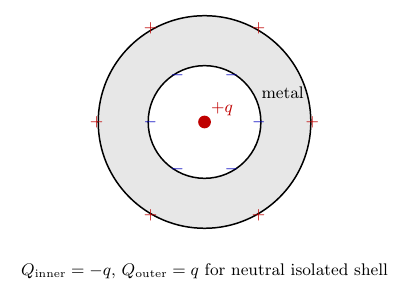
The conductor itself has charge Qc = Qinner + Qouter, so
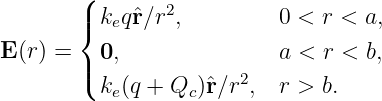
Because the charge is central and the boundaries concentric, induced surface densities are uniform: σa = −q∕(4πa2) and σ b = (Qc + q)∕(4πb2). Gauss’s Law gives
The singular point r = 0 is excluded. Note the cavity may have a strong nonzero field even while the metal has none.
Figure 1. A central charge creates negative induced charge on the cavity wall. An isolated neutral shell has compensating positive charge on its exterior.
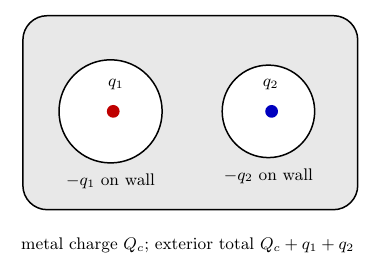
2 Ground the same shellWorked example 2. Now connect the shell to a large ground reservoir and take V = 0 on the metal. Keep the point charge q in the cavity, with no other external sources. The inner induced charge still totals −q from the metal Gaussian surface. The exterior region solves Laplace’s equation with V (b) = 0 and V (∞) = 0. The unique solution is V = 0 outside, hence E = 0 there and Qouter = 0. The conductor has acquired net charge −q through its connection to ground. This result relies on the absence of external source fields. Grounding by itself does not make every exterior Electric Field vanish. 3 Off-center point chargeWorked example 3. Displace the same point charge away from the cavity center while keeping it inside. A Gaussian surface in the metal still proves Qinner = −q. However, the induced inner surface density is no longer uniform. A single value σ = −q∕(4πa2) is generally incorrect. Determining σ(𝜃,ϕ) requires the boundary conditions and an image-charge or Green-function calculation. This demonstrates an important division of labor: Gauss’s law fixes the total induced charge, while the boundary-value solution fixes its distribution. 4 Several charges in one cavity and multiple cavitiesWorked example 4. Suppose a conductor contains two separate cavities, with total charges q1 and q2 in them. For each cavity, choose a Gaussian surface entirely in the surrounding conducting material. The total induced charge on the respective cavity walls is −q1 and −q2. For an isolated conductor with total metal charge Qc, its outer surface then carries
No assumption about the shapes of the cavities was needed. If all enclosed cavity charges sum to zero, the exterior total charge is Qc, yet the detailed exterior field may still be nontrivial in the presence of nonsymmetric external fields.
Figure 2. Independent cavity Gaussian surfaces constrain each inner-surface total, while the exterior total follows conductor charge conservation.
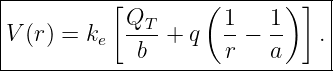
5 Potential continuity for the central shellFor the isolated concentric geometry of Example 1, choose V (∞) = 0 and let QT = q + Qc. For r > b, V = keQT ∕r. In the metal V = keQT ∕b. For r < a, integrate the cavity field:
At r = a, this reduces to the metal potential, verifying continuity. Its derivative recovers the cavity field. The absolute potential differs when grounded, but the field within the cavity is unchanged for this centered-charge, no-external-source configuration. 6 Exercises and worked answersExercise 1. A neutral isolated shell encloses −2 nC. Find inner and outer charges. Solution. Qinner = +2 nC and Qouter = −2 nC. Exercise 2. The same shell is grounded with no external sources. Find its exterior field. Solution. The exterior potential is the unique solution V = 0 under the stated boundary conditions, giving E = 0; Qouter = 0. Exercise 3. A conductor has cavities containing q1 = +3 nC and q2 = −5 nC and metal net charge Qc = +2 nC. Find the surface totals. Solution. The inner surfaces have −3 and +5 nC. The exterior has 2 + 3 − 5 = 0 nC. Exercise 4. Does zero total outer-surface charge prove zero exterior field for an arbitrary nonspherical conductor in an applied field? Solution. No. A distribution of positive and negative surface charge may have zero total while generating a nonzero multipole field. The boundary-value solution is needed. References
"Conducting Cavities, Shells, and Grounding" is owned by bloftin.
This object's parent. Cross-references: charge conservation, boundary conditions, Electric Field, Gaussian surface, positive charge, central charge, Gauss's Law, boundaries, flux, net charge, conductor, charge There are 9 references to this object. This is version 1 of Conducting Cavities, Shells, and Grounding, born on 2026-11-28. Object id is 1636, canonical name is ConductingCavitiesShellsAndGrounding. Accessed 15 times total. Classification:
|
|
|
|
Pending Errata and AddendaNone.
|
DiscussionNo messages.
|
Interact |