|
|
|
|||||||
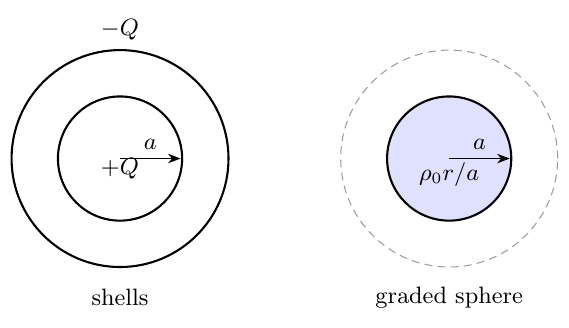
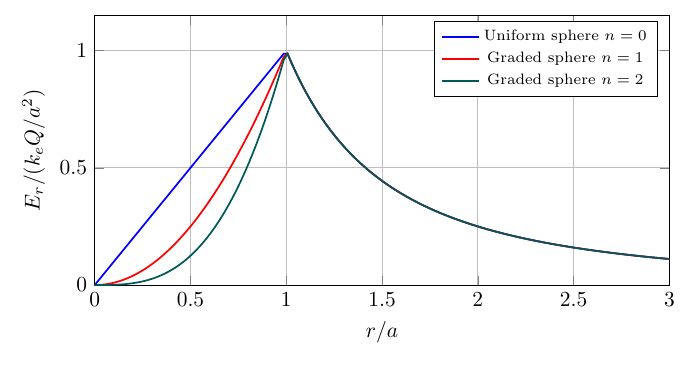
Therefore its radial field is keQr2∕a4 for r ≤ a and k eQ∕r2 outside. This field is continuous at a and rises quadratically from zero. Check. In the shared interval a < r < b both systems enclose exactly Q and have identical fields. Beyond b the fields differ because only the shells have zero net charge.
3 Practice variationGive the solid sphere the same exterior shell of charge −Q at b. Which parts of its field change? Solution. The fields for r < b stay fixed by spherical symmetry and Gauss’s law. For r > b the net charge vanishes, so the field is zero.
4 Separate enclosed charge from the flux areaThe radial field is the signed outward component E ⋅r. The Gaussian sphere has area 4πr2, distinct from the source shell element 4πs2 ds. The density factor s∕a turns the latter into a cubic integrand. At r = a, integration gives Q = πρ0a3. The interior field increases as r2 because the enclosed charge increases as r4 while the flux area increases as r2. For either ideal shell, E r is interpreted through one-sided values at the charged radius.
5 Worked example 2: compare the voltages at the centerUse V (∞) = 0 for both finite systems. For the shell pair the only radial field is in the gap, so the center value is
For the graded ball, the exterior contributes keQ∕a. The interior contributes keQ∫ 0a(r2∕a4) dr = k eQ∕(3a). Hence V B(0) = 4keQ∕(3a). Even in the interval with identical fields the potentials can differ by a constant if the reference is common and the exterior charges differ.
6 Additional worked example 3: an entire family of graded spheresLet the charge density in a nonconducting ball of radius a be
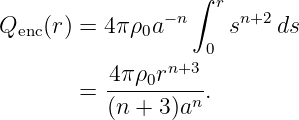
The spherical volume element is 4πs2ds. The enclosed charge is
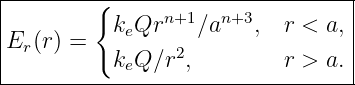
With total charge Q = 4πρ0a3∕(n + 3), the Electric Field becomes
For n = 0 the field increases linearly inside. For n = 1 it increases quadratically, giving the original graded sphere. For n = −1, the density is integrable near zero and the interior field has a finite nonzero radial magnitude; the vector field has no unique limit at the exact center, so do not silently call it continuous there. For n < −1, an integrable source may nevertheless have a singular local field at the center.
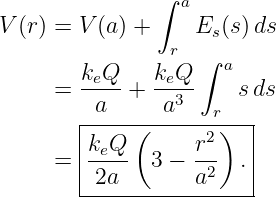
7 Additional worked example 4: potential inside a uniform charged ballTake a uniform-density sphere with total charge Q > 0 and radius a. The field is keQr∕a3 inside and keQ∕r2 outside. Use V (∞) = 0, so the exterior potential is k eQ∕r and V (a) = keQ∕a. For an interior point, integrate the field from r to a:
Differentiation yields −dV∕dr = keQr∕a3, and both V and its derivative join continuously at r = a. The potential remains finite at the center, 3keQ∕(2a).
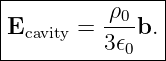
8 Additional worked example 5: the eccentric spherical cavityTake a uniform charge-filled sphere with density ρ0 and create an off-center spherical cavity whose center is displaced by a vector b from the original center. The cavity lies wholly inside the original ball. To compute the field in the cavity, superpose a full sphere of density ρ0 and a second, hypothetical sphere of density −ρ0 filling exactly the cavity. At a point inside the cavity,
Adding cancels the position-dependent parts:
This uniform field is generally not zero. A single Gaussian surface around the displaced cavity cannot determine it, because the actual source is not spherically symmetric. Gauss’s law is used first on two symmetric building blocks, and then the fields are superposed.
Figure 2. Normalized fields in uniformly and radially graded spheres of equal radius and total charge. All meet the point-charge exterior field at the surface.
9 More practice with solutionsExercise 3. For n = 2, what fraction of the total charge is enclosed by r = a∕2? Solution. The charge fraction is (r∕a)n+3 = (1∕2)5 = 1∕32. Exercise 4. What is the potential difference between center and surface of the uniform sphere? Solution. From Equation (6), V (0) − V (a) = 3keQ∕(2a) − keQ∕a = keQ∕(2a).
10 ExercisesExercise 1. Compare the ball’s field at r = a∕2 and r = 2a. Solution. The inside gives keQ(a∕2)2∕a4 = k eQ∕(4a2). The exterior gives k eQ∕(2a)2, equal in this case. Exercise 2. What jump occurs at the outer ideal shell in system A? Solution. The outside field is zero and the inside is keQ∕b2. The jump is −k eQ∕b2 = σ b∕𝜖0 because σb = −Q∕(4πb2).
References
References
"Fields of Nested Spherical Shells and a Graded Sphere" is owned by bloftin.
This object's parent. Cross-references: potential difference, Gaussian surface, vector, vector field, magnitude, Electric Field, spherical volume element, charge density, flux, spherical symmetry, net charge, volume element, Gauss's Law, enclosed charge, charge, solid, system This is version 1 of Fields of Nested Spherical Shells and a Graded Sphere, born on 2026-11-27. Object id is 1623, canonical name is FieldsOfNestedSphericalShellsAndAGradedSphere. Accessed 5 times total. Classification:
|
|
|
|
Pending Errata and AddendaNone.
|
DiscussionNo messages.
|
Interact |