1 Gaussian Co-Ordinates
From Relativity: The Special and General Theory by Albert Einstein.
According to Gauss, this combined analytical and geometrical mode of handling the problem can
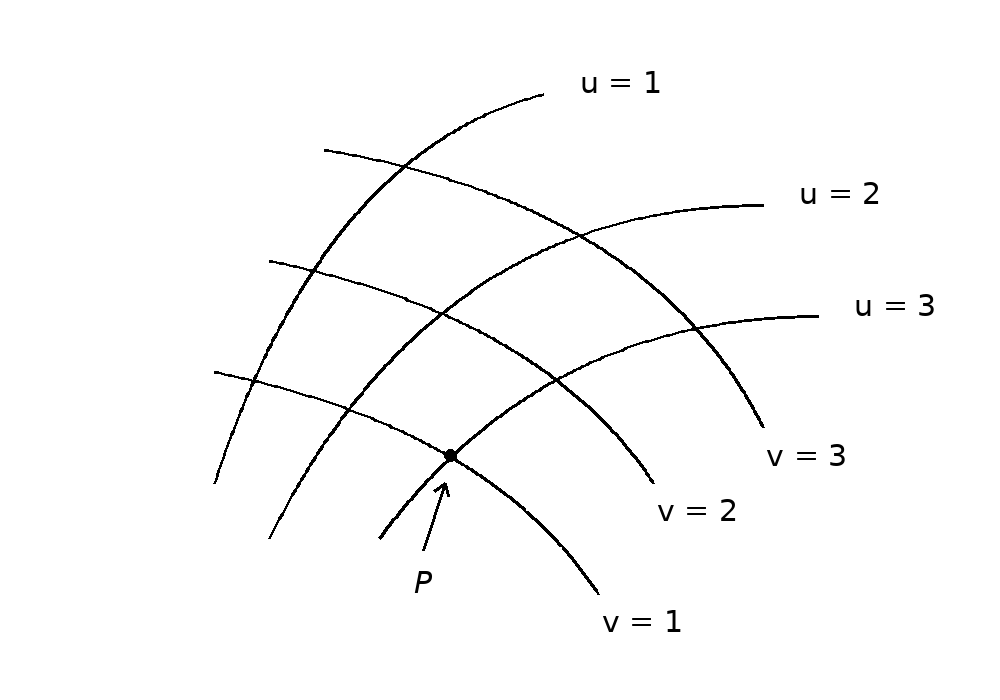
be arrived at in the following way. We imagine a system of arbitrary curves (see the diagram
above) drawn on the surface of the table. These we designate as u-curves, and we indicate each of
them by means of a number. The curves u = 1, u = 2, and u = 3 are drawn in the diagram.
Between the curves u = 1 and u = 2 we must imagine an infinitely large number to be drawn, all of
which correspond to real numbers lying between 1 and 2. We have then a system of u-curves, and
this “infinitely dense” system covers the whole surface of the table. These u-curves must not
intersect each other, and through each point of the surface one and only one curve must pass.
Thus a perfectly definite value of u belongs to every point on the surface of the marble
slab.
In like manner we imagine a system of v-curves drawn on the surface. These satisfy the same
conditions as the u-curves, they are provided with numbers in a corresponding manner, and they
may likewise be of arbitrary shape. It follows that a value of u and a value of v belong to every
point on the surface of the table. We call these two numbers the co-ordinates of the surface of the
table (Gaussian co-ordinates). For example, the point P in the diagram has a particular pair of
Gaussian co-ordinates (u,v).
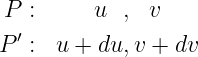
Two neighbouring points P and P′ on the surface then correspond to the co-ordinates
where du and dv signify very small changes. In a similar manner we may indicate the distance
(line-interval) between P and P′, as measured with a little rod, by the very small number ds.
Then, according to Gauss, the most general quadratic form for the line element in two dimensions
is
where g11, g12, and g22 are quantities that depend in a perfectly definite way on u and v. These
quantities determine the metric relations of the surface relative to the u-curves and
v-curves.
For the case in which the points of the surface considered form a Euclidean continuum with
reference to the measuring rods, it is possible to choose the u-curves and v-curves and attach
numbers to them in such a manner that
Under these conditions, the u-curves and v-curves are straight lines in the sense of Euclidean
geometry, and they are perpendicular to each other. Here the Gaussian co-ordinates are simply
Cartesian ones. It is clear that Gaussian co-ordinates are nothing more than an association of
two sets of numbers with the points of the surface considered, of such a nature that
numerical values differing very slightly from each other are associated with neighbouring
points.
So far, these considerations hold for a continuum of two dimensions. But the Gaussian method can
also be applied to a continuum of three, four, or more dimensions. If, for instance, a
continuum of four dimensions is considered, we may associate with every point four
numbers,
which are known as co-ordinates. Adjacent points correspond to adjacent values of the
co-ordinates. If a distance ds is associated with adjacent points P and P′, this distance being
measurable and well defined from a physical point of view, then the line element may be
written
where the coefficients gμν vary with position in the continuum.
Only when the continuum is Euclidean is it possible to choose the co-ordinates so that, throughout
the region under consideration,
In this case relations hold in the four-dimensional continuum which are analogous to those holding
in ordinary Euclidean measurements.
The Gaussian treatment of ds2 is local: sufficiently small regions of a smooth continuum can be
described by co-ordinates and a metric whose coefficients encode the local distance relations. For
example, this applies to the marble-slab illustration when the temperature is nearly constant over a
sufficiently small region.
We can sum this up as follows: Gauss developed a method for the mathematical treatment of
continua in which “size-relations,” or distances between neighbouring points, are defined. To every
point of a continuum are assigned as many numbers (Gaussian co-ordinates) as the continuum has
dimensions. The Gaussian coordinate system is a generalisation of the Cartesian coordinate system
and is applicable to non-Euclidean continua through the position-dependent metric coefficients
gμν.
2 References
This article is derived from the Einstein Reference Archive (marxists.org), 1999, 2002. Einstein
Reference Archive which is under the FDL copyright.

![[parent]](https://images.physicslibrary.org/images/uparrow.png)