Physics Library
 An open source physics library
Encyclopedia | Forums | Docs | Random  

[parent] GRE Physics Companion: Fourier Analysis, Wave Packets, and Dispersion

(Example)

GRE Physics Companion: Fourier Analysis, Wave Packets, and Dispersion

A wave packet can be represented as

|------------∫--------------------|
ψ (x,t) = 1--   A(k)ei[kx−ω(k)t]dk. |
----------2π-----------------------
(1)

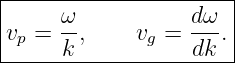
The central velocities are

|----------------------|
|     ω            dω  |
|vp = --,    vg =  ---.|
------k------------dk--
(2)

PIC

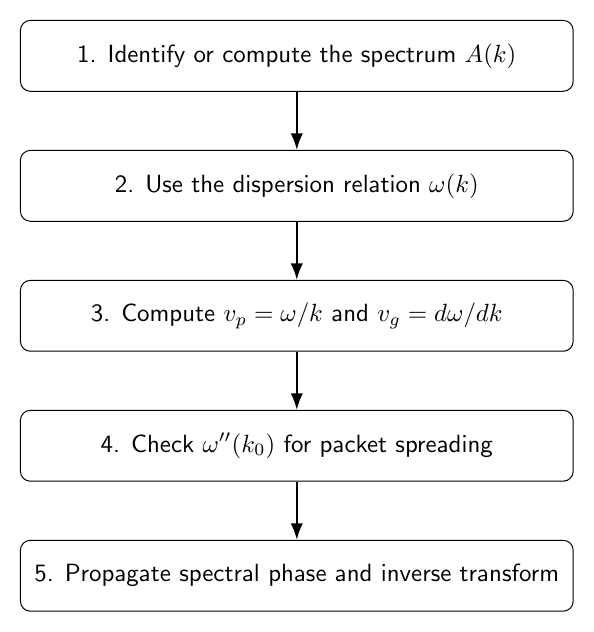
Figure 1. A compact Fourier-wave strategy: identify the spectrum, use the dispersion relation to evolve each component, compute phase and group velocities, and use curvature of ω(k) to diagnose packet spreading.

1 High-value GRE facts

  1. A localized disturbance requires a range of wave numbers.
  2. vp = ω∕k.
  3. vg = dω∕dk.
  4. A linear dispersion relation gives vp = vg.
  5. Nonzero d2ω∕dk2 produces leading-order narrowband spreading.
  6. For a Gaussian amplitude, narrow spatial width means broad spectral width.
  7. A real field has conjugate-symmetric complex Fourier coefficients.
  8. Linear propagation changes spectral phase even when spectral magnitude is unchanged.
  9. Parseval’s relation equates quadratic content in real and spectral representations.
  10. A discrete normal-mode sum becomes a Fourier integral in the infinite-domain limit.

Part I: Original GRE-style problems

Problem 1: phase velocity

For a Fourier component with frequency

ω
(3)

and wave number

k,
(4)

the phase velocity is

  1. dω∕dk
  2. ω∕k
  3. k∕ω
  4. d2ω∕dk2
  5. always zero

Problem 2: group velocity

For a narrowband packet, the envelope velocity is

  1. ω∕k
  2. k∕ω
  3. dω∕dk
  4. d2ω∕dk2
  5. ωk

Problem 3: nondispersive relation

Which dispersion relation is nondispersive for positive

k?
(5)

  1. ω = ck
  2. ω = αk2
  3. ω = √ --
  k
  4. ω = ω0 + αk2
  5. ω = 1∕k

Problem 4: Gaussian localization

If a Gaussian amplitude has characteristic spectral width

σk,
(6)

its characteristic spatial amplitude width is

  1. σk
  2. 1∕σk
  3. σk2
  4. 2πσk
  5. independent of σk

Problem 5: two-wave envelope

For two nearby components, the finite-difference envelope velocity is

  1. Δk∕Δω
  2. Δω∕Δk
  3. ω1∕k2
  4. ω2∕k1
  5. zero

Problem 6: spectral evolution

In an ideal linear time-invariant dispersive system, the spectrum evolves as

  1. A(k,t) = A(k, 0)e−iω(k)t
  2. A(k,t) = A(k, 0)e−ikt
  3. A(k,t) = A(k, 0) + ωt
  4. A(k,t) = 0
  5. A(k,t) = A(k, 0)e+k2t necessarily

Problem 7: packet spreading

Leading-order narrowband spreading is controlled by

  1. ω
  2. k
  3. dω∕dk
  4. d2ω∕dk2
  5. only the wave amplitude

Problem 8: lattice phase velocity

For the monatomic chain example with

a = 0.100 mm,    κ = 400 mN  ∕m,   m  = 1.00mkg,
(7)

and

ka = π ∕2,
(8)

the phase velocity is closest to

  1. 1.00 m/s
  2. 1.41 m/s
  3. 1.80 m/s
  4. 2.00 m/s
  5. 2.83 m/s

Problem 9: lattice group velocity

For the same lattice state, the group velocity is closest to

  1. 1.00 m/s
  2. 1.41 m/s
  3. 1.80 m/s
  4. 2.00 m/s
  5. 2.83 m/s

Problem 10: real field symmetry

For a real periodic field with complex Fourier coefficients,

  1. c−n = cn
  2. c−n = −cn
  3. c−n = cn∗
  4. c−n = 0
  5. cn must be real for every n

Problem 11: Parseval meaning

Parseval’s relation states that

  1. only the zero-frequency component matters
  2. a quadratic norm can be computed equivalently in real or spectral space
  3. every waveform has one Fourier component
  4. phase and group velocities are equal
  5. dispersion is impossible

Problem 12: Gaussian width after dispersion

A Gaussian amplitude has

σx(0) = 0.500mm,       ω′0′= 0.400 mm2  ∕s.
(9)

After

t = 1.00 ms,
(10)

its quadratic-dispersion width is closest to

  1. 0.250 m
  2. 0.500 m
  3. 0.707 m
  4. 0.943 m
  5. 1.60 m

Part II: Complete worked solutions

Solution 1

A constant phase satisfies

kx − ωt = constant.
(11)

Therefore

vp = ω-.
     k
(12)

Answer: (B).

Solution 2

The narrowband envelope velocity is

     d ω
vg = ---.
      dk
(13)

Answer: (C).

Solution 3

If

ω = ck,
(14)

then

vp = c,    vg = c,
(15)

and

ω′′ = 0.
(16)

Answer: (A).

Solution 4

For the amplitude convention used here,

σxσk =  1.
(17)

Thus

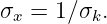
σx =  1∕σk.
(18)

Answer: (B).

Solution 5

The slowly varying envelope has phase

Δk  x − Δ ω t.
(19)

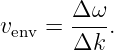
Therefore

v   =  Δ-ω-.
 env   Δk
(20)

Answer: (B).

Solution 6

Each Fourier component acquires its own propagation phase:

                 −iω(k)t
A(k, t) = A (k,0)e      .
(21)

Answer: (A).

Solution 7

The first derivative moves the envelope. The second derivative produces leading-order narrowband spreading. Therefore the controlling quantity is

 2     2
d ω ∕dk .
(22)

Answer: (D).

Solution 8

At

ka = π ∕2,
(23)

k =  -π----≈ 15.71mm  − 1,
     0.200
(24)

and

ω = 40 sin (π ∕4) ≈ 28.28mrad  ∕s.
(25)

Hence

      28.28
vp ≈  -----≈  1.80mm  ∕s.
      15.71
(26)

Answer: (C).

Solution 9

vg = 2.00 cos(π∕4 ) ≈ 1.41 mm ∕s.
(27)

Answer: (B).

Solution 10

A real field requires conjugate symmetry:

       ∗
c−n = cn.
(28)

Answer: (C).

Solution 11

Parseval’s relation equates a quadratic norm in the two representations, up to the transform-convention factor. Answer: (B).

Solution 12

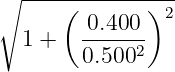
σx(t) = 0.500∘ ---------------
      ( 0.400 )2
  1 +   -----2-
        0.500 (29)
≈ 0.943 mm. (30)

Answer: (D).

2 GRE checklist

  1. Decide whether the problem concerns one Fourier component or a packet.
  2. Use vp = ω∕k for a phase point.
  3. Use vg = dω∕dk for a narrowband envelope.
  4. Check whether ω(k) is linear before assuming nondispersive propagation.
  5. Use ω′′(k0) to diagnose leading-order packet spreading.
  6. Remember that narrow spatial localization requires broad spectral support.
  7. Keep the Fourier-transform convention consistent.
  8. On a dispersion graph, distinguish the secant slope from the tangent slope.

References

References

[1]   PhysicsLibrary, M06-09, Waves on Strings: Reflection, Transmission, and Mechanical Impedance.

[2]   PhysicsLibrary, M06-08, Continuous Strings, Standing Waves, and Normal Modes.

[3]   PhysicsLibrary, M06-06, Discrete Oscillator Chains and Dispersion.

[4]   A. P. French, Vibrations and Waves, W. W. Norton, 1971.

[5]   R. N. Bracewell, The Fourier Transform and Its Applications, 3rd ed., McGraw-Hill, 2000.


"GRE Physics Companion: Fourier Analysis, Wave Packets, and Dispersion" is owned by bloftin.
(view preamble)
View style:
Other names:  M06-10G
Also defines:  Fourier transform, wave packet, phase velocity, group velocity, dispersive broadening, Parseval relation
Keywords:  GRE physics, Fourier analysis, wave packets, dispersion, phase velocity, group velocity, Gaussian packet, spectral width, Parseval relation, lattice dispersion % Level: GRE Physics preparation / upper undergraduate review

This object's parent.

Cross-references: graph, norm, periodic, wave amplitude, system, frequency, representations, magnitude, amplitude, phase, dispersion relation, spectrum, velocities
There are 5 references to this object.

This is version 1 of GRE Physics Companion: Fourier Analysis, Wave Packets, and Dispersion, born on 2026-10-18.
Object id is 1507, canonical name is GREPhysicsCompanionFourierAnalysisWavePacketsAndDispersion.
Accessed 7 times total.

Classification:
Physics Classification: 45.50.-j (Dynamics and kinematics of a particle and a system of particles)
 45.05.+x (General theory of classical mechanics of discrete systems)

Pending Errata and Addenda

None.

Discussion

No messages.

Interact