0.1 Minkowski’s Four-Dimensional Space
From Relativity: The Special and General Theory by Albert Einstein The non-mathematician is
seized by a mysterious shuddering when he hears of “four-dimensional” things, by a
feeling not unlike that awakened by thoughts of the occult. And yet there is no more
common-place statement than that the world in which we live is a four-dimensional space-time
continuum.
Space is a three-dimensional continuum. By this we mean that it is possible to describe the
position of a point (at rest) by means of three numbers (coordinates) x,y,z, and that there is an
indefinite number of points in the neighbourhood of this one, the position of which can be
described by coordinates such as x1,y1,z1, which may be as near as we choose to the respective
values of the coordinates x,y,z, of the first point. In virtue of the latter property we speak of a
“continuum,” and owing to the fact that there are three coordinates we speak of it as being
“three-dimensional.”
Similarly, the world of physical phenomena which was briefly called “world” by Minkowski is
naturally four dimensional in the space-time sense. For it is composed of individual events, each of
which is described by four numbers, namely, three space coordinates x,y,z, and a time coordinate,
the time value t. The “world” is in this sense also a continuum; for to every event there are as
many “neighbouring” events (realised or at least thinkable) as we care to choose, the coordinates
x1,y1,z1,t1 of which differ by an indefinitely small amount from those of the event x,y,z,t
originally considered. That we have not been accustomed to regard the world in this sense as a
four-dimensional continuum is due to the fact that in physics, before the advent of the theory of
relativity, time played a different and more independent role, as compared with the space
coordinates. It is for this reason that we have been in the habit of treating time as an
independent continuum. As a matter of fact, according to classical mechanics, time is
absolute, i.e. it is independent of the position and the condition of motion of the system of
coordinates. We see this expressed in the last equation of the Galileian transformation
(t′ = t)
The four-dimensional mode of consideration of the “world” is natural on the theory of relativity,
since according to this theory time is robbed of its independence. This is shown by the fourth
equation of the Lorentz transformation:
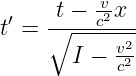
Moreover, according to this equation the time difference Δt′ of two events with respect to K′ does
not in general vanish, even when the time difference Δt′ of the same events with reference to K
vanishes. Pure “space-distance” of two events with respect to K results in “time-distance” of the
same events with respect to K′. But the discovery of Minkowski, which was of importance for the
formal development of the theory of relativity, does not lie here. It is to be found rather in the fact
of his recognition that the four-dimensional space-time continuum of the theory of relativity, in its
most essential formal properties, shows a pronounced relationship to the three-dimensional
continuum of Euclidean geometrical space. In order to give due prominence to this
relationship, however, we must replace the usual time coordinate t by an imaginary
magnitude  ct proportional to it. Under these conditions, the natural laws satisfying the
demands of the (special) theory of relativity assume mathematical forms, in which the
time coordinate plays exactly the same role as the three space coordinates. Formally,
these four coordinates correspond exactly to the three space coordinates in Euclidean
geometry. It must be clear even to the non-mathematician that, as a consequence of this
purely formal addition to our knowledge, the theory perforce gained clearness in no mean
measure.
ct proportional to it. Under these conditions, the natural laws satisfying the
demands of the (special) theory of relativity assume mathematical forms, in which the
time coordinate plays exactly the same role as the three space coordinates. Formally,
these four coordinates correspond exactly to the three space coordinates in Euclidean
geometry. It must be clear even to the non-mathematician that, as a consequence of this
purely formal addition to our knowledge, the theory perforce gained clearness in no mean
measure.
These inadequate remarks can give the reader only a vague notion of the important idea
contributed by Minkowski. Without it the general theory of relativity, of which the fundamental
ideas are developed in the following pages, would perhaps have got no farther than its long
clothes. Minkowski’s work is doubtless difficult of access to anyone inexperienced in
mathematics, but since it is not necessary to have a very exact grasp of this work in
order to understand the fundamental ideas of either the special or the general theory of
relativity, I shall leave it here at present, and revert to it only towards the end of Part
2.
0.2 References
This article is derived from the Einstein Reference Archive (marxists.org) 1999, 2002. Einstein
Reference Archive which is under the FDL copyright.

![[parent]](https://images.physicslibrary.org/images/uparrow.png)