GRE Physics Companion: Relative Motion
This companion is designed for rapid review after M01-09. Most GRE style relative motion
problems become short once the observer labels are written explicitly before numbers are
substituted.
1 Fast triage
Start from
Read the subscripts literally: “P relative to G equals P relative to B plus B relative to
G.”
For two objects in the same frame,
In one dimension, choose a positive direction and keep the signs. In two dimensions, work in
components before taking magnitudes or angles.
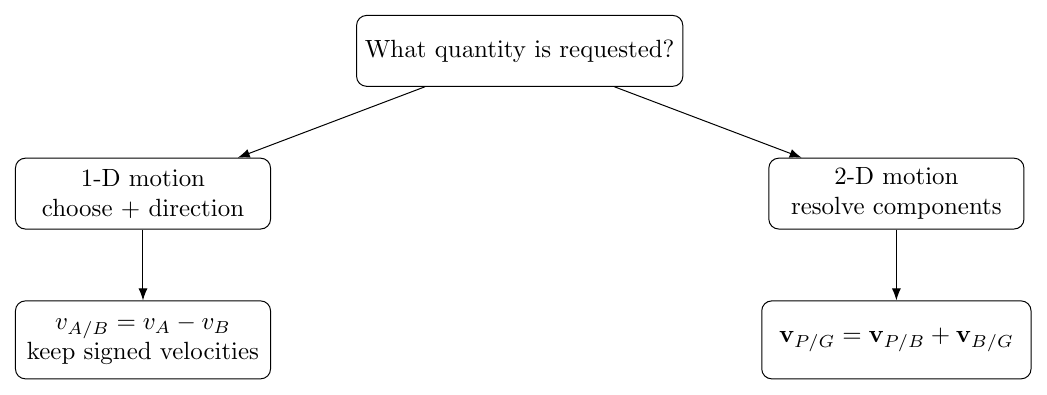
Figure 1. GRE speed triage for relative motion. Write the observer chain first, then use signed
scalars in one dimension or components in two dimensions.
2 Common traps
Do not automatically add speeds. Same direction motions usually involve subtraction when one
object is viewed from the other.
Do not subtract vector magnitudes when directions differ. Subtract the vectors component by
component.
For river and wind problems, the velocity relative to the medium and the velocity of the medium
relative to the ground are different vectors.
A frame moving at constant velocity changes measured velocity but not acceleration in Newtonian
mechanics.
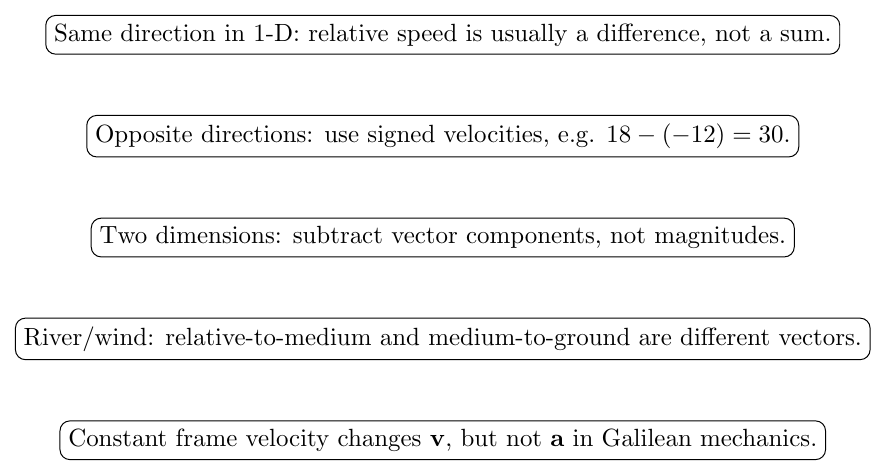
Figure 2. Common GRE traps in relative motion: sign errors in one dimension, subtracting
magnitudes instead of vectors, and confusing velocity relative to a medium with velocity relative
to the ground.
3 Worked GRE example 1: moving walkway
A person walks at 1.5 m/s relative to a walkway that moves east at 2.0 m/s relative to the
floor. What is the person’s floor speed when walking east? What if the person walks
west?
Eastward walking gives
Westward walking gives vP∕W = −1.5 m/s, so
The person still moves east relative to the floor in the second case.
4 Worked GRE example 2: river crossing
A boat moves due north at 6 m/s relative to the water while the current is 8 m/s east. Find the
ground speed.
The components are perpendicular, so
The 6-8-10 triangle gives the magnitude immediately.
5 GRE speed questions
- A train moves east at 20 m/s. A passenger walks east at 2 m/s relative to the train.
The passenger’s ground speed is (A) 18 (B) 20 (C) 22 (D) 40 m/s.
- Cars A and B move east at 30 m/s and 24 m/s. The speed of A relative to B is (A) 6
(B) 24 (C) 30 (D) 54 m/s.
- Cars A and B move toward one another at 18 m/s and 12 m/s. Their closing speed is
(A) 6 (B) 15 (C) 30 (D) 216 m/s.
- A boat moves north at 3 m/s relative to the water while the current flows east at 4
m/s. Its ground speed is (A) 1 (B) 5 (C) 7 (D) 12 m/s.
- Frame B moves at constant velocity relative to inertial frame G. A particle’s
acceleration measured in G is 5 m/s2. The acceleration measured in B is (A) 0 (B) less
than 5 (C) 5 (D) greater than 5 m/s2.
- If vA = 4ex + 3ey m/s and vB = ex − ey m/s, then |vA∕B| is (A) 3 (B) 4 (C) 5 (D) 7
m/s.
6 Answers and rationales
- C. 20 + 2 = 22 m/s east.
- A. Same-direction relative speed is 30 − 24 = 6 m/s.
- C. With east positive, one velocity is negative, so subtraction gives 18 − (−12) = 30
m/s.
- B. The perpendicular components form a 3-4-5 triangle.
- C. Constant relative frame velocity has zero relative acceleration, so Galilean inertial
frames measure the same acceleration.
- C. vA∕B = 3ex + 4ey m/s, whose magnitude is 5 m/s.
References
[1] PhysicsLibrary, M01-09, Relative Motion.
[2] S. J. Ling, J. Sanny, and W. Moebs, University Physics, Volume 1, OpenStax, 2016.

![[parent]](https://images.physicslibrary.org/images/uparrow.png)




