Physics Library
 An open source physics library
Encyclopedia | Forums | Docs | Random |  
Login
create new user
Username:
Password:
forget your password?
Main Menu
Sections

Meta

Talkback

Downloads

Information
[parent] example of Wave Mechanics: Energy in a 1D Wave (Example)

Wave Mechanics Examples: Energy in a 1D Wave

This companion article provides exercises for WM18, wave mechanics: energy in a 1D Wave. All exercises are stated first so they can be attempted without seeing the answers. Complete worked solutions follow in Part II.

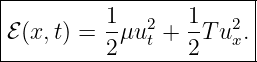
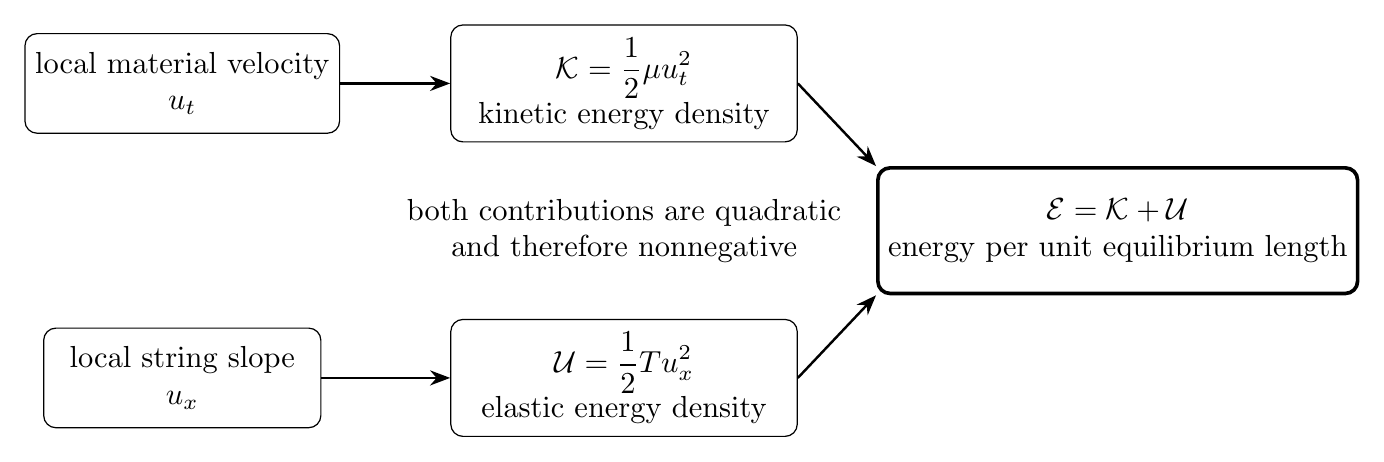
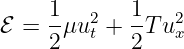
For the ideal stretched string, the local mechanical energy per unit equilibrium length is

|------------------------|
|         1       1      |
|ℰ(x, t) = --μu2t + --Tu2x.|
----------2-------2------
(1)

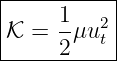
The two contributions are

|----------|
|     1-  2|
|𝒦 =  2μu t|
------------
(2)

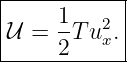
and

|-----------|
𝒰  = 1T u2. |
-----2---x---
(3)

For the ideal string,

 2   T-
c =  μ .
(4)

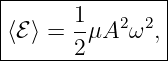
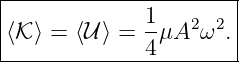
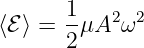
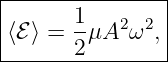
For a pure traveling wave, the kinetic and elastic potential energy densities are equal point by point. For a sinusoidal traveling wave,

|---------------|
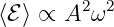
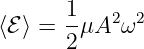
⟨ℰ ⟩ = 1μA2 ω2, |
-------2---------
(5)

with

|----------------------|
|             1        |
|⟨𝒦 ⟩ = ⟨𝒰 ⟩ =-μA2 ω2. |
--------------4--------
(6)

These relations follow from the ideal-string energy model developed in WM18 [1235].

PIC

Figure. The ideal-string energy density separates into a kinetic contribution controlled by local material velocity and an elastic contribution controlled by local slope.

How to use this problem set

Attempt all exercises in Part I before consulting Part II. Keep three distinctions explicit throughout:

  • the propagation speed c is not the same as the material velocity ut;
  • displacement u is not itself an energy measure;
  • pointwise equality 𝒦 = 𝒰 is special to a pure traveling wave and does not hold for every wave field.

Part I: Exercises

Exercise 1: Local kinetic, potential, and total energy density

A string has

μ = 0.018kg/m,      T =  72N.
(7)

At one event (x,t),

ut = 1.20m/s,      ux = − 0.050.
(8)

Find:

  1. the kinetic energy density;
  2. the elastic potential energy density;
  3. the total energy density;
  4. whether the negative sign of ux makes the potential energy density negative.

Exercise 2: Dimensional consistency

Show that both

1-μu2
2   t
(9)

and

1-  2
2T ux
(10)

have units of joules per meter.

Also explain why ux is dimensionless when both u and x are measured in meters.

Exercise 3: Pure traveling wave and equal energy partition

A pure right-moving wave travels on a string with

T =  45N,     μ =  0.0050 kg/m.
(11)

At one event its slope is

ux = 0.060.
(12)

  1. Find the wave speed c.
  2. Use the right-moving relation ut = cux to find ut.
  3. Find 𝒦 and 𝒰.
  4. Verify numerically that 𝒦 = 𝒰.
  5. Find the total energy density.

Exercise 4: Energy distribution in a smooth Gaussian pulse

Consider a pure right-moving Gaussian pulse

               [           ]
                  (x-−-ct)2
u(x,t) = A exp  −    2σ2     .
(13)

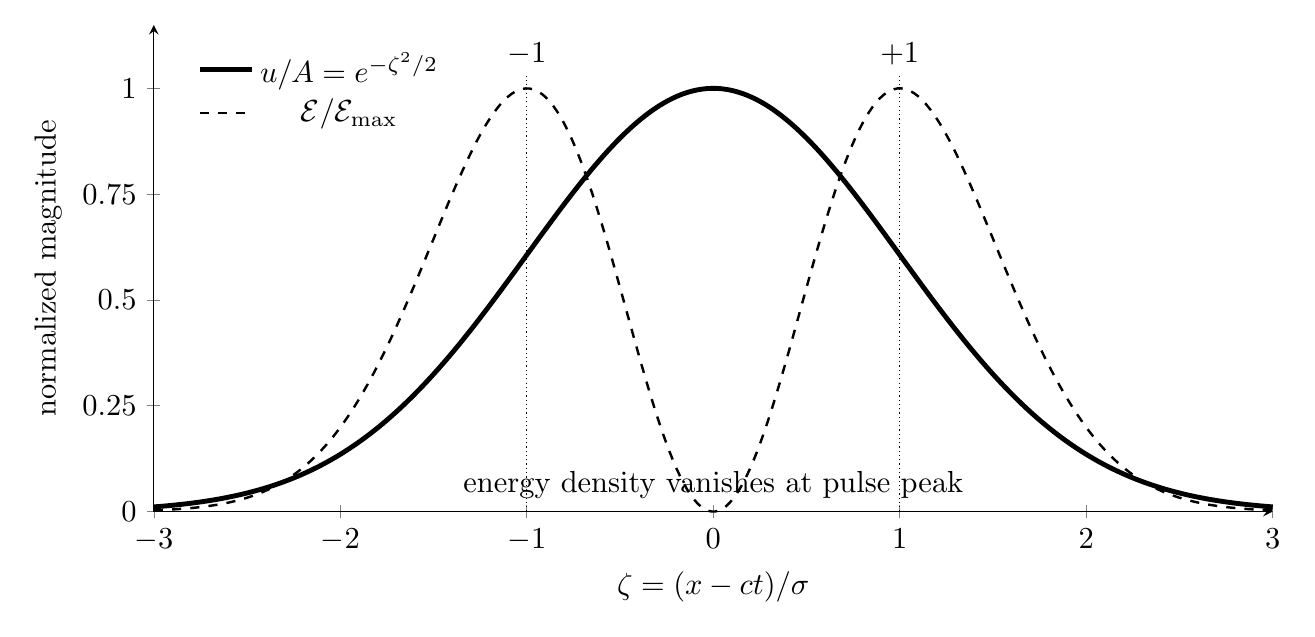
The normalized displacement and normalized energy density are shown below.

PIC

Figure. A smooth Gaussian displacement pulse and the corresponding normalized local energy density.

Answer the following.

  1. Why is the energy density zero at the exact displacement peak x = ct?
  2. At which normalized positions ζ = (x ct)∕σ is the energy density largest?
  3. Does zero local energy density at the pulse center imply that the whole pulse has zero energy?
  4. Why does the energy-density curve have two lobes even though the displacement pulse has one peak?

Exercise 5: Instantaneous energy density of a sinusoidal traveling wave

A sinusoidal traveling wave is

u(x,t) = A cos𝜃,     𝜃 = kx − ωt + ϕ.
(14)

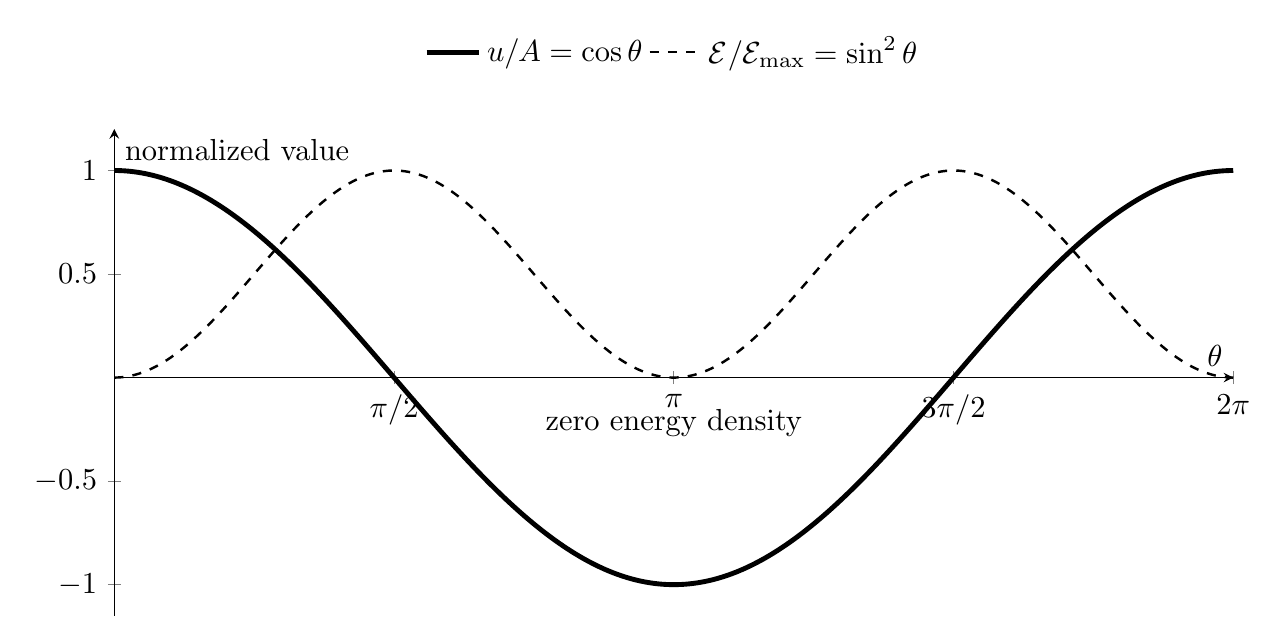
For a pure traveling wave,

        2 2   2
ℰ =  μA  ω sin 𝜃.
(15)

The relationship between displacement phase and energy density is shown below.

PIC

Figure. Normalized sinusoidal displacement and normalized energy density over one phase cycle.

Suppose

A = 3.0 mm,      f = 40 Hz,     μ = 0.010 kg/m.
(16)

Find the instantaneous total energy density at

  1. 𝜃 = 0;
  2. 𝜃 = π∕6;
  3. 𝜃 = π∕2.

Exercise 6: Average energy density and energy per wavelength

A sinusoidal traveling wave has

A =  2.5 mm,      f = 60 Hz,
(17)

on a string with

μ = 0.015kg/m,      T =  96N.
(18)

Find:

  1. c;
  2. λ;
  3. ω;
  4. ⟨ℰ⟩;
  5. the average energy contained in one wavelength;
  6. the average kinetic and potential energy densities separately.

Exercise 7: Square-law scaling

A sinusoidal traveling wave has initial average energy density ⟨ℰ⟩0.

Determine the new average energy density in terms of ⟨ℰ⟩0 when:

  1. the amplitude is doubled and frequency is unchanged;
  2. the frequency is tripled and amplitude is unchanged;
  3. the amplitude is halved and the frequency is doubled;
  4. the amplitude changes sign but keeps the same magnitude.

Exercise 8: Infer amplitude from measured average energy density

A sinusoidal traveling wave has

⟨ℰ ⟩ = 0.020 J/m,      μ = 0.012 kg/m,     f =  80Hz.
(19)

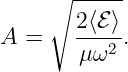
Use

      1-  2  2
⟨ℰ ⟩ = 2μA  ω
(20)

to find the displacement amplitude A.

Exercise 9: Total energy of a Gaussian traveling pulse

For the Gaussian pulse

               [          2]
u(x,t) = A exp  − (x-−-ct)-  ,
                     2σ2
(21)

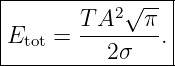
show that its total energy is

|----------------|
|       T A2√ π- |
|Etot = --------.|
----------2-σ----
(22)

Then evaluate this result for

T = 50 N,     A =  1.0cm,     σ =  0.20 m.
(23)

Exercise 10: Simultaneous right- and left-moving components

At one event in a two-direction field,

u(x,t) = F (x − ct) + G (x + ct),
(24)

suppose

F ′ = 0.080,    G ′ = − 0.030,    T = 60 N.
(25)

Use

ℰ = T [(F ′)2 + (G ′)2]
(26)

together with

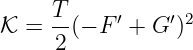
𝒦  = T-(− F ′ + G ′)2
      2
(27)

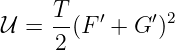
and

     T    ′    ′2
𝒰  = 2-(F  + G )
(28)

to find , 𝒦, and 𝒰. Verify that 𝒦 + 𝒰 = .

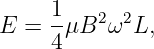
Exercise 11: Energy exchange in a standing normal mode

A standing normal mode has total energy

E  = 1-μB2 ω2L,
     4
(29)

with

            2
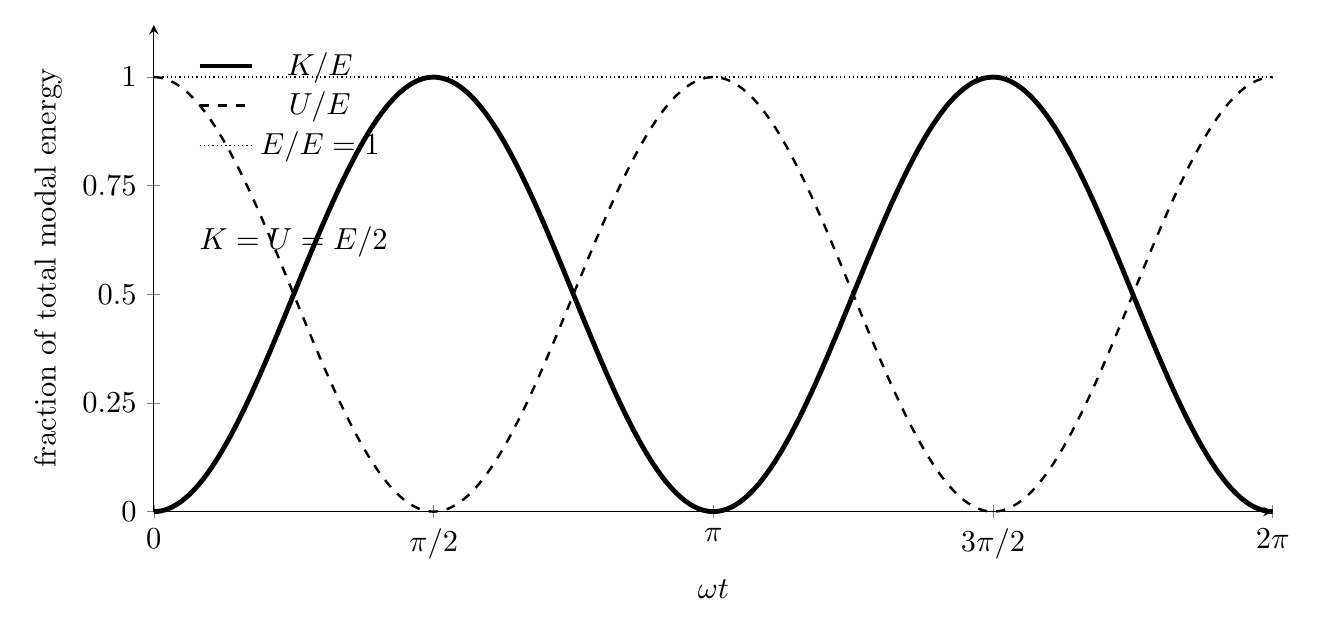
K (t) = E sin (ωt)
(30)

and

U(t) = E cos2(ωt).
(31)

The exchange is shown below.

PIC

Figure. Integrated kinetic and elastic potential energy exchange in one ideal standing-wave normal mode.

Take

μ =  0.010kg/m,      B =  6.0mm,      f =  25Hz,     L  = 1.20m.
(32)

Find:

  1. the constant total energy E;
  2. K and U at t = 0;
  3. K and U after one-quarter of an oscillation period;
  4. K and U after one-eighth of a period.

Exercise 12: Diagnose conceptual statements

For each statement, decide whether it is correct. If incorrect, rewrite it accurately.

  1. “A point with zero displacement must have zero wave energy density.”
  2. “For a pure traveling wave on an ideal string, local kinetic and elastic potential energy densities are equal.”
  3. “The propagation speed c is the material velocity that belongs in the kinetic energy formula.”
  4. “Doubling the sinusoidal amplitude doubles the average energy density.”
  5. “The total mechanical energy density of an ideal string can never be negative.”

Exercise 13: Where is the energy in a smooth pulse?

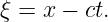
For the Gaussian pulse of Exercise 9, define

ξ = x − ct.
(33)

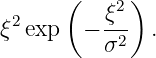
Show that the traveling-wave energy density is proportional to

      (     )
 2        ξ2-
ξ exp   − σ2   .
(34)

Then determine the values of ξ at which the energy density is largest.

Explain physically why those locations lie on either side of the displacement peak.

Exercise 14: Full string-energy synthesis

A sinusoidal right-moving wave travels on an ideal string with

T =  100N,      μ = 0.025kg/m,
(35)

and has

A =  4.0 mm,      f = 30 Hz.
(36)

Find:

  1. c;
  2. ω;
  3. λ;
  4. k;
  5. ⟨ℰ⟩;
  6. ⟨𝒦⟩ and ⟨𝒰⟩;
  7. the average energy in one wavelength;
  8. the maximum slope magnitude Ak and whether the small-slope assumption appears reasonable.

Part II: Complete Worked Solutions

Solution 1: Local kinetic, potential, and total energy density

The kinetic density is

𝒦 = 1-
2μut2 (37)
= 1-
2(0.018)(1.20)2 (38)
= 0.01296 J/m . (39)

The potential density is

𝒰 = 1
--
2Tux2 (40)
= 1-
2(72)(0.050)2 (41)
= 0.0900 J/m . (42)

Therefore

= 𝒦 + 𝒰 (43)
= 0.01296 + 0.0900 (44)
= 0.10296 J/m 0.103 J/m . (45)

The sign of the slope does not make the elastic energy negative because the slope enters as ux2.

Solution 2: Dimensional consistency

For the kinetic term,

[μut2] = kg-
m( m-)
   s2 (46)
= kgm
--2--
 s (47)
= N (48)
= J
--
m. (49)

For the potential term, ux is a derivative of length with respect to length, so

[ux ] = m-=  1.
       m
(50)

Thus

[Tux2] = N (51)
= J-
m. (52)

Both terms therefore have the correct units of energy per unit length.

Solution 3: Pure traveling wave and equal energy partition

The wave speed is

c = ∘ ---
  T
  --
  μ (53)
= ∘ -------
    45
  -------
  0.0050 (54)
= 94.9 m/s . (55)

For a right-moving pure wave,

ut = − cux.
(56)

Hence

ut = (94.9)(0.060) (57)
= 5.69 m/s . (58)

The kinetic density is

𝒦 = 1-
2(0.0050)(5.69)2 (59)
0.0810 J/m . (60)

The elastic density is

𝒰 = 1-
2(45)(0.060)2 (61)
= 0.0810 J/m . (62)

Thus

|-------|
|𝒦 =  𝒰 .
--------
(63)

The total density is

|--------------|
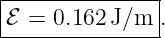
ℰ =  0.162 J/m  .
----------------
(64)

Solution 4: Energy distribution in a smooth Gaussian pulse

At the pulse center,

x =  ct,
(65)

so the Gaussian profile has zero slope:

ux = 0.
(66)

For a right-moving pure wave,

ut = − cux,
(67)

so ut = 0 there as well. Therefore

|------|
-ℰ-=-0-|
(68)

at the exact displacement peak.

From the normalized energy curve, the maxima occur at

---------
|ζ = ±1 ,
---------
(69)

or equivalently

|------------|
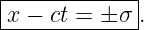
x-−-ct-=-±-σ-.
(70)

Zero energy density at one point does not imply zero total pulse energy. The pulse energy is distributed over the regions where the profile has nonzero slope and nonzero local material velocity.

The energy-density curve has two lobes because the Gaussian has one rising side and one falling side. Energy depends on the square of the slope, so both sides contribute positively.

Solution 5: Instantaneous energy density of a sinusoidal traveling wave

First compute

ω =  2πf = 80 πrad/s.
(71)

The maximum value of the total energy density is

max = μA2ω2 (72)
= (0.010)(0.0030)2(80π)2 (73)
5.68 × 10³ J/m . (74)

At 𝜃 = 0,

sin2 (0) = 0,
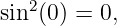
(75)

so

|------|
-ℰ-=-0-.
(76)

At 𝜃 = π∕6,

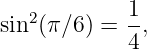
sin2(π∕6 ) = 1,
            4
(77)

so

|--------------------|
ℰ ≃  1.42 × 10 −3J/m  .
----------------------
(78)

At 𝜃 = π∕2,

sin2(π ∕2) = 1,
(79)

so

|--------------------|
ℰ ≃  5.68 × 10 −3J/m  .
----------------------
(80)

Solution 6: Average energy density and energy per wavelength

The speed is

c = ∘ ------
  --96--
  0.015 (81)
= √-----
 6400 (82)
= 80.0 m/s . (83)

The wavelength is

λ = c
--
f (84)
= 80.0
 60 (85)
= 1.33 m . (86)

The angular frequency is

|------------------------------------|
ω-=--2π(60)-=-120π-rad/s-≃-377-rad/s-.
(87)

The average energy density is

⟨ℰ⟩ = 1-
2μA2ω2 (88)
= 1-
2(0.015)(0.0025)2(120π)2 (89)
6.66 × 10³ J/m . (90)

The average energy in one wavelength is

Eλ = ⟨ℰ⟩λ (91)
= (6.66 × 10³)(1.33) (92)
8.88 × 10³ J . (93)

The average kinetic and potential densities are equal and each is half of the total average:

|------------------------------|
-⟨𝒦-⟩ =-⟨𝒰-⟩-≃-3.33 ×-10−3-J/m.|
(94)

Solution 7: Square-law scaling

Since

        2 2
⟨ℰ⟩ ∝ A  ω
(95)

and ω f:

  1. Doubling A gives
    |-----|
|4⟨ℰ⟩0|.
-------
    (96)

  2. Tripling f gives
    |-----|
|9⟨ℰ⟩ |.
-----0-
    (97)

  3. Halving A contributes a factor 14, while doubling f contributes a factor 4. The factors cancel:
    |----|
⟨ℰ-⟩0-.
    (98)

  4. Changing A to A does not alter A2, so
    |----|
⟨ℰ-⟩0-.
    (99)

Solution 8: Infer amplitude from measured average energy density

Solve

⟨ℰ ⟩ = 1μA2 ω2
      2
(100)

for A:

     ∘ -----

A  =    2⟨ℰ⟩.
        μω2
(101)

Here

ω =  2π(80) = 160π rad/s.
(102)

Thus

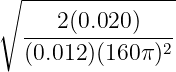
A = ∘ ---------------

  ---2-(0.020-)---
  (0.012)(160π )2 (103)
0.00363 m. (104)

Therefore

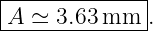
|-------------|
-A-≃--3.63-mm--.
(105)

Solution 9: Total energy of a Gaussian traveling pulse

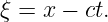
Let

ξ = x − ct.
(106)

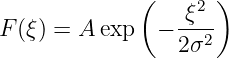
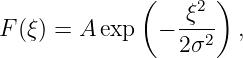
Then

              (   ξ2 )
F (ξ) = A exp   − --2-
                  2σ
(107)

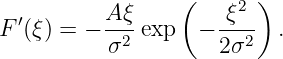
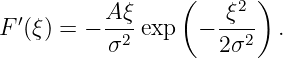
and

                 (     2 )
F ′(ξ) = − A-ξexp   − -ξ--  .
          σ2         2σ2
(108)

For a pure traveling wave,

ℰ = T [F ′(ξ )]2.
(109)

Therefore

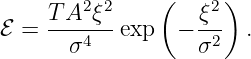
               (     )
    T-A2ξ2-       -ξ2
ℰ =   σ4   exp  − σ2   .
(110)

Integrate over the whole line:

        TA2 ∫  ∞      2  2
Etot =  --4--    ξ2e−ξ ∕σ dξ.
         σ    −∞
(111)

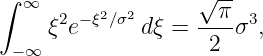
Using

∫ ∞       2 2      √ π-
     ξ2e−ξ∕σ d ξ = ---σ3,
 −∞                 2
(112)

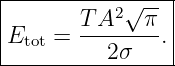
we obtain

|-----------√----|
|       T A2  π  |
|Etot = --2-σ---.|
-----------------
(113)

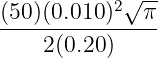
Numerically,

Etot =            2√ --
(50-)(0.010)---π
     2(0.20) (114)
2.22 × 10² J . (115)

Solution 10: Simultaneous right- and left-moving components

The total energy density is

= 60[(0.080)2 + (0.030)2] (116)
= 60(0.0073) (117)
= 0.438 J/m . (118)

The kinetic density is

𝒦 = 60-
 2[0.080 0.030]2 (119)
= 30(0.110)2 (120)
= 0.363 J/m . (121)

The potential density is

𝒰 = 60
---
 2[0.080 0.030]2 (122)
= 30(0.050)2 (123)
= 0.0750 J/m . (124)

The check is

|---------------------------|
|0.363 + 0.0750 = 0.438 J/m .
----------------------------
(125)

This example shows that 𝒦 and 𝒰 need not be equal when both propagation directions are present.

Solution 11: Energy exchange in a standing normal mode

First compute

ω = 2π (25) = 50π rad/s.
(126)

Then

E = 1
--
4(0.010)(0.0060)2(50π)2(1.20) (127)
2.66 × 10³ J . (128)

At t = 0,

sin2(0) = 0,     cos2(0) = 1,
(129)

so

|-------------------|
K  = 0,     U =  E. |
---------------------
(130)

After one-quarter period,

ωt = π-,
     2
(131)

so

|-------------------|
K--=-E,------U-=-0.--
(132)

After one-eighth period,

     π-
ωt = 4 ,
(133)

and

   2(π )      2 (π )   1
sin   --  = cos   --  = --.
      4          4     2
(134)

Therefore

|----------------------------|
|         E-             −3  |
K--=-U--=--2-≃--1.33-×-10---J.-
(135)

Solution 12: Diagnose conceptual statements

  1. Incorrect. Zero displacement does not imply zero energy density. A point can have nonzero velocity or nonzero slope while passing through equilibrium.
  2. Correct for a pure traveling wave in the ideal-string model.
  3. Incorrect. The kinetic energy uses the transverse material velocity ut, not the propagation speed c by itself.
  4. Incorrect. Average sinusoidal energy density is proportional to A2, so doubling amplitude multiplies the average energy density by four.
  5. Correct within the ideal model because both terms in
        1-  2   1-  2
ℰ = 2 μut + 2 Tux
    (136)

    are nonnegative when μ > 0 and T > 0.

Solution 13: Where is the energy in a smooth pulse?

For

             (    ξ2 )
F (ξ) = A exp  − ---2  ,
                 2σ
(137)

we have

                 (     2 )
F ′(ξ) = − A-ξexp   − -ξ--  .
          σ2         2σ2
(138)

Thus

                     (     )
       ′   2    2       ξ2-
ℰ ∝ [F (ξ)] ∝ ξ  exp  − σ2   .
(139)

Differentiate the shape factor:

d
dξ-[ 2 −ξ2∕σ2]
 ξ e = 2ξeξ2∕σ2 (       )
      ξ2
 1 −  σ2-. (140)

The stationary points are

ξ = 0
(141)

and

ξ = ± σ.
(142)

The center ξ = 0 is the zero-energy minimum, while the two maxima occur at

|--------|
|ξ = ± σ.|
----------
(143)

These locations lie on the two flanks of the Gaussian, where the magnitude of the slope is largest. The displacement peak itself is locally flat.

Solution 14: Full string-energy synthesis

The wave speed is

c = ∘  ------
   -100--
   0.025 (144)
= √ -----
  4000 (145)
63.25 m/s . (146)

The angular frequency is

|-------------------------------------|
-ω-=-2π-(30) =-60π-rad/s-≃-188.5-rad/s-.
(147)

The wavelength is

λ = c-
f (148)
= 63.25
------
 30 (149)
2.108 m . (150)

The Wavenumber is

k = ω-
 c (151)
2.98 rad/m . (152)

The average total energy density is

⟨ℰ⟩ = 1
--
2(0.025)(0.0040)2(60π)2 (153)
7.11 × 10³ J/m . (154)

The two average contributions are equal:

|------------------------------|
|                      −3      |
-⟨𝒦-⟩ =-⟨𝒰-⟩-≃-3.55 ×-10--J/m.-
(155)

The average energy in one wavelength is

Eλ = ⟨ℰ⟩λ (156)
(7.11 × 10³)(2.108) (157)
1.50 × 10² J . (158)

For a sinusoid, the maximum slope magnitude is

|ux|max = Ak.
(159)

Thus

Ak = (0.0040)(2.98) (160)
0.0119 . (161)

Since this is much less than one, the small-slope assumption appears reasonable for this example.

Common mistakes

  • Mistake: using displacement u itself as the local energy measure. The ideal-string energy depends on ut2 and u x2.
  • Mistake: replacing the material velocity ut by the propagation speed c in the kinetic term.
  • Mistake: forgetting to square amplitude or frequency in the average sinusoidal energy formula.
  • Mistake: assuming 𝒦 = 𝒰 point by point for Standing Waves or arbitrary two-direction superpositions.
  • Mistake: interpreting the zero energy density at the exact top of a smooth traveling pulse as zero total pulse energy.
  • Mistake: confusing energy density, measured in joules per meter, with power, measured in joules per second. Power flow is developed in the next article.

What WM18E1 reinforces

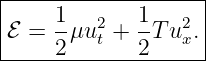
The ideal string stores local mechanical energy according to

|------------------|
|    1-  2   1-  2 |
ℰ =  2μu t + 2T ux.|
--------------------
(162)

Pure traveling waves divide that local energy equally between kinetic and elastic forms, while standing waves exchange integrated kinetic and potential energy in time. For sinusoidal traveling waves,

|---------------|
|      1-  2 2  |
⟨ℰ ⟩ = 2μA  ω , |
-----------------
(163)

which makes the square-law dependence on amplitude and frequency explicit.

The next step is to ask how rapidly this stored energy crosses a fixed position. That leads to the wave-power relation developed in the next main article.

References

References

[1]   A. P. French, Vibrations and Waves, M.I.T. Introductory Physics Series, W. W. Norton & Company, 1971.

[2]   Frank S. Crawford, Jr., Waves, Berkeley Physics Course, Volume 3, McGraw-Hill, 1968.

[3]   William Moebs, Samuel J. Ling, and Jeff Sanny, University Physics, Volume 1, OpenStax, 2016, Section 16.4, “Energy and Power of a Wave.”

[4]   Howard Georgi, The Physics of Waves, Benjamin/Cummings, 1992, continuum and traveling-wave chapters; also distributed through MIT OpenCourseWare 8.03SC.

[5]   Massachusetts Institute of Technology, 8.03SC Physics III: Vibrations and Waves, Fall 2016, Problem Set 5 and Lecture 10 materials on traveling waves and string energy, MIT OpenCourseWare.


"example of Wave Mechanics: Energy in a 1D Wave" is owned by bloftin.
(view preamble)
View style:
Other names:  WM18E1
Keywords:  wave mechanics, wave energy, energy density, kinetic energy density, elastic potential energy density, stretched string, traveling wave, standing wave, amplitude squared, frequency squared, exercises, worked solutions

This object's parent.

Cross-references: power, Standing Waves, formula, Wavenumber, square, magnitude, positions, kinetic energy, field, speed, velocity, relations, equilibrium, energy, mechanics, wave, WM18

This is version 1 of example of Wave Mechanics: Energy in a 1D Wave, born on 2026-09-12.
Object id is 1184, canonical name is ExampleOfWaveMechanicsEnergyInA1DWave.
Accessed 4 times total.

Classification:
Physics Classification46.40.Cd (Mechanical wave propagation (including diffraction, scattering, and)
 46.40.-f (Vibrations and mechanical waves )
Pending Errata and Addenda
None.
Discussion
Style: Expand: Order:

No messages.

Interact
rate | post | correct | update request | add example | add (any)