Physics Library
 An open source physics library
Encyclopedia | Forums | Docs | Random |  
Login
create new user
Username:
Password:
forget your password?
Main Menu
Sections

Meta

Talkback

Downloads

Information
[parent] example of Euler angles: elementary axis rotations and passive rotation matrices (Example)

Euler Angles: Elementary Axis Rotations and Passive Rotation Matrices Examples, Exercises, and Solutions

This entry is the self study companion to Euler Angles: elementary axis rotations and passive rotation matrices.

The goal is to turn the three elementary passive rotation matrices into working tools. The exercises emphasize geometric interpretation, sign checking, orthogonality, inverse transformations, and the way these elementary factors assemble into larger Euler angle formulas.

All exercises are stated first. Complete worked solutions follow afterward.

Convention summary

PhysicsLibrary uses passive coordinate transformations between right handed orthonormal frames.

If a physical vector has coordinate columns ${}^{A}\mathbf v$ and ${}^{B}\mathbf v$ in frames $A$ and $B$, then

$\displaystyle {}^{B}\mathbf v = {}^{B}C_A\,{}^{A}\mathbf v.$ (1)

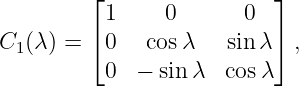
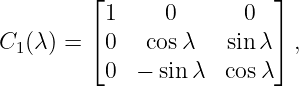
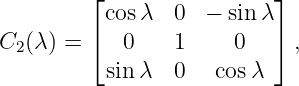
The elementary passive matrices are

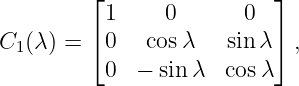
$\displaystyle C_1(\lambda) = \begin{bmatrix} 1&0&0\ 0&\cos\lambda&\sin\lambda\ 0&-\sin\lambda&\cos\lambda \end{bmatrix},$ (2)
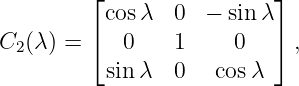
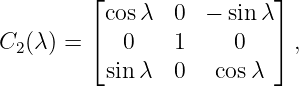
$\displaystyle C_2(\lambda) = \begin{bmatrix} \cos\lambda&0&-\sin\lambda\ 0&1&0\ \sin\lambda&0&\cos\lambda \end{bmatrix},$ (3)

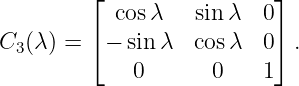
and

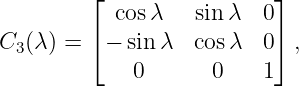
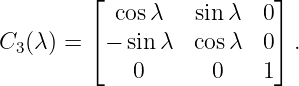
$\displaystyle C_3(\lambda) = \begin{bmatrix} \cos\lambda&\sin\lambda&0\ -\sin\lambda&\cos\lambda&0\ 0&0&1 \end{bmatrix}.$ (4)

For a generic intrinsic $i$-$j$-$k$ Euler sequence,

$\displaystyle {}^{B}C_A = C_k(\gamma)C_j(\beta)C_i(\alpha).$ (5)

Visual reference sheet

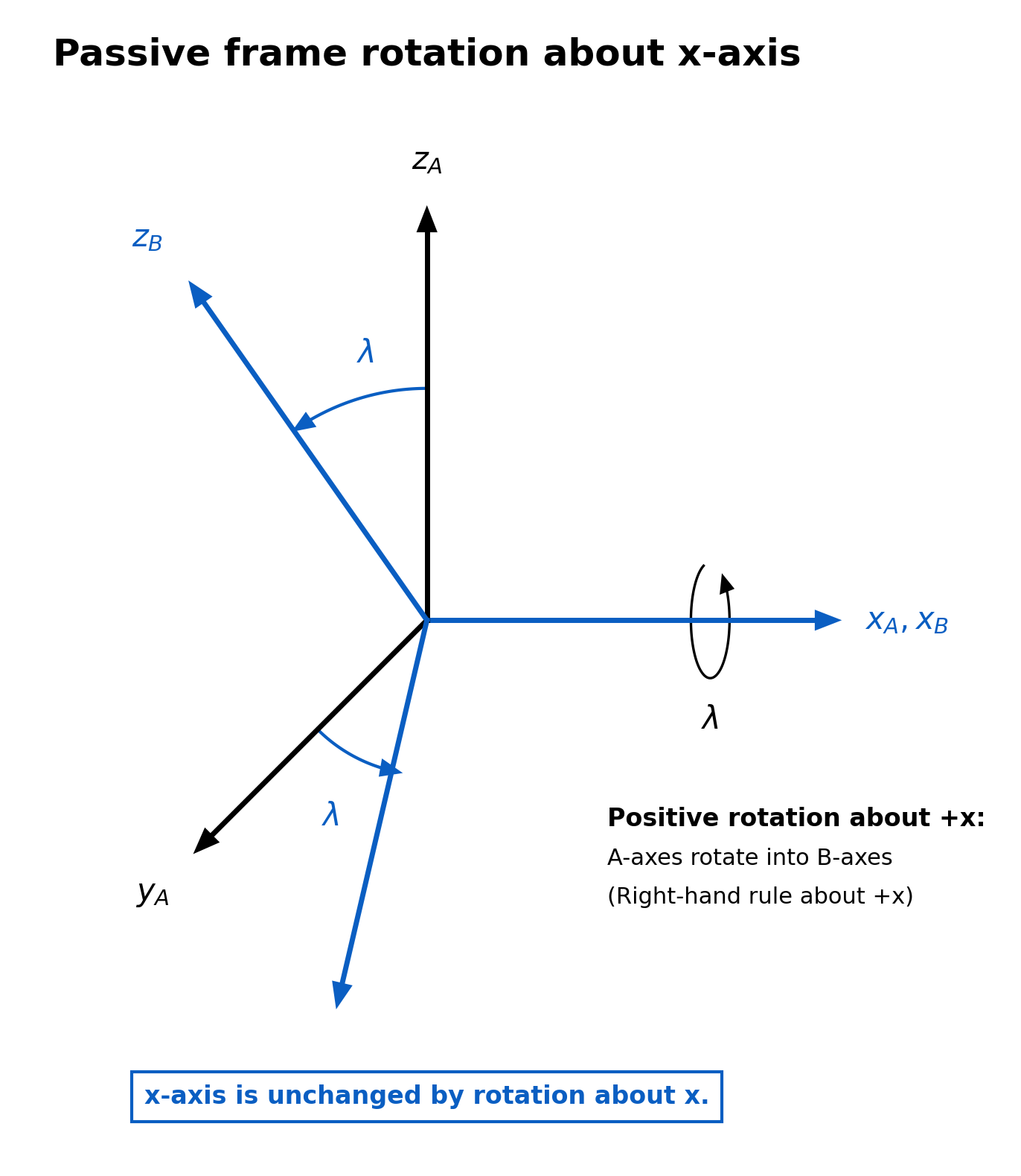
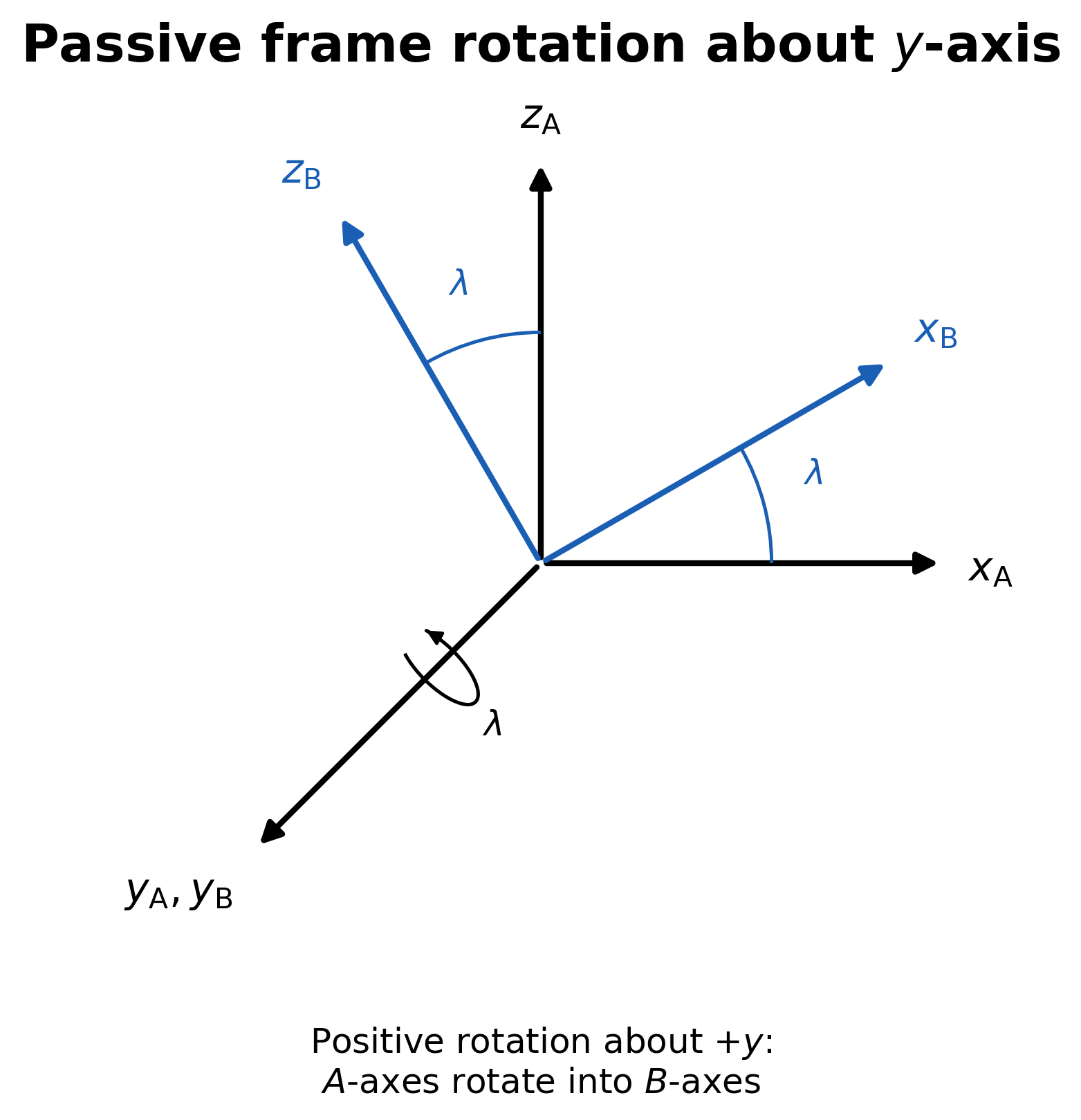
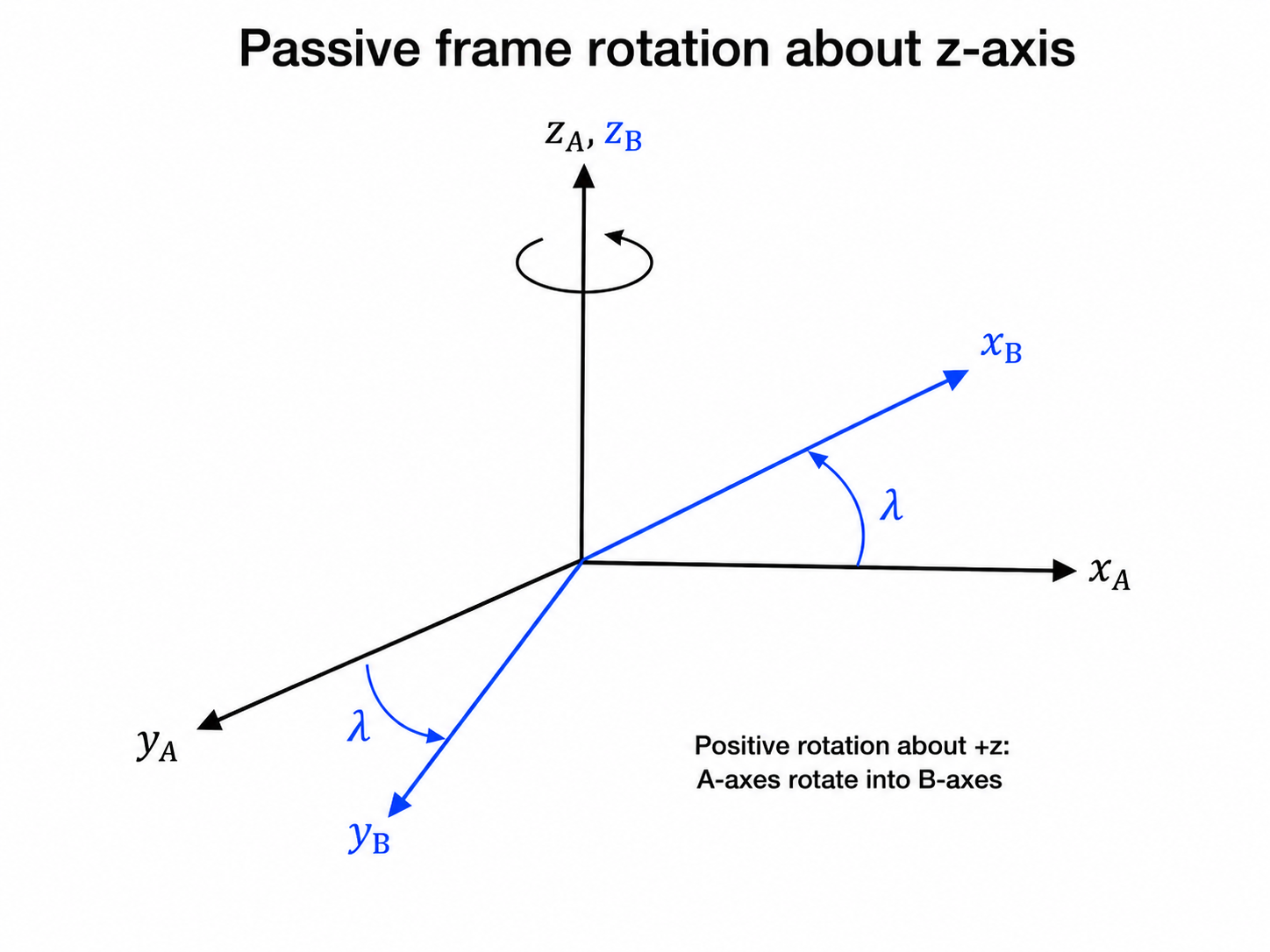
The three figures from the parent article are included here as quick visual reference.

Image EA02_passive_rotation_about_x_axis

Figure. Passive frame rotation about axis $1$, the $x$ axis.
Image EA02_passive_rotation_about_y_axis

Figure. Passive frame rotation about axis $2$, the $y$ axis.
Image EA02_passive_rotation_about_z_axis

Figure. Passive frame rotation about axis $3$, the $z$ axis.

Exercises

  1. Interpret the map.

    Explain in words what the equation

    $\displaystyle {}^{B}\mathbf v = {}^{B}C_A\,{}^{A}\mathbf v $

    means.

    What stays physically unchanged and what changes?

  2. Identify the unchanged coordinate.

    For a passive frame rotation about axis $1$, which coordinate component is unchanged?

    Repeat the question for rotations about axis $2$ and axis $3$.

  3. Write the three elementary matrices.

    Write the matrices $C_1(\lambda)$, $C_2(\lambda)$, and $C_3(\lambda)$.

  4. A $90^\circ$ check for $C_1$.

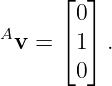
    Use $C_1(\pi/2)$ to compute the new coordinates of

    $\displaystyle {}^{A}\mathbf v = \begin{bmatrix} 0\\ 1\\ 0 \end{bmatrix}. $
  5. A $90^\circ$ check for $C_2$.

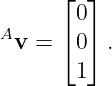
    Use $C_2(\pi/2)$ to compute the new coordinates of

    $\displaystyle {}^{A}\mathbf v = \begin{bmatrix} 0\\ 0\\ 1 \end{bmatrix}. $
  6. A $90^\circ$ check for $C_3$.

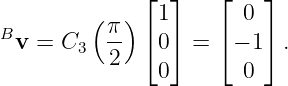
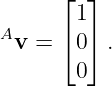
    Use $C_3(\pi/2)$ to compute the new coordinates of

    $\displaystyle {}^{A}\mathbf v = \begin{bmatrix} 1\\ 0\\ 0 \end{bmatrix}. $
  7. A negative angle check.

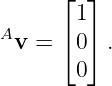
    Evaluate $C_3(-\pi/2)$ and apply it to

    $\displaystyle {}^{A}\mathbf v = \begin{bmatrix} 1\\ 0\\ 0 \end{bmatrix}. $

    Compare the result with Exercise 6.

  8. Orthogonality.

    Show directly that

    $\displaystyle C_1(\lambda)^T C_1(\lambda)=I. $

    State the analogous result for $C_2$ and $C_3$.

  9. Inverse and transpose.

    Show that

    $\displaystyle C_i(\lambda)^{-1} = C_i(\lambda)^T = C_i(-\lambda) $

    for $i=1,2,3$.

  10. determinant.

    Find $\det C_2(\lambda)$.

    What should the determinant be for each elementary passive rotation matrix?

  11. Active versus passive.

    If $R_i(\lambda)$ denotes the active vector rotation matrix for the same positive geometric angle about the same axis, what is the relation between $R_i(\lambda)$ and $C_i(\lambda)$?

  12. Columns as transformed basis vectors.

    What do the columns of ${}^{B}C_A$ represent in the passive convention?

    Use this to interpret the columns of $C_3(\lambda)$.

  13. Small angle form.

    Write the first order approximation of $C_2(\lambda)$ for small $\vert\lambda\vert$.

  14. Build a 3-2-1 passive Euler matrix.

    Write the passive intrinsic $3$-$2$-$1$ matrix product in terms of yaw, pitch, and roll angles $(\psi,\theta,\phi)$.

  15. Zero angle specialization.

    Starting from the passive intrinsic $3$-$2$-$1$ product, set

    $\displaystyle \phi=0,\qquad \theta=0. $

    Which elementary matrix remains?

  16. Reverse map.

    If

    $\displaystyle {}^{B}C_A=C_1(\lambda), $

    write the matrix ${}^{A}C_B$ explicitly.

  17. Sign debugging.

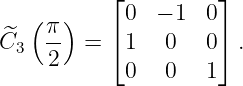
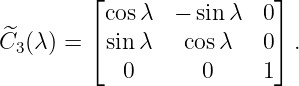
    A student proposes that the passive rotation about axis $3$ is

    $\displaystyle \widetilde C_3(\lambda) = \begin{bmatrix} \cos\lambda&-\sin\lambda&0\ \sin\lambda&\cos\lambda&0\ 0&0&1 \end{bmatrix}. $

    Give one quick test showing that this is not the PhysicsLibrary passive matrix for positive frame rotation about $+z$.

  18. composition order.

    Why does the product

    $\displaystyle {}^{B}C_A = C_k(\gamma)C_j(\beta)C_i(\alpha) $

    still describe the chronological intrinsic sequence $i\rightarrow j\rightarrow k$?

Solutions

Solution 1: interpret the map

The equation

$\displaystyle {}^{B}\mathbf v = {}^{B}C_A\,{}^{A}\mathbf v $

means that the physical vector is the same geometric object in space, but its coordinate description changes when we switch from frame $A$ to frame $B$.

Under a passive transformation, the vector stays fixed and the coordinate frame changes.

Solution 2: identify the unchanged coordinate

For rotation about axis $1$, the first coordinate is unchanged.

For rotation about axis $2$, the second coordinate is unchanged.

For rotation about axis $3$, the third coordinate is unchanged.

This is visible directly in the matrices and geometrically because the rotation axis itself is common to both frames.

Solution 3: write the three elementary matrices

The three elementary passive matrices are

$\displaystyle C_1(\lambda) = \begin{bmatrix} 1&0&0\ 0&\cos\lambda&\sin\lambda\ 0&-\sin\lambda&\cos\lambda \end{bmatrix},$ (6)
$\displaystyle C_2(\lambda) = \begin{bmatrix} \cos\lambda&0&-\sin\lambda\ 0&1&0\ \sin\lambda&0&\cos\lambda \end{bmatrix},$ (7)

and

$\displaystyle C_3(\lambda) = \begin{bmatrix} \cos\lambda&\sin\lambda&0\ -\sin\lambda&\cos\lambda&0\ 0&0&1 \end{bmatrix}.$ (8)

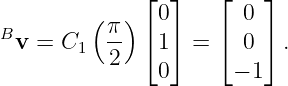
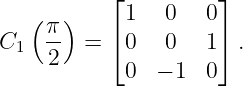
Solution 4: a $90^\circ$ check for $C_1$

At $\lambda=\pi/2$,

$\displaystyle C_1\left(\frac{\pi}{2}\right) = \begin{bmatrix} 1&0&0\ 0&0&1\ 0&-1&0 \end{bmatrix}. $

Thus

$\displaystyle {}^{B}\mathbf v = C_1\left(\frac{\pi}{2}\right) \begin{bmatrix} 0\\ 1\\ 0 \end{bmatrix}= \begin{bmatrix} 0\\ 0\\ -1 \end{bmatrix}.$ (9)

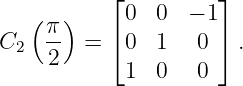
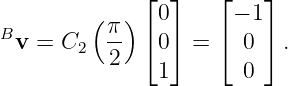
Solution 5: a $90^\circ$ check for $C_2$

At $\lambda=\pi/2$,

$\displaystyle C_2\left(\frac{\pi}{2}\right) = \begin{bmatrix} 0&0&-1\ 0&1&0\ 1&0&0 \end{bmatrix}. $

Therefore

$\displaystyle {}^{B}\mathbf v = C_2\left(\frac{\pi}{2}\right) \begin{bmatrix} 0\\ 0\\ 1 \end{bmatrix}= \begin{bmatrix} -1\\ 0\\ 0 \end{bmatrix}.$ (10)

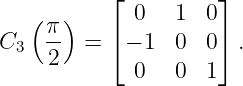
Solution 6: a $90^\circ$ check for $C_3$

At $\lambda=\pi/2$,

$\displaystyle C_3\left(\frac{\pi}{2}\right) = \begin{bmatrix} 0&1&0\ -1&0&0\ 0&0&1 \end{bmatrix}. $

Hence

$\displaystyle {}^{B}\mathbf v = C_3\left(\frac{\pi}{2}\right) \begin{bmatrix} 1\\ 0\\ 0 \end{bmatrix}= \begin{bmatrix} 0\\ -1\\ 0 \end{bmatrix}.$ (11)

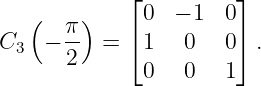
Solution 7: a negative angle check

Because

$\displaystyle \cos\left(-\frac{\pi}{2}\right)=0, \qquad \sin\left(-\frac{\pi}{2}\right)=-1, $

we obtain

$\displaystyle C_3\left(-\frac{\pi}{2}\right) = \begin{bmatrix} 0&-1&0\ 1&0&0\ 0&0&1 \end{bmatrix}. $

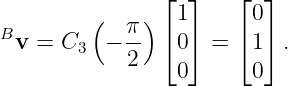
Applying it to the same vector gives

$\displaystyle {}^{B}\mathbf v = C_3\left(-\frac{\pi}{2}\right) \begin{bmatrix} 1\\ 0\\ 0 \end{bmatrix}= \begin{bmatrix} 0\\ 1\\ 0 \end{bmatrix}.$ (12)

This is the opposite coordinate change from the positive angle case in Exercise 6.

Solution 8: orthogonality

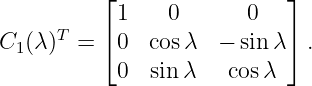
We have

$\displaystyle C_1(\lambda)^T = \begin{bmatrix} 1&0&0\ 0&\cos\lambda&-\sin\lambda\ 0&\sin\lambda&\cos\lambda \end{bmatrix}. $

Multiplying gives

$\displaystyle C_1(\lambda)^T C_1(\lambda) = \begin{bmatrix} 1&0&0\ 0&\cos^2\lambda+\sin^2\lambda&0\ 0&0&\cos^2\lambda+\sin^2\lambda \end{bmatrix}= I.$ (13)

The analogous results are

$\displaystyle C_2(\lambda)^T C_2(\lambda)=I, \qquad C_3(\lambda)^T C_3(\lambda)=I.$ (14)

Solution 9: inverse and transpose

For every orthogonal matrix,

$\displaystyle C_i(\lambda)^{-1}=C_i(\lambda)^T. $

Also, replacing $\lambda$ by $-\lambda$ reverses the signs of the sine terms but leaves the cosine terms unchanged. That is exactly what the transpose does for these matrices. Hence

$\displaystyle C_i(\lambda)^{-1} = C_i(\lambda)^T = C_i(-\lambda), \qquad i=1,2,3.$ (15)

Solution 10: determinant

Expanding $\det C_2(\lambda)$ along the second row gives

$\displaystyle \det C_2(\lambda) = \cos^2\lambda+\sin^2\lambda = 1.$ (16)

Each elementary passive rotation matrix should have determinant $+1$ because it is a proper orthogonal matrix.

Solution 11: active versus passive

If $R_i(\lambda)$ is the active vector rotation matrix for the same positive geometric angle, then

$\displaystyle R_i(\lambda) = C_i(\lambda)^T = C_i(-\lambda).$ (17)

The passive map changes coordinates by the inverse of the active vector rotation.

Solution 12: columns as transformed basis vectors

The columns of ${}^{B}C_A$ are the coordinates of the basis vectors of frame $A$ expressed in frame $B$.

Therefore the columns of $C_3(\lambda)$ are

$\displaystyle {}^{B}\hat{\mathbf a}_1 = \begin{bmatrix} \cos\lambda\ -\sin\la... ...ix}, \qquad {}^{B}\hat{\mathbf a}_3 = \begin{bmatrix} 0\\ 0\\ 1 \end{bmatrix}. $

So the old $x$ and $y$ basis vectors are expressed in the new rotated frame by the first two columns, while the $z$ basis vector is unchanged.

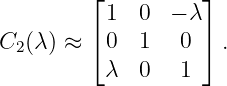
Solution 13: small angle form

For small $\vert\lambda\vert$,

$\displaystyle \cos\lambda\approx 1, \qquad \sin\lambda\approx \lambda. $

Thus

$\displaystyle C_2(\lambda) \approx \begin{bmatrix} 1&0&-\lambda\ 0&1&0\ \lambda&0&1 \end{bmatrix}.$ (18)

Solution 14: build a 3-2-1 passive Euler matrix

For the PhysicsLibrary passive intrinsic $3$-$2$-$1$ sequence,

$\displaystyle \alpha=\psi, \qquad \beta=\theta, \qquad \gamma=\phi. $

Therefore

$\displaystyle {}^{B}C_A = C_1(\phi)C_2(\theta)C_3(\psi).$ (19)

The rightmost factor acts first on a coordinate column.

Solution 15: zero angle specialization

Starting from

$\displaystyle {}^{B}C_A = C_1(\phi)C_2(\theta)C_3(\psi), $

set $\phi=0$ and $\theta=0$. Since

$\displaystyle C_1(0)=I, \qquad C_2(0)=I, $

the product reduces to

$\displaystyle {}^{B}C_A = C_3(\psi).$ (20)

So only the yaw transformation remains.

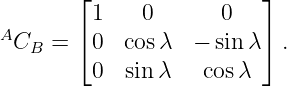
Solution 16: reverse map

If

$\displaystyle {}^{B}C_A=C_1(\lambda), $

then

$\displaystyle {}^{A}C_B = ({}^{B}C_A)^T = C_1(\lambda)^T = C_1(-\lambda).$ (21)

Explicitly,

$\displaystyle {}^{A}C_B = \begin{bmatrix} 1&0&0\ 0&\cos\lambda&-\sin\lambda\ 0&\sin\lambda&\cos\lambda \end{bmatrix}.$ (22)

Solution 17: sign debugging

A quick test is to evaluate the student's matrix at $\lambda=\pi/2$.

This gives

$\displaystyle \widetilde C_3\left(\frac{\pi}{2}\right) = \begin{bmatrix} 0&-1&0\ 1&0&0\ 0&0&1 \end{bmatrix}. $

Applying it to

$\displaystyle \begin{bmatrix} 1\\ 0\\ 0 \end{bmatrix}$

produces

$\displaystyle \begin{bmatrix} 0\\ 1\\ 0 \end{bmatrix}, $

whereas the correct PhysicsLibrary passive matrix should send that vector to

$\displaystyle \begin{bmatrix} 0\\ -1\\ 0 \end{bmatrix}$

for positive frame rotation about $+z$.

So the student's matrix is the active rotation matrix or, equivalently, the passive matrix with the angle sign reversed.

Solution 18: composition order

A coordinate column is multiplied from the right.

Thus in

$\displaystyle {}^{B}C_A = C_k(\gamma)C_j(\beta)C_i(\alpha), $

the first factor acting on ${}^{A}\mathbf v$ is $C_i(\alpha)$.

The result is then acted on by $C_j(\beta)$, and finally by $C_k(\gamma)$.

So the matrix product still represents the chronological intrinsic sequence $i\rightarrow j\rightarrow k$.

Compact review

The essential formulas reinforced in this exercise companion are

$\displaystyle {}^{B}\mathbf v = {}^{B}C_A\,{}^{A}\mathbf v,$ (23)
$\displaystyle C_1(\lambda) = \begin{bmatrix} 1&0&0\ 0&\cos\lambda&\sin\lambda\ 0&-\sin\lambda&\cos\lambda \end{bmatrix},$ (24)
$\displaystyle C_2(\lambda) = \begin{bmatrix} \cos\lambda&0&-\sin\lambda\ 0&1&0\ \sin\lambda&0&\cos\lambda \end{bmatrix},$ (25)
$\displaystyle C_3(\lambda) = \begin{bmatrix} \cos\lambda&\sin\lambda&0\ -\sin\lambda&\cos\lambda&0\ 0&0&1 \end{bmatrix},$ (26)
$\displaystyle C_i(\lambda)^{-1} = C_i(\lambda)^T = C_i(-\lambda),$ (27)

and

$\displaystyle {}^{B}C_A = C_k(\gamma)C_j(\beta)C_i(\alpha).$ (28)

These formulas are the building blocks for all later Euler Angle matrix derivations.

References and further reading

Henderson provides a classic engineering presentation of Euler angles, quaternions, and transformation matrices.

Moore gives a modern passive reference frame treatment.

Diebel provides a compact comparison of attitude representations.

Bibliography

1
D. M. Henderson, Euler Angles, Quaternions, and Transformation Matrices: Working Relationships, JSC-12960, NASA Johnson Space Center, 1977. NASA Technical Reports Server
2
J. K. Moore, Learn Multibody Dynamics, chapter “Orientation of Reference Frames,” 2026 edition. Licensed CC BY 4.0. Orientation of Reference Frames
3
J. Diebel, “Representing Attitude: Euler Angles, Unit Quaternions, and Rotation Vectors,” Stanford University, 2006. Online PDF

License

Unless otherwise noted, this PhysicsLibrary entry is intended for release under the Creative Commons Attribution ShareAlike 4.0 International license.


"example of Euler angles: elementary axis rotations and passive rotation matrices" is owned by bloftin.
(view preamble)
View style:
Keywords:  Euler angles, passive rotation matrix, direction cosine, matrix, elementary rotations, coordinate transformation, exercises

This object's parent.

Cross-references: Euler Angle, composition, matrix product, relation, determinant, vector, formulas, matrices, Euler Angles

This is version 1 of example of Euler angles: elementary axis rotations and passive rotation matrices, born on 2026-08-30.
Object id is 1133, canonical name is ExampleOfEulerAnglesElementaryAxisRotationsAndPassiveRotationMatrices.
Accessed 9 times total.

Classification:
Physics Classification02.40.Yy (Geometric mechanics )
 45.40.-f (Dynamics and kinematics of rigid bodies)
 02.10.Ud (Linear algebra)
Pending Errata and Addenda
None.
Discussion
Style: Expand: Order:

No messages.

Interact
rate | post | correct | update request | add example | add (any)