Physics Library
 An open source physics library
Encyclopedia | Forums | Docs | Random |  
Login
create new user
Username:
Password:
forget your password?
Main Menu
Sections

Meta

Talkback

Downloads

Information
[parent] example of Euler angles: 3-2-1 yaw pitch roll (Example)

Euler Angles: 3-2-1 Yaw Pitch Roll Examples, Exercises, and Solutions

This entry is the self study companion to Euler Angles: 3-2-1 yaw pitch roll.

The problems develop the intrinsic $3$-$2$-$1$ sequence from its moving-frame geometry through the passive direction cosine matrix, aerospace sign interpretation, inverse extraction, singularity, quaternion representation, angular velocity relation, and numerical implementation.

All exercises are stated first. Complete worked solutions follow afterward.

Convention summary

PhysicsLibrary uses the passive coordinate map

$\displaystyle {}^B\mathbf v = {}^BC_A\,{}^A\mathbf v.$ (1)

For intrinsic $3$-$2$-$1$ yaw pitch roll,

$\displaystyle \psi:\ 3_A, \qquad \theta:\ 2_1, \qquad \phi:\ 1_2,$ (2)

and

$\displaystyle {}^BC_A = C_1(\phi)C_2(\theta)C_3(\psi).$ (3)

For a conventional aircraft body frame,

$\displaystyle +x=\hbox{forward}, \qquad +y=\hbox{right}, \qquad +z=\hbox{down}. $

The common principal branch is

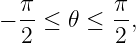
$\displaystyle -\pi<\psi\leq\pi, \qquad -\frac{\pi}{2}\leq\theta\leq\frac{\pi}{2}, \qquad -\pi<\phi\leq\pi.$ (4)

Visual reference

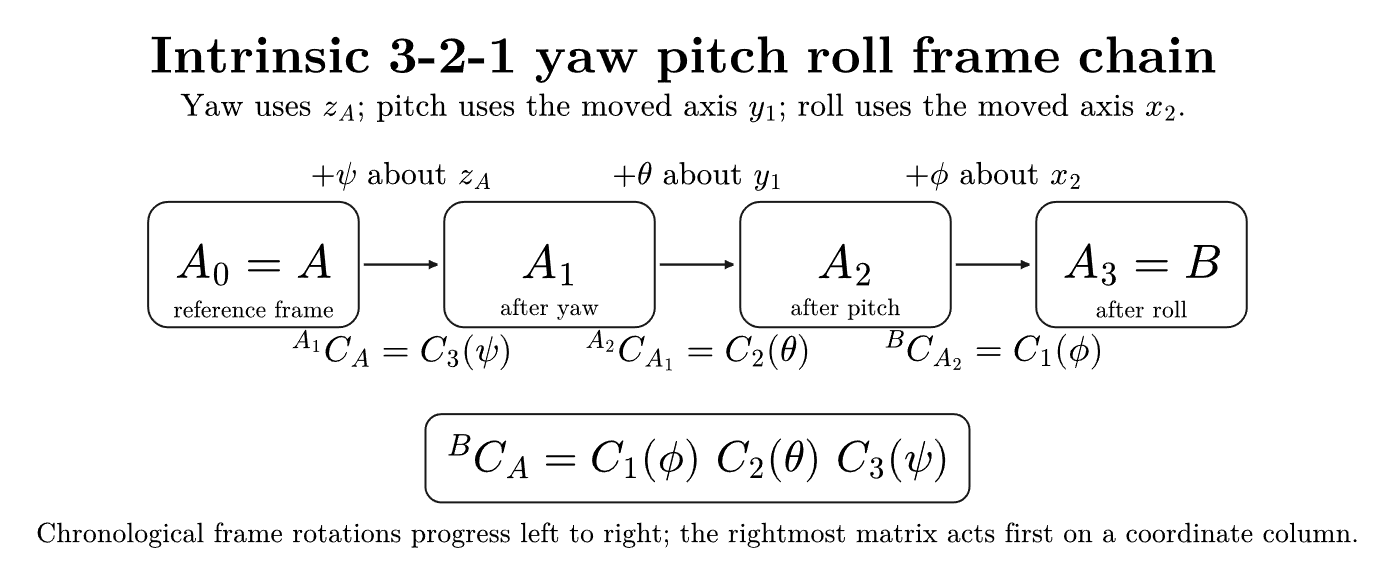
Image EA07_intrinsic_321_frame_chain

Figure. Intrinsic $3$-$2$-$1$ frame chain: yaw about $z_A$, pitch about $y_1$, and roll about $x_2$.
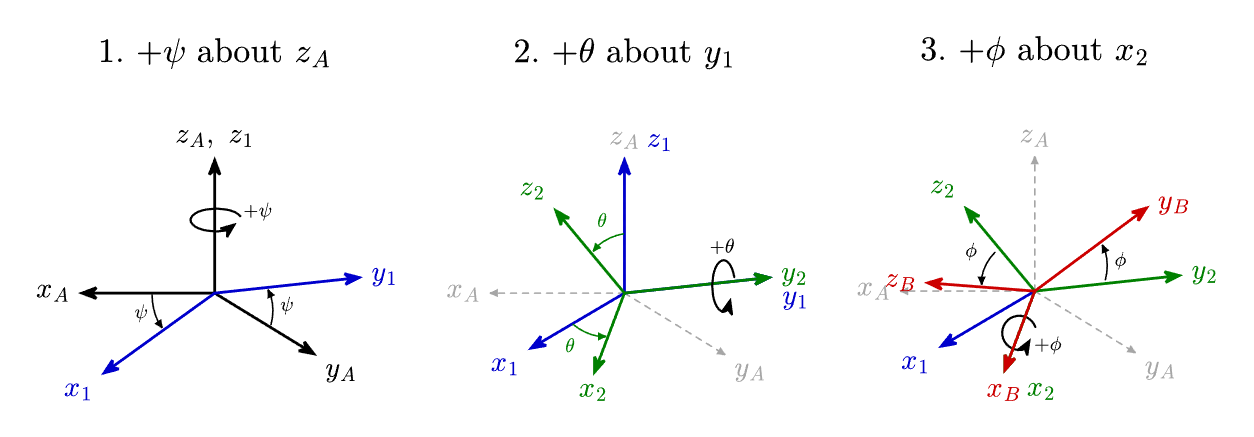
Image EA07_yaw_pitch_roll_positive_directions

Figure. Positive yaw, pitch, and roll directions for the conventional Forward-Right-Down body-axis interpretation.
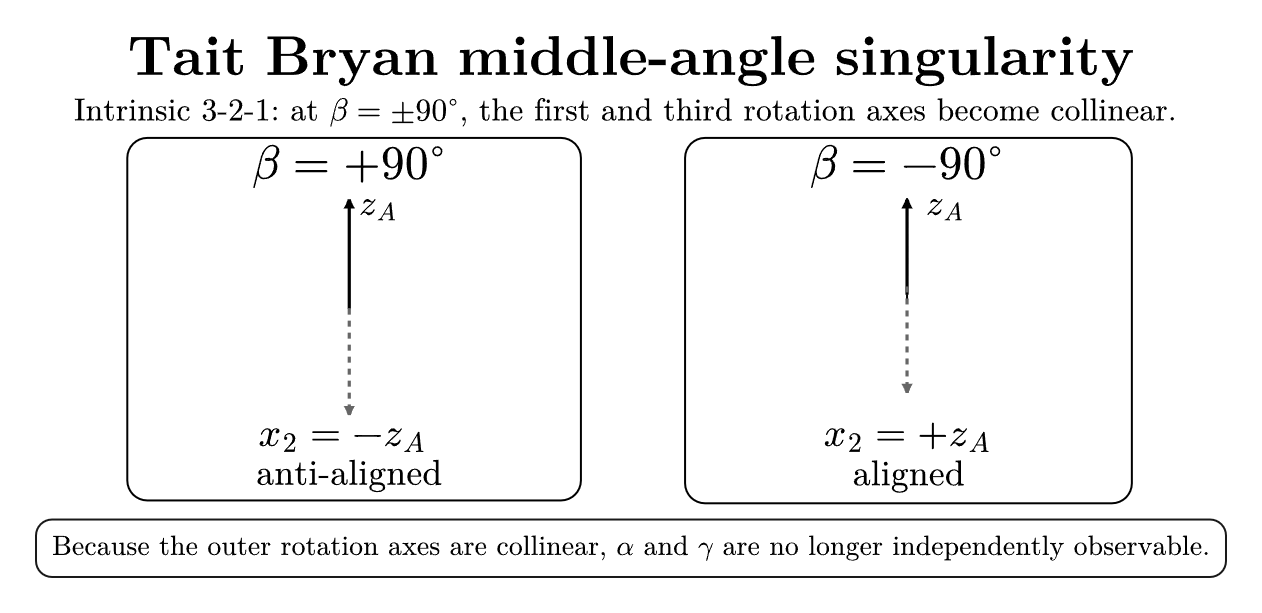
Image EA05_tait_bryan_middle_angle_singularity

Figure. At $\theta=\pm90^\circ$, the first and third physical rotation axes become collinear.

Exercises

  1. Map direction and chronological order.

    State what

    $\displaystyle {}^B\mathbf v={}^BC_A\,{}^A\mathbf v $

    means physically. Then state the chronological intrinsic $3$-$2$-$1$ frame rotations associated with $(\psi,\theta,\phi)$.

  2. Intermediate-frame construction.

    Introduce $A_0,A_1,A_2,A_3$ for intrinsic $3$-$2$-$1$ and write the three frame-labeled passive coordinate maps. Show how they compose to form ${}^BC_A$.

  3. Aerospace positive-angle interpretation.

    For a Forward-Right-Down body frame, explain the physical sense of positive $\psi$, positive $\theta$, and positive $\phi$.

  4. Elementary passive matrices and single-axis checks.

    Write $C_1(\phi)$, $C_2(\theta)$, and $C_3(\psi)$. Then state the three single-angle reductions of the complete $3$-$2$-$1$ DCM.

  5. Derive the full passive 3-2-1 DCM.

    Starting from

    $\displaystyle {}^BC_A=C_1(\phi)C_2(\theta)C_3(\psi), $

    multiply the matrices and obtain all nine elements.

  6. Interpret rows and columns.

    For

    $\displaystyle C={}^BC_A, $

    state the geometric meaning of row $i$ and column $j$. What does the first row represent in the aerospace specialization?

  7. Recover yaw and pitch from the forward axis.

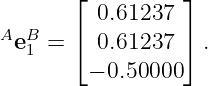
    A body forward axis expressed in North-East-Down coordinates is

    $\displaystyle {}^A\mathbf e_1^B = \begin{bmatrix} 0.61237\ 0.61237\ -0.50000 \end{bmatrix}. $

    Assuming the principal branch, find yaw and pitch. Can roll be obtained from this vector alone?

  8. Principal ranges.

    State the common principal ranges for $\psi$, $\theta$, and $\phi$. Explain why $\cos\theta\geq0$ on this branch.

  9. Inverse DCM extraction.

    For a nonsingular passive DCM

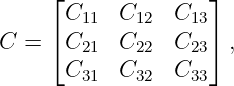
    $\displaystyle C= \begin{bmatrix} C_{11}&C_{12}&C_{13}\ C_{21}&C_{22}&C_{23}\ C_{31}&C_{32}&C_{33} \end{bmatrix}, $

    write the principal extraction formulas for $\theta$, $\phi$, and $\psi$.

  10. Alternative pitch extraction.

    Show why

    $\displaystyle \theta = \operatorname{atan2} \left( -C_{13}, \sqrt{C_{11}^2+C_{12}^2} \right) $

    is equivalent to the principal arcsine formula away from singularity.

  11. Numerical DCM.

    Compute the passive $3$-$2$-$1$ DCM for

    $\displaystyle \psi=30^\circ, \qquad \theta=20^\circ, \qquad \phi=10^\circ. $
  12. Numerical round trip and DCM checks.

    Using the matrix from Exercise 11:

    1. recover $(\psi,\theta,\phi)$;
    2. state the orthogonality check;
    3. state the determinant check;
    4. write the reverse coordinate map.
  13. Locate and interpret the singularity.

    State the $3$-$2$-$1$ singularity condition. Explain geometrically what happens to $z_A$ and $x_2$ at $\theta=+90^\circ$ and $\theta=-90^\circ$.

  14. Exact coupling at positive ninety degrees.

    Set

    $\displaystyle \theta=+\frac{\pi}{2} $

    in the full $3$-$2$-$1$ DCM and show that only one combination of yaw and roll remains observable. Identify that combination.

  15. Exact coupling at negative ninety degrees.

    Repeat Exercise 14 for

    $\displaystyle \theta=-\frac{\pi}{2}. $

    Which combination of yaw and roll remains observable?

  16. A singular-case software convention.

    At $\theta=+90^\circ$, suppose the original Euler angles are

    $\displaystyle \psi=50^\circ, \qquad \phi=20^\circ. $

    The implementation chooses $\phi=0$ at singularity. What yaw should it return so that the same orientation is represented?

  17. Equivalent extrinsic description.

    Write the extrinsic sequence and chronological angle order equivalent to intrinsic

    $\displaystyle 3$-$\displaystyle 2$-$\displaystyle 1(\psi,\theta,\phi). $
  18. Active versus passive.

    If $C={}^BC_A$ is the PhysicsLibrary passive $3$-$2$-$1$ matrix, what active rotation matrix represents the corresponding physical rotation? Explain why transposed formulas often appear in references.

  19. Passive quaternion composition.

    Write the passive Hamilton quaternion product corresponding to intrinsic $3$-$2$-$1$. Then write its four scalar-first components in terms of half-angle sines and cosines.

  20. Numerical quaternion consistency.

    For

    $\displaystyle (\psi,\theta,\phi)=(30^\circ,20^\circ,10^\circ), $

    compute the passive quaternion and state the DCM consistency relation that should hold.

  21. Euler rates to body angular velocity.

    At

    $\displaystyle \phi=10^\circ, \qquad \theta=20^\circ, $

    let

    $\displaystyle \dot\phi=5^\circ/{\rm s}, \qquad \dot\theta=2^\circ/{\rm s}, \qquad \dot\psi=3^\circ/{\rm s}. $

    Compute the body angular velocity components $(p,q,r)$.

  22. Body angular velocity to Euler rates.

    At the same attitude, suppose

    $\displaystyle p=3.97394^\circ/{\rm s}, \qquad q=2.45914^\circ/{\rm s}, \qquad r=2.42895^\circ/{\rm s}. $

    Recover $(\dot\phi,\dot\theta,\dot\psi)$. Why does this inverse relation become singular at $\theta=\pm90^\circ$?

  23. Small-angle approximation.

    Derive the first-order passive DCM for small $(\phi,\theta,\psi)$ and express it using the cross-product matrix of

    $\displaystyle \boldsymbol\epsilon= \begin{bmatrix} \phi\\ \theta\\ \psi \end{bmatrix}. $
  24. Exact relative attitude versus Euler subtraction.

    Two body attitudes relative to the same reference frame are

    $\displaystyle (\psi_1,\theta_1,\phi_1) = (10^\circ,5^\circ,-2^\circ) $

    and

    $\displaystyle (\psi_2,\theta_2,\phi_2) = (15^\circ,8^\circ,1^\circ). $

    First form the naive Euler-coordinate difference. Then describe the correct DCM operation for the exact relative attitude. The exact relative $3$-$2$-$1$ principal angles are approximately

    $\displaystyle (5.060^\circ,2.844^\circ,2.559^\circ). $

    Explain what this comparison demonstrates.

  25. Convention and implementation audit.

    A source says only “use yaw pitch roll.” List at least eight convention or implementation questions that should be answered before directly copying its formulas into a PhysicsLibrary implementation.

Solutions

Solution 1: map direction and chronological order

The equation

$\displaystyle {}^B\mathbf v={}^BC_A\,{}^A\mathbf v $

means that the physical vector is unchanged while its coordinates are re-expressed from frame $A$ into frame $B$.

The chronological intrinsic rotations are

$\displaystyle +\psi\hbox{ about }3_A, \qquad +\theta\hbox{ about }2_1, \qquad +\phi\hbox{ about }1_2.$ (5)

Thus the first axis belongs to the initial frame, while the second and third axes belong to successive intermediate frames.

Solution 2: intermediate-frame construction

Let

$\displaystyle A_0=A, \qquad A_3=B. $

The three passive frame maps are

$\displaystyle {}^{A_1}C_A=C_3(\psi),$ (6)
$\displaystyle {}^{A_2}C_{A_1}=C_2(\theta),$ (7)

and

$\displaystyle {}^BC_{A_2}=C_1(\phi).$ (8)

Matching adjacent frame labels gives

$\displaystyle {}^BC_A = {}^BC_{A_2}\,{}^{A_2}C_{A_1}\,{}^{A_1}C_A = C_1(\phi)C_2(\theta)C_3(\psi).$ (9)

Solution 3: aerospace positive-angle interpretation

For Forward-Right-Down axes:

  • positive yaw rotates the current $x$ axis toward the current $y$ axis;
  • positive pitch rotates the current $x$ axis toward the negative current $z$ direction, corresponding to nose up;
  • positive roll rotates the current $y$ axis toward the current $z$ axis, corresponding to right wing down.

These are physical frame rotations following the right hand rule.

Solution 4: elementary passive matrices and single-axis checks

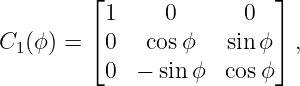
The passive elementary matrices are

$\displaystyle C_1(\phi) = \begin{bmatrix} 1&0&0\ 0&\cos\phi&\sin\phi\ 0&-\sin\phi&\cos\phi \end{bmatrix},$ (10)
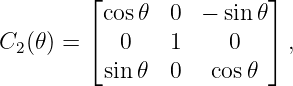
$\displaystyle C_2(\theta) = \begin{bmatrix} \cos\theta&0&-\sin\theta\ 0&1&0\ \sin\theta&0&\cos\theta \end{bmatrix},$ (11)

and

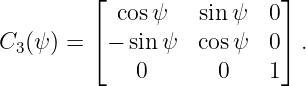
$\displaystyle C_3(\psi) = \begin{bmatrix} \cos\psi&\sin\psi&0\ -\sin\psi&\cos\psi&0\ 0&0&1 \end{bmatrix}.$ (12)

Therefore

$\displaystyle \theta=\phi=0 \quad\Longrightarrow\quad {}^BC_A=C_3(\psi),$ (13)
$\displaystyle \psi=\phi=0 \quad\Longrightarrow\quad {}^BC_A=C_2(\theta),$ (14)

and

$\displaystyle \psi=\theta=0 \quad\Longrightarrow\quad {}^BC_A=C_1(\phi).$ (15)

Solution 5: derive the full passive 3-2-1 DCM

Use

$\displaystyle c_\phi=\cos\phi, \qquad s_\phi=\sin\phi, $

with analogous notation for $\theta$ and $\psi$.

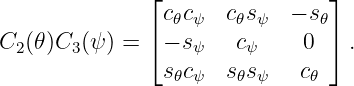
First,

$\displaystyle C_2(\theta)C_3(\psi) = \begin{bmatrix} c_\theta c_\psi & c_\theta... ...psi & c_\psi & 0\ s_\theta c_\psi & s_\theta s_\psi & c_\theta \end{bmatrix}.$ (16)

Premultiplication by $C_1(\phi)$ gives

$\displaystyle {}^BC_A = \begin{bmatrix} c_\theta c_\psi & c_\theta s_\psi & -s_... ... s_\psi & c_\phi s_\theta s_\psi-s_\phi c_\psi & c_\phi c_\theta \end{bmatrix}.$ (17)

Solution 6: interpret rows and columns

For

$\displaystyle C={}^BC_A, $

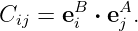
its entries satisfy

$\displaystyle C_{ij}=\mathbf e_i^B\mathbin{\boldsymbol{\cdot}}\mathbf e_j^A.$ (18)

Thus row $i$ is the body basis vector $\mathbf e_i^B$ expressed in frame $A$, and column $j$ is the reference basis vector $\mathbf e_j^A$ expressed in frame $B$.

The first row is the body forward axis expressed in the reference frame:

$\displaystyle {}^A\mathbf e_1^B = \begin{bmatrix} c_\theta c_\psi & c_\theta s_\psi & -s_\theta \end{bmatrix}.$ (19)

Solution 7: recover yaw and pitch from the forward axis

The horizontal components are equal and positive, so

$\displaystyle \psi = \operatorname{atan2}(0.61237,0.61237) = 45^\circ.$ (20)

The Down component gives

$\displaystyle -\sin\theta=-0.50000, $

hence

$\displaystyle \theta=30^\circ.$ (21)

Roll cannot be determined from the forward axis alone because the final roll is about that same forward axis and therefore does not change its direction.

Solution 8: principal ranges

A common principal branch is

$\displaystyle -\pi<\psi\leq\pi,$ (22)
$\displaystyle -\frac{\pi}{2}\leq\theta\leq\frac{\pi}{2},$ (23)

and

$\displaystyle -\pi<\phi\leq\pi.$ (24)

Because $\theta$ lies between minus and plus ninety degrees,

$\displaystyle \cos\theta\geq0.$ (25)

Solution 9: inverse DCM extraction

Away from the singularity,

$\displaystyle \theta=\arcsin(-C_{13}),$ (26)
$\displaystyle \phi=\operatorname{atan2}(C_{23},C_{33}),$ (27)

and

$\displaystyle \psi=\operatorname{atan2}(C_{12},C_{11}).$ (28)

The two-argument arctangent is required to preserve the correct quadrant.

Solution 10: alternative pitch extraction

From the first row of the DCM,

$\displaystyle C_{11}=c_\theta c_\psi, \qquad C_{12}=c_\theta s_\psi. $

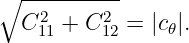
Therefore

$\displaystyle \sqrt{C_{11}^2+C_{12}^2} = \vert c_\theta\vert.$ (29)

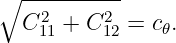
On the principal branch, $c_\theta\geq0$, so

$\displaystyle \sqrt{C_{11}^2+C_{12}^2}=c_\theta.$ (30)

Since

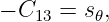
$\displaystyle -C_{13}=s_\theta, $

the atan2 expression uses $(\sin\theta,\cos\theta)$ and returns the same principal pitch.

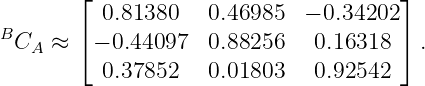
Solution 11: numerical DCM

For

$\displaystyle \psi=30^\circ, \qquad \theta=20^\circ, \qquad \phi=10^\circ, $
$\displaystyle {}^BC_A \approx \begin{bmatrix} 0.81380&0.46985&-0.34202\ -0.44097&0.88256&0.16318\ 0.37852&0.01803&0.92542 \end{bmatrix}.$ (31)

Solution 12: numerical round trip and DCM checks

The extraction equations give

$\displaystyle \theta = \arcsin(0.34202) \approx20^\circ, $

$\displaystyle \phi = \operatorname{atan2}(0.16318,0.92542) \approx10^\circ, $

and

$\displaystyle \psi = \operatorname{atan2}(0.46985,0.81380) \approx30^\circ. $

Thus

$\displaystyle (\psi,\theta,\phi) = (30^\circ,20^\circ,10^\circ).$ (32)

A valid DCM must satisfy

$\displaystyle CC^T=I,$ (33)

and

$\displaystyle \det C=1.$ (34)

The reverse map is

$\displaystyle {}^AC_B=({}^BC_A)^T.$ (35)

Solution 13: locate and interpret the singularity

The singularity condition is

$\displaystyle \cos\theta=0,$ (36)

so

$\displaystyle \theta=\pm\frac{\pi}{2}.$ (37)

At $\theta=+90^\circ$, the third rotation axis $x_2$ is anti-aligned with the first rotation axis $z_A$:

$\displaystyle x_2=-z_A.$ (38)

At $\theta=-90^\circ$, they are aligned:

$\displaystyle x_2=+z_A.$ (39)

The physical orientation remains valid; only the Euler coordinate chart loses local uniqueness.

Solution 14: exact coupling at positive ninety degrees

Setting

$\displaystyle \theta=+\frac{\pi}{2} $

in the full DCM gives

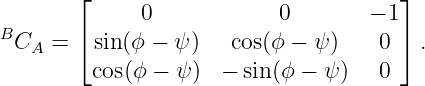
$\displaystyle {}^BC_A = \begin{bmatrix} 0&0&-1\ \sin(\phi-\psi)&\cos(\phi-\psi)&0\ \cos(\phi-\psi)&-\sin(\phi-\psi)&0 \end{bmatrix}.$ (40)

Only

$\displaystyle \phi-\psi$ (41)

appears. Therefore yaw and roll cannot be recovered independently.

Solution 15: exact coupling at negative ninety degrees

At

$\displaystyle \theta=-\frac{\pi}{2}, $
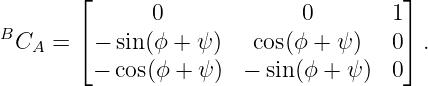
$\displaystyle {}^BC_A = \begin{bmatrix} 0&0&1\ -\sin(\phi+\psi)&\cos(\phi+\psi)&0\ -\cos(\phi+\psi)&-\sin(\phi+\psi)&0 \end{bmatrix}.$ (42)

Only

$\displaystyle \phi+\psi$ (43)

is observable.

Solution 16: a singular-case software convention

At positive ninety degrees,

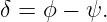
$\displaystyle \delta=\phi-\psi. $

For the original angles,

$\displaystyle \delta=20^\circ-50^\circ=-30^\circ.$ (44)

If software imposes

$\displaystyle \phi=0, $

then it must satisfy

$\displaystyle 0-\psi=-30^\circ. $

Therefore it should return

$\displaystyle \psi=30^\circ, \qquad \phi=0.$ (45)

This new pair represents the same singular orientation because the observable combination remains $\phi-\psi=-30^\circ$.

Solution 17: equivalent extrinsic description

Reverse the axis order and angle association:

intrinsic $\displaystyle 3$-$\displaystyle 2$-$\displaystyle 1 (\psi,\theta,\phi) \equiv$   extrinsic $\displaystyle 1$-$\displaystyle 2$-$\displaystyle 3 (\phi,\theta,\psi).$ (46)

Both descriptions produce the same final orientation and the same passive DCM.

Solution 18: active versus passive

The corresponding active rotation matrix is

$\displaystyle R_{\rm active}=({}^BC_A)^T.$ (47)

Thus an active-vector reference can legitimately display the transpose of the PhysicsLibrary passive coordinate map. Apparent sign or factor-order conflicts should be investigated at the transformation-semantics level before being called errors.

Solution 19: passive quaternion composition

For a positive passive frame rotation,

$\displaystyle q_i^P(\lambda) = \cos\frac{\lambda}{2} - \mathbf e_i\sin\frac{\lambda}{2}. $

Therefore

$\displaystyle {}^Bq_A = q_1^P(\phi)q_2^P(\theta)q_3^P(\psi).$ (48)

Define

$\displaystyle c_{\phi/2}=\cos\frac{\phi}{2}, \qquad s_{\phi/2}=\sin\frac{\phi}{2}, $

with analogous notation for $\theta$ and $\psi$.

Using Hamilton multiplication and scalar-first storage,

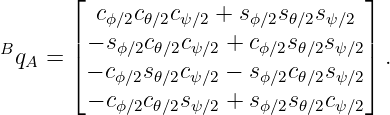
$\displaystyle {}^Bq_A = \begin{bmatrix} c_{\phi/2}c_{\theta/2}c_{\psi/2} +s_{\p... ...{\phi/2}c_{\theta/2}s_{\psi/2} +s_{\phi/2}s_{\theta/2}c_{\psi/2} \end{bmatrix}.$ (49)

Solution 20: numerical quaternion consistency

For

$\displaystyle (\psi,\theta,\phi) = (30^\circ,20^\circ,10^\circ), $

the passive quaternion is approximately

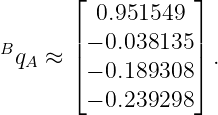
$\displaystyle {}^Bq_A \approx \begin{bmatrix} 0.951549\ -0.038135\ -0.189308\ -0.239298 \end{bmatrix}.$ (50)

It should have unit norm to numerical precision and satisfy

$\displaystyle {}^BC_A=C({}^Bq_A).$ (51)

This is one of the strongest convention checks available because it compares two independent attitude representations.

Solution 21: Euler rates to body angular velocity

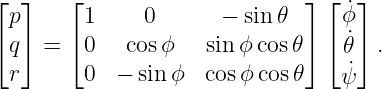
For intrinsic $3$-$2$-$1$,

$\displaystyle \begin{bmatrix} p\\ q\\ r \end{bmatrix}= \begin{bmatrix} 1&0&-\si... ...ta \end{bmatrix}\begin{bmatrix} \dot\phi\\ \dot\theta\\ \dot\psi \end{bmatrix}.$ (52)

At $\phi=10^\circ$, $\theta=20^\circ$, and the stated Euler rates,

$\displaystyle p\approx3.97394^\circ/{\rm s},$ (53)
$\displaystyle q\approx2.45914^\circ/{\rm s},$ (54)

and

$\displaystyle r\approx2.42895^\circ/{\rm s}.$ (55)

Thus $(p,q,r)$ are not simply $(\dot\phi,\dot\theta,\dot\psi)$.

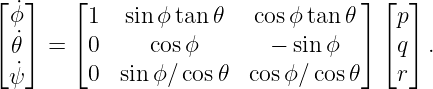
Solution 22: body angular velocity to Euler rates

Away from the singularity,

$\displaystyle \begin{bmatrix} \dot\phi\\ \dot\theta\\ \dot\psi \end{bmatrix}= \... ...theta&\cos\phi/\cos\theta \end{bmatrix}\begin{bmatrix} p\\ q\\ r \end{bmatrix}.$ (56)

Substitution gives approximately

$\displaystyle \dot\phi=5.00000^\circ/{\rm s}, \qquad \dot\theta=2.00000^\circ/{\rm s}, \qquad \dot\psi=3.00000^\circ/{\rm s}.$ (57)

The inverse contains $\tan\theta$ and $1/\cos\theta$. It therefore becomes singular when

$\displaystyle \cos\theta=0.$ (58)

This is the same geometric singularity found in the Euler coordinate chart.

Solution 23: small-angle approximation

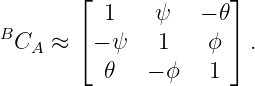
For small angles,

$\displaystyle \sin\lambda\approx\lambda, \qquad \cos\lambda\approx1. $

Keeping only first-order terms gives

$\displaystyle {}^BC_A \approx \begin{bmatrix} 1&\psi&-\theta\ -\psi&1&\phi\ \theta&-\phi&1 \end{bmatrix}.$ (59)

Define

$\displaystyle \boldsymbol\epsilon = \begin{bmatrix} \phi\\ \theta\\ \psi \end{bmatrix}. $

Then

$\displaystyle {}^BC_A \approx I-[\boldsymbol\epsilon\times].$ (60)

This local relationship does not make finite yaw pitch roll triples ordinary vectors.

Solution 24: exact relative attitude versus Euler subtraction

The naive coordinate difference is

$\displaystyle (\Delta\psi,\Delta\theta,\Delta\phi) = (5^\circ,3^\circ,3^\circ).$ (61)

Let

$\displaystyle C_1={}^{{B_1}}C_A, \qquad C_2={}^{{B_2}}C_A. $

The exact passive relative map from frame $B_1$ coordinates to frame $B_2$ coordinates is

$\displaystyle {}^{{B_2}}C_{{B_1}} = C_2C_1^T.$ (62)

For the stated attitudes,

$\displaystyle {}^{{B_2}}C_{{B_1}} \approx \begin{bmatrix} 0.99488&0.08809&-0.04962\ -0.08591&0.99530&0.04460\ 0.05332&-0.04010&0.99777 \end{bmatrix}.$ (63)

Extracting intrinsic $3$-$2$-$1$ principal angles gives approximately

$\displaystyle (\psi_{\rm rel},\theta_{\rm rel},\phi_{\rm rel}) = (5.060^\circ,2.844^\circ,2.559^\circ).$ (64)

This differs from $(5^\circ,3^\circ,3^\circ)$ because Euler coordinates are nonlinear sequence-dependent coordinates. Exact finite relative attitude must be formed by attitude composition rather than coordinate subtraction.

Solution 25: convention and implementation audit

Before copying a yaw pitch roll formula, determine at least:

  1. whether the sequence is intrinsic or extrinsic;
  2. whether the transformation is active or passive;
  3. the coordinate-map direction;
  4. whether vectors are represented as columns or rows;
  5. the positive-angle convention;
  6. whether $3$-$2$-$1$ denotes chronological rotations or written matrix factor order;
  7. the reference-frame axis directions, such as North-East-Down or East-North-Up;
  8. the body-axis convention, such as Forward-Right-Down;
  9. the principal Euler angle ranges;
  10. the singular-case extraction policy;
  11. the quaternion multiplication and storage conventions if quaternions are also used;
  12. whether body angular velocity or Euler angle rates are being supplied by the software interface.

A robust implementation should also verify zero-angle and single-axis cases, orthogonality, determinant $+1$, transpose reversal, DCM-to-Euler round trips, quaternion agreement, and expected behavior near the pitch singularity.

Compact review

The passive intrinsic $3$-$2$-$1$ map is

$\displaystyle {}^BC_A=C_1(\phi)C_2(\theta)C_3(\psi).$ (65)

Away from singularity,

$\displaystyle \theta=\arcsin(-C_{13}),$ (66)
$\displaystyle \phi=\operatorname{atan2}(C_{23},C_{33}),$ (67)

and

$\displaystyle \psi=\operatorname{atan2}(C_{12},C_{11}).$ (68)

The singularity is

$\displaystyle \cos\theta=0,$ (69)

with outer-angle coupling

$\displaystyle \phi-\psi \qquad\hbox{at}\qquad \theta=+\frac{\pi}{2},$ (70)

and

$\displaystyle \phi+\psi \qquad\hbox{at}\qquad \theta=-\frac{\pi}{2}.$ (71)

The passive quaternion is

$\displaystyle {}^Bq_A=q_1^P(\phi)q_2^P(\theta)q_3^P(\psi).$ (72)

Body angular velocity and Euler coordinate rates are related by a state-dependent matrix and are not generally equal component by component.

Sources and exercise provenance

The exercises and worked solutions in this companion are newly written for PhysicsLibrary to reinforce the convention and derivations developed in Euler angles: 3-2-1 yaw pitch roll.

Bibliography

1
D. M. Henderson, Euler Angles, Quaternions, and Transformation Matrices: Working Relationships, JSC-12960, NASA Johnson Space Center, 1977. NASA Technical Reports Server
2
Federal Aviation Administration, Pilot's Handbook of Aeronautical Knowledge, FAA-H-8083-25C, 2023. FAA Pilot's Handbook of Aeronautical Knowledge
3
J. Diebel, “Representing Attitude: Euler Angles, Unit Quaternions, and Rotation Vectors,” Stanford University, 2006. Online PDF
4
SciPy Developers, “Rotation.from_euler,” SciPy documentation. SciPy Euler rotation documentation

License

Unless otherwise noted, this PhysicsLibrary entry is intended for release under the Creative Commons Attribution ShareAlike 4.0 International license.


"example of Euler angles: 3-2-1 yaw pitch roll" is owned by bloftin.
(view preamble)
View style:
Keywords:  Euler angles, 3-2-1 sequence, yaw pitch roll, aerospace attitude, passive transformation, direction cosine matrix, gimbal lock, quaternion, Euler rates, exercises, worked solutions

This object's parent.

Cross-references: norm, operation, reference frame, relative attitude, quaternion product, composition, observable, determinant, formulas, vector, matrices, relation, velocity, representation, quaternion, direction cosine matrix, Euler Angles

This is version 1 of example of Euler angles: 3-2-1 yaw pitch roll, born on 2026-08-30.
Object id is 1132, canonical name is ExampleOfEulerAngles321YawPitchRoll.
Accessed 31 times total.

Classification:
Physics Classification45.40.-f (Dynamics and kinematics of rigid bodies)
 02.40.Yy (Geometric mechanics )
 06.30.Gv (Velocity, acceleration, and rotation)
Pending Errata and Addenda
None.
Discussion
Style: Expand: Order:

No messages.

Interact
rate | post | correct | update request | add example | add (any)