|
|
|
|||||||
For intrinsic i-j-k,
For Tait Bryan angles,
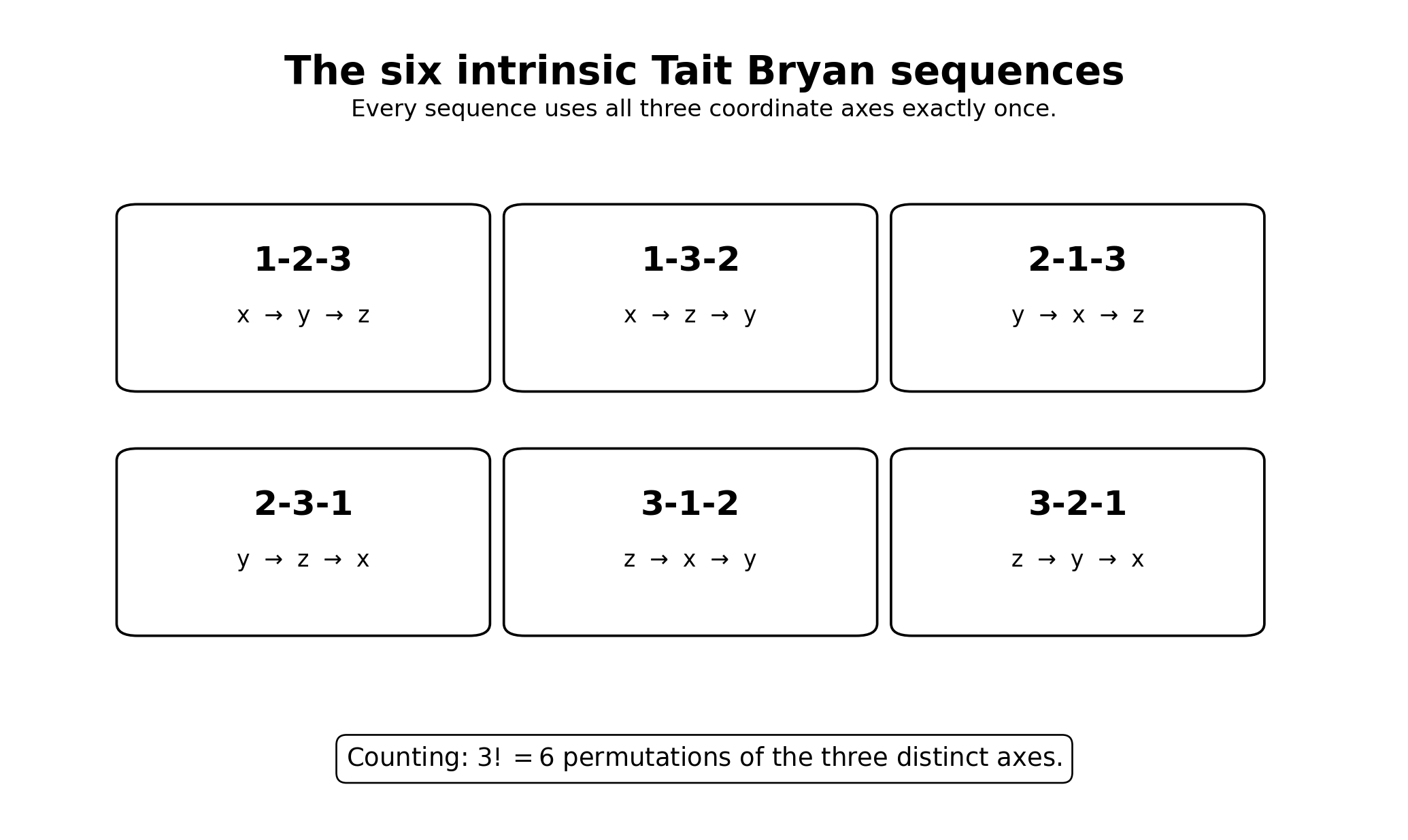
The six intrinsic Tait Bryan sequences are
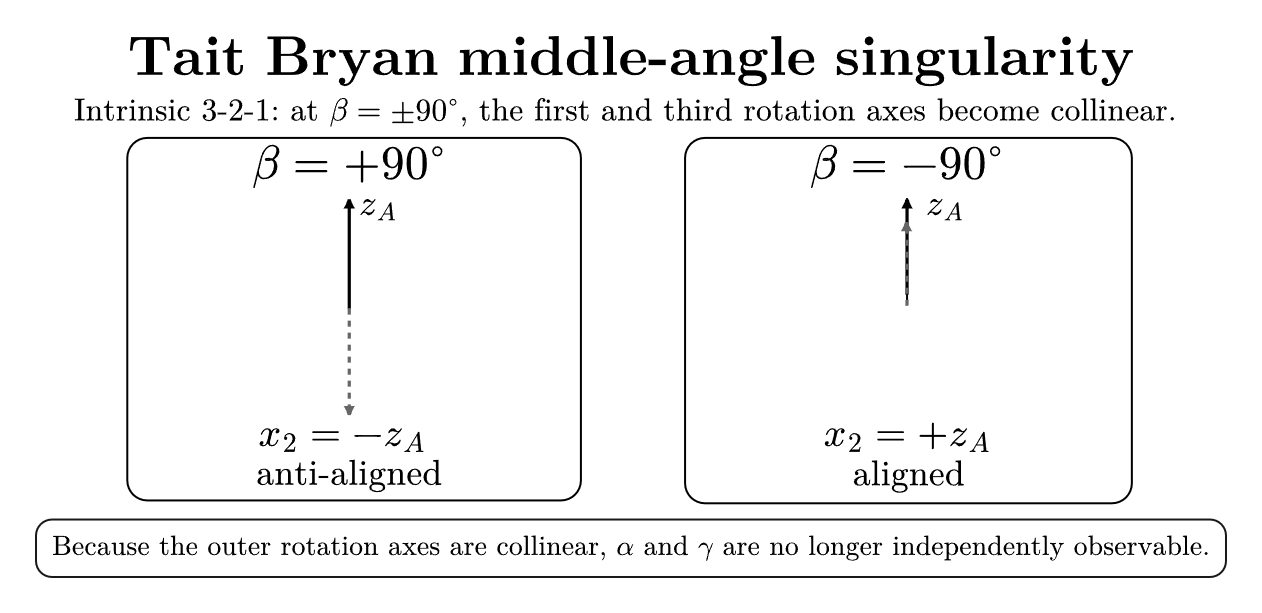
Their generic middle-angle singularity is
For the aerospace intrinsic 3-2-1 sequence,
and
2 Visual reference
Figure. The six intrinsic Tait Bryan sequences.
Figure. The generic Tait Bryan singularity illustrated with intrinsic 3-2-1.
3 Exercises
4 Solutions
Solution 1: recognize a Tait Bryan sequenceA Tait Bryan sequence uses all three axes exactly once. Therefore
 are Tait Bryan. The sequences
 are proper Euler because the first and third axis labels match.
Solution 2: generate the six sequencesChoose a first axis in three ways. Then arrange the remaining two axes in two possible orders. Therefore
 The six sequences are
Solution 3: write all six passive productsUsing
 the six products are
and
Solution 4: sequence from a matrix productCompare
 with
 Thus
 The chronological intrinsic sequence is
Solution 5: another sequence from a matrix productFor
 we identify
 Therefore the sequence is
Solution 6: single-angle checks for 2-3-1From
 we obtain
and
Solution 7: universal singularity conditionFor every Tait Bryan sequence, the Jacobian from Euler coordinate rates to angular velocity loses rank when the first and third physical rotation axes become collinear. That occurs when the middle rotation turns through a right angle:
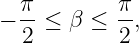
On the usual principal branch,
so the singular values are
Solution 8: interpret the singularity geometricallyFor intrinsic 3-2-1, the first rotation axis is zA. The third rotation is about x2. At
 the axis x2 becomes anti-aligned with zA. At
 the axis x2 becomes aligned with zA. Thus the first and third rotations are about the same physical line, so yaw and roll can no longer be determined independently.
Solution 9: why the physical orientation remains validThe rigid body still has a perfectly valid orientation in three-dimensional space. Only the chosen three-coordinate parameterization loses local uniqueness. A quaternion or DCM remains nonsingular at the same physical attitude. Therefore gimbal lock is a coordinate singularity, not a disappearance of physical orientation.
Solution 10: aerospace notationPhysicsLibrary uses

 and
 Thus
Solution 11: expand the first row of the 3-2-1 DCMFirst multiply
 The first row of that product is
![[ ]
c𝜃cψ c𝜃sψ − s𝜃 .](https://images.physicslibrary.org/cache/objects/1128/make4ht/ExampleOfEulerAnglesTaitBryanAngles54x.png) Premultiplication by C1(ϕ) leaves the first row unchanged because the first row of C1(ϕ) is
![[1 0 0].](https://images.physicslibrary.org/cache/objects/1128/make4ht/ExampleOfEulerAnglesTaitBryanAngles55x.png) Therefore the first row of the full DCM is
Solution 12: extract yaw pitch rollOn the nonsingular principal branch,
and
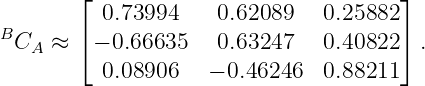
Solution 13: numerical yaw pitch roll matrixWith
 the passive DCM is
Solution 14: numerical round tripFrom the matrix,
 Thus
 Next,
 and
 Therefore the principal round trip recovers
Solution 15: equivalent extrinsic descriptionReverse both axis order and associated angle order:
Solution 16: another intrinsic/extrinsic conversionFor intrinsic 1-3-2,
Solution 17: Tait Bryan triples are not vectorsEuler coordinates are nonlinear sequence-dependent coordinates. The second and third rotations occur about intermediate axes whose directions depend on earlier rotations. Therefore subtracting coordinate triples does not reproduce exact finite rotation composition. The exact relative attitude should instead be computed from DCMs or quaternions.
Solution 18: quaternion counterpartFor intrinsic 3-2-1 yaw pitch roll,
The quaternion and DCM must satisfy
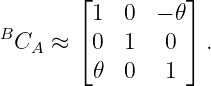
Solution 19: small pitch caseWith
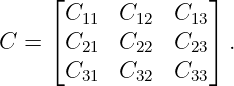
 the DCM reduces to
 For small |𝜃|,
 Thus
Solution 20: convention auditBefore comparing the textbook formula with PhysicsLibrary, one should ask:
Without those declarations, identical-looking symbols can represent different transformations.
5 Compact reviewTait Bryan sequences use the three coordinate axes exactly once:
For intrinsic i-j-k,
Their generic singularity is
For aerospace intrinsic 3-2-1,
with
and
6 Sources and exercise provenanceThe exercises and solutions in this companion are newly written for PhysicsLibrary to reinforce the Tait Bryan framework developed in Euler angles: Tait Bryan angles.
References
[1] D. M. Henderson, Euler Angles, Quaternions, and Transformation Matrices: Working Relationships, JSC-12960, NASA Johnson Space Center, 1977. NASA Technical Reports Server [2] J. Diebel, “Representing Attitude: Euler Angles, Unit Quaternions, and Rotation Vectors,” Stanford University, 2006. Online PDF [3] H. Goldstein, C. Poole, and J. Safko, Classical Mechanics, 3rd ed., Addison Wesley, 2002. Publisher search
LicenseUnless otherwise noted, this PhysicsLibrary entry is intended for release under the Creative Commons Attribution ShareAlike 4.0 International license. "example of Euler angles: Tait Bryan angles" is owned by bloftin.
This object's parent. Cross-references: operator, composition, angular velocity, Jacobian, quaternion product, relative attitude, vectors, formulas, rigid body, matrix, Tait Bryan sequence, Tait Bryan sequences, representations, quaternion, matrix products, Euler Angles This is version 3 of example of Euler angles: Tait Bryan angles, born on 2026-08-29, modified 2026-08-30. Object id is 1128, canonical name is ExampleOfEulerAnglesTaitBryanAngles. Accessed 222 times total. Classification:
|
|
|
|
Pending Errata and AddendaNone.
|
DiscussionNo messages.
|
Interact |
![[parent]](https://images.physicslibrary.org/images/uparrow.png)



































![[ ]
c𝜃cψ c𝜃sψ − s𝜃 .](https://images.physicslibrary.org/cache/objects/1128/make4ht/ExampleOfEulerAnglesTaitBryanAngles56x.png)