|
|
|
|||||||
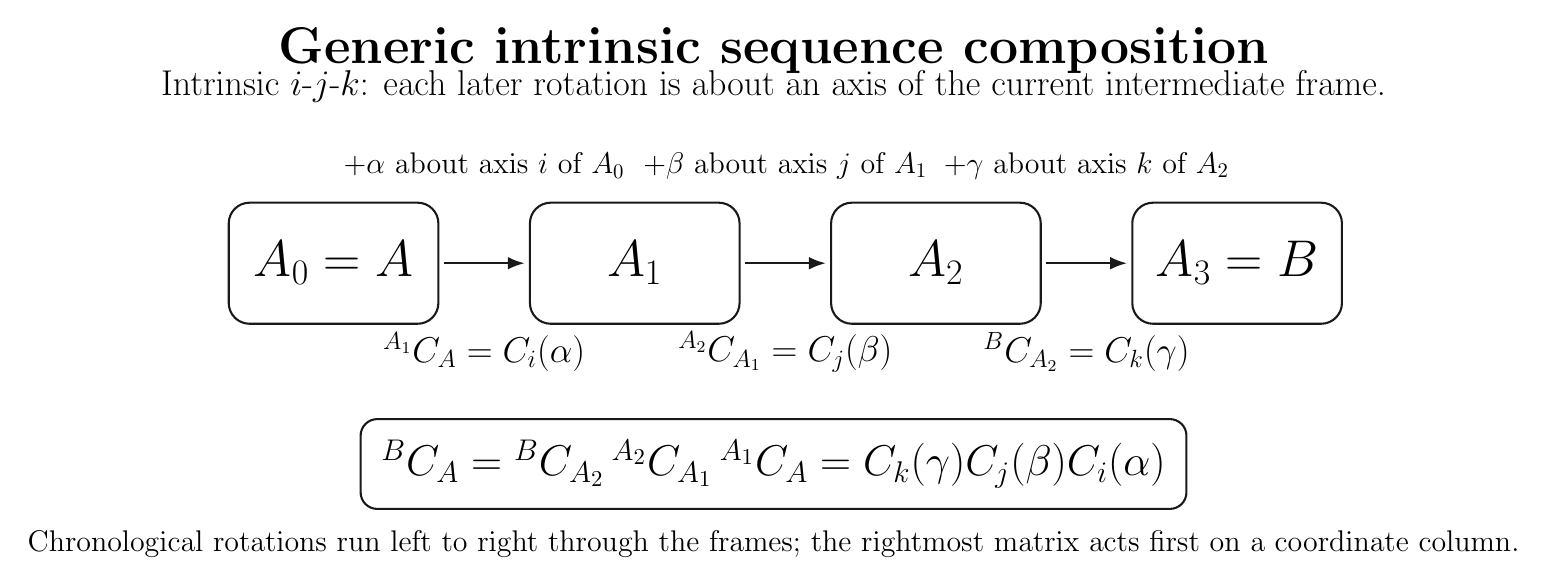
For intrinsic i-j-k,
For extrinsic i-j-k,
The reverse-order equivalence is
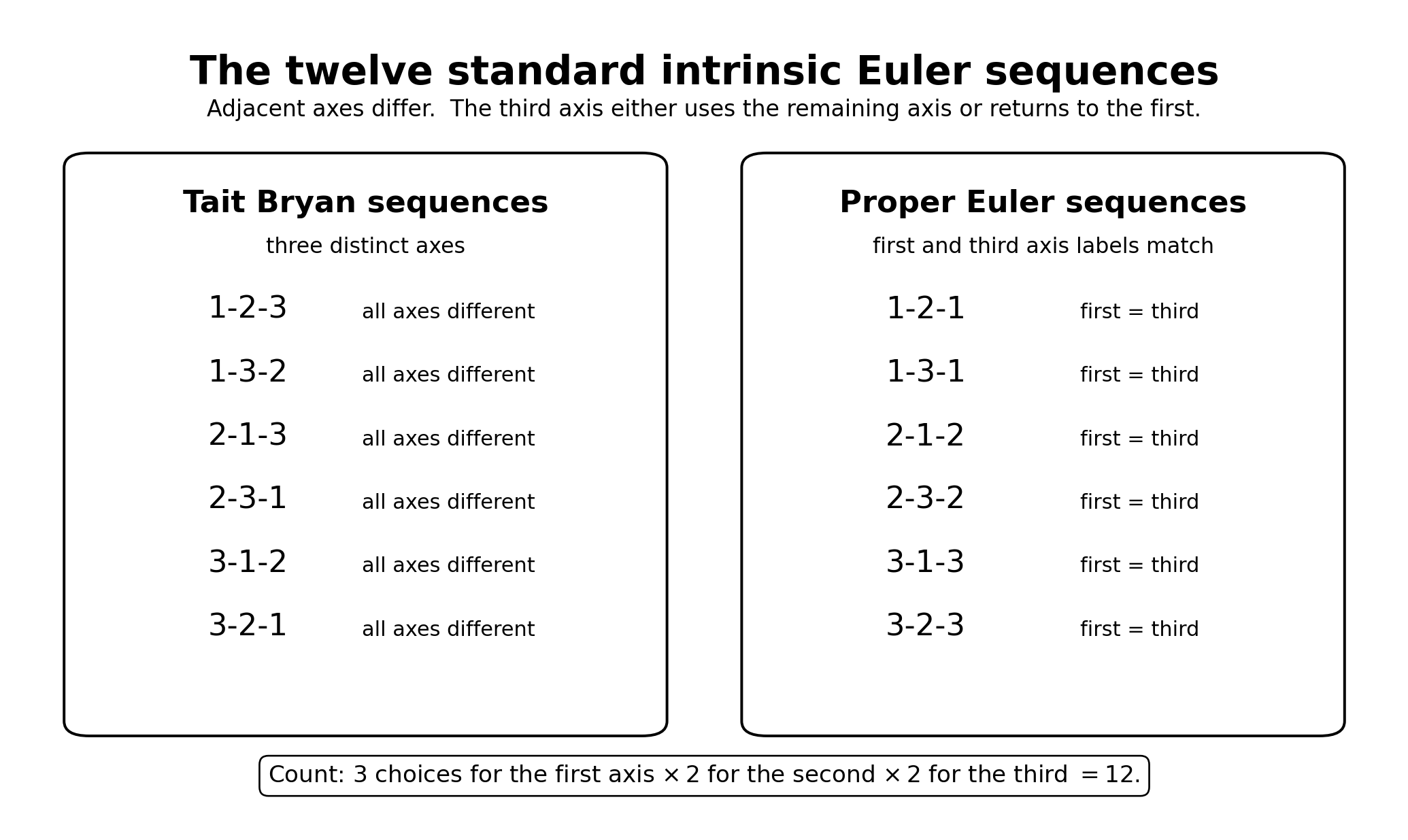
The six Tait Bryan sequences are
The six proper Euler sequences are
2 Visual reference
Figure. Generic intrinsic frame-chain composition.
Figure. The twelve standard intrinsic Euler sequences separated into Tait Bryan and proper Euler families.
3 Exercises
4 Solutions
Solution 1: derive the count of twelveThere are three choices for the first axis. The second axis must differ from the first, leaving two choices. The third axis has two standard choices: the remaining unused axis, producing a Tait Bryan sequence, or the first axis again, producing a proper Euler sequence. Therefore
Solution 2: classify the sequence familyTait Bryan means all three axis labels are different. Proper Euler means the first and third labels match. Thus
 are Tait Bryan, while
 are proper Euler.
Solution 3: list all six Tait Bryan sequencesThe six are
Solution 4: list all six proper Euler sequencesThe six are
Solution 5: write an intrinsic productFor 1-3-2,
 Therefore
Solution 6: write a proper Euler productFor intrinsic 3-1-3,
The first rotation is about axis 3 of the initial frame. After the middle rotation, the third rotation is about axis 3 of a different intermediate frame. The two axis labels match, but the physical axes generally do not.
Solution 7: frame-chain derivationFor intrinsic 2-3-1,
and
Therefore
Solution 8: rightmost factor diagnosticCoordinate columns are multiplied from the left. Hence C2(α) acts on Av first, followed by C 3(β) and then C1(γ). The chronological intrinsic order is therefore

Solution 9: single-angle reductionsFrom
 we obtain
and
Solution 10: intrinsic/extrinsic conversionReverse both axis order and associated angle order:
Solution 11: palindrome sequence subtletyReversing 3-2-3 leaves the same digit string, so
The axis labels look unchanged, but the angle association still reverses.
Solution 12: Tait Bryan singularityThe generic singularity is
On
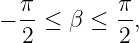 the singular values are
Solution 13: proper Euler singularityThe generic singularity is
On
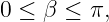 the singular values are
Solution 14: aerospace 3-2-1 specializationPhysicsLibrary uses
 Thus
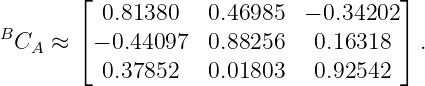
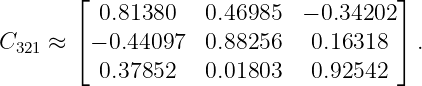
Solution 15: numerical 3-2-1 compositionUsing the elementary passive matrices gives
This matrix is orthogonal and has determinant +1 to numerical precision.
Solution 16: compare two sequence ordersFor intrinsic 3-2-1,
For intrinsic 1-2-3,
They are different, demonstrating sequence dependence and noncommutativity.
Solution 17: recognize the family from the singularityIf
 the sequence is proper Euler. If
 the sequence is Tait Bryan.
Solution 18: quaternion counterpartFor intrinsic 2-1-3,
The passive quaternion and DCM must satisfy
Solution 19: debug a wrong productThe student wrote the matrices in chronological left-to-right order. The correct passive intrinsic product is
Solution 20: recover a sequence from a productCompare
 with
 Thus
 The sequence is
which is Tait Bryan.
Solution 21: recover a proper Euler sequence from a productThe product
 has
 Therefore the sequence is
which is proper Euler.
Solution 22: verification batteryUseful checks include:
5 Compact reviewFor every intrinsic sequence,
There are six Tait Bryan sequences:
There are six proper Euler sequences:
Their generic singularity conditions are
and
6 Sources and exercise provenanceThe exercises and worked solutions in this companion are newly written for PhysicsLibrary to reinforce the sequence framework developed in Euler angles: sequence composition and the twelve standard sequences.
References
[1] D. M. Henderson, Euler Angles, Quaternions, and Transformation Matrices: Working Relationships, JSC-12960, NASA Johnson Space Center, 1977. NASA Technical Reports Server [2] J. Diebel, “Representing Attitude: Euler Angles, Unit Quaternions, and Rotation Vectors,” Stanford University, 2006. Online PDF [3] J. K. Moore, Learn Multibody Dynamics, chapter “Orientation of Reference Frames,” 2026 edition. Licensed CC BY 4.0. Orientation of Reference Frames
LicenseUnless otherwise noted, this PhysicsLibrary entry is intended for release under the Creative Commons Attribution ShareAlike 4.0 International license. "example of Euler angles: sequence composition and the twelve standard sequences" is owned by bloftin.
This object's parent. Cross-references: identity, determinant, relation, quaternion product, quaternion, Tait Bryan sequence, matrix, Tait Bryan sequences, formulas, composition, Euler Angles This is version 2 of example of Euler angles: sequence composition and the twelve standard sequences, born on 2026-08-29, modified 2026-08-30. Object id is 1126, canonical name is ExampleOfEulerAnglesSequenceCompositionAndTheTwelveStandardSequences. Accessed 218 times total. Classification:
|
|
|
|
Pending Errata and AddendaNone.
|
DiscussionNo messages.
|
Interact |
![[parent]](https://images.physicslibrary.org/images/uparrow.png)