|
|
|
|||||||
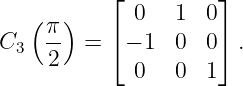
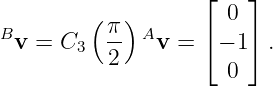
A fixed physical vector having coordinates
 therefore has new coordinates
The physical vector did not move. The coordinate axes moved, so the coordinates change with the passive sign. This test is used repeatedly throughout the series.
5 Intrinsic Euler sequencesLet the original frame be
 and the final frame be
 An intrinsic i-j-k sequence is
 The three steps are:
The successive passive coordinate transformations are
and
Substitution gives the universal PhysicsLibrary intrinsic sequence rule
The rightmost matrix acts first. This is ordinary composition of coordinate maps, not a reversal of the chronological physical sequence.
6 The twelve standard three angle sequencesA useful three angle sequence cannot repeat the same axis in two consecutive rotations because consecutive rotations about the same current axis combine into one rotation. This leaves twelve standard intrinsic sequences.
Tait Bryan sequencesTait Bryan sequences use three distinct axes:
Proper Euler sequencesProper Euler sequences repeat the first axis as the third axis:
The PhysicsLibrary legacy sequence entries retain their canonical names: Euler 121 sequence, Euler 123 sequence, Euler 131 sequence, Euler 132 sequence, Euler 212 sequence, Euler 213 sequence, Euler 231 sequence, Euler 232 sequence, Euler 312 Sequence, Euler 313 sequence, Euler 321 sequence, and Euler 323 sequence. Those entries form a reference subseries and are to be modernized under the convention established here.
7 Intrinsic and extrinsic descriptionsAn intrinsic sequence rotates about moving axes. An extrinsic sequence rotates about axes fixed in the original frame. These are not different orientation spaces. A physical orientation described by an intrinsic sequence can be redescribed by an extrinsic sequence using the reverse axis order with the corresponding angle association. For example, intrinsic 3-2-1 consists of:
The same final orientation can be described using a corresponding fixed axis sequence, but PhysicsLibrary names and derives its sequence articles intrinsically. Passive versus active and intrinsic versus extrinsic are independent distinctions. A source may be active and intrinsic, passive and intrinsic, active and extrinsic, or passive and extrinsic.
8 Why generic angles are
|
 | (16) |
for generic sequence positions and reserves

for physical roll, pitch, and yaw when those meanings are intended.
 -
- -
- yaw pitch roll
For intrinsic 3-2-1,
 | (17) |
Thus
 | (18) |
Let


and

Then
 | (19) |
This is the flagship Tait Bryan sequence in the PhysicsLibrary series.
An Euler triple is a set of nonlinear coordinates for an orientation.
In general,

does not represent the composition of the corresponding orientations.
Finite rotations in three dimensions do not commute, and the meaning of each Euler angle depends on the intermediate frame created by earlier rotations.
Euler angles therefore should not be transformed, added, subtracted, or integrated as though they formed an ordinary three component geometric vector.
This distinction is particularly important in attitude estimation, where a small local rotation error may be approximated by a three component vector even though a finite Euler triple is not such a vector.
Euler angles give local coordinates on the orientation manifold.
No three parameter Euler chart is globally nonsingular.
For a Tait Bryan sequence, the singularity occurs when the first and third rotation axes align after the middle rotation.
In the principal branch this occurs when
 | (20) |
For 3-2-1 yaw pitch roll,
 | (21) |
At this configuration, yaw and roll lose independent meaning.
For a proper Euler sequence, the coordinate singularity occurs when
 | (22) |
that is,
 | (23) |
on the usual principal interval.
The physical orientation remains well defined at every Euler singularity. Only the selected coordinate chart loses rank.
Euler representations are also not globally unique. Periodicity, alternate branches, and singular outer-angle coupling allow more than one triple to represent the same orientation.
Inverse Euler extraction must declare a principal range.
A common PhysicsLibrary default for a Tait Bryan sequence is
 | (24) |
with special handling at the middle-angle singularity.
A common proper Euler principal choice is
 | (25) |
Individual sequence articles must state their extraction ranges explicitly.
A direction cosine matrix represents the complete orientation using nine entries constrained by orthonormality.
Under the PhysicsLibrary convention,
 | (26) |
The reverse map is
 | (27) |
where
 | (28) |
A matrix that is the transpose of a PhysicsLibrary Euler matrix may therefore describe the same relative physical orientation while mapping coordinates in the opposite direction.
Unlike an Euler coordinate chart, a valid DCM has no gimbal lock singularity. Its redundancy is controlled by the orthogonality constraints.
The migrated PhysicsLibrary quaternion series uses the same passive frame map direction as this Euler series.
For
 | (29) |
the passive quaternion coordinate transformation is
 | (30) |
The quaternion and DCM describe the same map:
 | (31) |
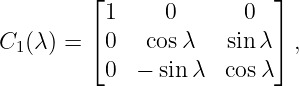
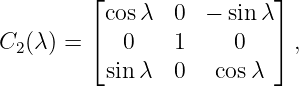
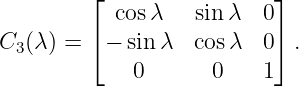
For a positive elementary frame rotation through λ about axis i,
 | (32) |
Therefore an intrinsic i-j-k sequence has quaternion product
 | (33) |
in the same written factor order as the passive DCM product
 | (34) |
For aerospace intrinsic 3-2-1,
 | (35) |
and
 | (36) |
This direct frame alignment is the canonical PhysicsLibrary bridge between the Euler and quaternion series.
It replaces older explanations in which the quaternion represented the opposite map direction and the Euler matrix was related by an additional transpose.
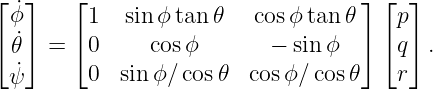
Euler angle rates

are rates of change of nonlinear orientation coordinates.
They are not, in general, the components of physical angular velocity in either the reference or body frame.
For aerospace 3-2-1, let
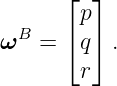
Then
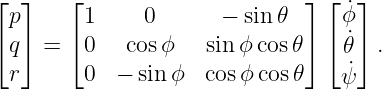 | (37) |
Away from gimbal lock,
 | (38) |
The inverse mapping becomes singular as

The rate singularity and the geometric Euler coordinate singularity are the same phenomenon viewed differentially.
Euler angles remain extremely useful as human readable orientation coordinates, but software should distinguish display coordinates from internal attitude state representation.
Important practices include:
 rather than a single argument inverse tangent when extracting angles;
The twelve established PhysicsLibrary sequence pages remain useful canonical reference objects and should be modernized rather than discarded.
They are:
Each modernized sequence page should use the same template:
The series naturally falls into five stages.
Begin with this overview, then read:
These articles establish enough geometry to read any later sequence formula without relying on a memorized sign convention.
Next read:
These articles explain the common singularity and branch structure within each six-sequence family.
The principal engineering references are:
The 3-2-1 and 3-1-3 articles provide one complete example from each Euler family.
Continue with:
These entries make clear where Euler coordinates fail, where they remain useful, and how they connect to nonsingular attitude representations.
Finish with:
A compact route is:
Emphasize:
Emphasize:
Every convention sensitive Euler formula should be tested against a common battery of simple checks.

 | (39) |
 | (40) |
 | (41) |
 | (42) |
These tests are intentionally repetitive. A formula can look algebraically reasonable while still carrying the wrong map direction, sign convention, or sequence interpretation.
An engineering paper, simulation, software interface, or PhysicsLibrary entry using Euler angles should state enough information to reconstruct its orientation map.
A concise declaration should include:
For the PhysicsLibrary aerospace 3-2-1 convention, a compact declaration is:
 | (43) |
with intrinsic moving axes, passive A → B coordinate mapping, right handed frames, and

The PhysicsLibrary Euler angle series uses intrinsic moving axis sequences and passive coordinate transformations.
The central sequence rule is
 | (44) |
The aerospace 3-2-1 specialization is
 | (45) |
The migrated quaternion series uses the same frame direction:
 | (46) |
with
 | (47) |
Euler angles remain valuable because they are minimal and interpretable. Their limitations are equally fundamental: noncommutativity, nonuniqueness, branch dependence, and coordinate singularities.
The purpose of the remaining articles is to make those strengths and limitations explicit enough that every formula can be traced back to a clear frame map rather than memorized as an isolated sign pattern.
Henderson’s NASA memorandum is a classic engineering reference because it tabulates all twelve three angle transformations and emphasizes the importance of transformation direction.
Moore’s multibody dynamics text develops orientation through reference frame basis relationships and is useful for passive direction cosine matrix interpretation.
Diebel surveys Euler angles, rotation matrices, quaternions, and rotation vectors in a unified attitude representation context.
Sommer and coauthors provide a modern discussion of quaternion convention management that is useful when comparing the Euler and quaternion series.
[1] D. M. Henderson, Euler Angles, Quaternions, and Transformation Matrices: Working Relationships, JSC-12960, NASA Johnson Space Center, 1977. NASA Technical Reports Server
[2] J. K. Moore, Learn Multibody Dynamics, chapter “Orientation of Reference Frames,” 2026 edition. Licensed CC BY 4.0. Orientation of Reference Frames
[3] J. Diebel, “Representing Attitude: Euler Angles, Unit Quaternions, and Rotation Vectors,” Stanford University, 2006. Online PDF
[4] H. Sommer, I. Gilitschenski, M. Bloesch, S. Weiss, R. Siegwart, and J. Nieto, “Why and How to Avoid the Flipped Quaternion Multiplication,” Aerospace, vol. 5, no. 3, article 72, 2018. Published under CC BY 4.0. Publisher article
Unless otherwise noted, this PhysicsLibrary entry is intended for release under the Creative Commons Attribution ShareAlike 4.0 International license.
| Keywords: | Euler angles, Tait Bryan angles, proper Euler angles, intrinsic rotation, passive transformation, direction cosine matrix, yaw, pitch, roll, gimbal lock, angular velocity |
| Physics Classification: | 02.40.Yy (Geometric mechanics ) |
| 45.40.-f (Dynamics and kinematics of rigid bodies) | |
| 07.05.Tp (Computer modeling and simulation) |
None.
No messages.






 sign check