Physics Library
 An open source physics library
Encyclopedia | Forums | Docs | Random | Template Test |  
Login
create new user
Username:
Password:
forget your password?
Main Menu
Sections

Meta

Talkback

Downloads

Information
[parent] example of quaternion conjugate (Example)

Quaternion Conjugate: Examples, Exercises, and Solutions

This entry is the self study companion to quaternion conjugate.

Quaternion conjugation is simple to define but unusually important. It reverses the sign of the vector part, reverses product order, produces the quadratic real quantity $qq^*$, and for unit attitude quaternions reverses the direction of a passive frame map.

All exercises are stated first. Complete worked solutions follow afterward.

Formula summary

For

$\displaystyle q = q_w + q_x\mathbf i + q_y\mathbf j + q_z\mathbf k,$ (1)

the conjugate is

$\displaystyle q^* = q_w - q_x\mathbf i - q_y\mathbf j - q_z\mathbf k.$ (2)

In scalar vector notation,

$\displaystyle q = q_w+\mathbf q, \qquad q^* = q_w-\mathbf q.$ (3)

Conjugation is an involution:

$\displaystyle (q^*)^*=q.$ (4)

It is real linear:

$\displaystyle (p+q)^* = p^*+q^*,$ (5)
$\displaystyle (\lambda q)^* = \lambda q^*, \qquad \lambda\in\mathbb{R}.$ (6)

Most importantly, conjugation reverses product order:

$\displaystyle (pq)^* = q^*p^*.$ (7)

The product of a quaternion with its conjugate is real:

$\displaystyle qq^* = q^*q = q_w^2+q_x^2+q_y^2+q_z^2.$ (8)

For a unit quaternion,

$\displaystyle q^*=q^{-1}.$ (9)

For the PhysicsLibrary passive attitude convention,

$\displaystyle {}^{A}q_B = ({}^{B}q_A)^*.$ (10)

Exercises

  1. Basic conjugation.

    For

    $\displaystyle q = 3 - 2\mathbf i + 5\mathbf j - 7\mathbf k, $

    compute $q^*$ and the scalar first component columns of both $q$ and $q^*$.

    Which component is unchanged?

  2. Real and pure special cases.

    Compute the conjugate of

    $\displaystyle r=5 $

    and of

    $\displaystyle v = 2\mathbf i - 3\mathbf j + 4\mathbf k. $

    Show that every real quaternion satisfies

    $\displaystyle r^*=r $

    and every pure quaternion satisfies

    $\displaystyle v^*=-v. $
  3. Conjugation as an involution.

    Starting from

    $\displaystyle q=q_w+\mathbf q, $

    prove directly that

    $\displaystyle (q^*)^*=q. $

    Then verify the result numerically for

    $\displaystyle q = -2 + \mathbf i + 3\mathbf j - 4\mathbf k. $
  4. Conjugate of a sum and real scalar multiple.

    Let

    $\displaystyle p = 2+\mathbf i-3\mathbf j $

    and

    $\displaystyle q = -1+4\mathbf j+2\mathbf k. $

    Verify explicitly that

    $\displaystyle (p+q)^* = p^*+q^* $

    and

    $\displaystyle (-3p)^* = -3p^*. $
  5. Product reversal using basis quaternions.

    Evaluate

    $\displaystyle (\mathbf i\mathbf j)^* $

    directly.

    Then evaluate

    $\displaystyle \mathbf j^*\mathbf i^*. $

    Verify

    $\displaystyle (\mathbf i\mathbf j)^* = \mathbf j^*\mathbf i^*. $

    Explain why the reversed factor order is essential.

  6. Product reversal for general numerical quaternions.

    Let

    $\displaystyle p = 1+2\mathbf i-\mathbf j+3\mathbf k $

    and

    $\displaystyle q = 2-\mathbf i+4\mathbf j+\mathbf k. $

    Compute $pq$, then $(pq)^*$.

    Separately compute $q^*p^*$ and verify that the two results agree.

  7. Why $p^*q^*$ is generally wrong.

    Using the same $p$ and $q$ from Exercise 6, compute

    $\displaystyle p^*q^* $

    and compare it with $(pq)^*$.

    Relate the difference to noncommutativity.

  8. Product with the conjugate.

    For

    $\displaystyle q = 2-\mathbf i+2\mathbf j+2\mathbf k, $

    compute

    $\displaystyle qq^* $

    and

    $\displaystyle q^*q. $

    Show explicitly that both are the same real quaternion.

  9. Derive $qq^*$ in scalar vector form.

    Let

    $\displaystyle q=q_w+\mathbf q. $

    Using the Hamilton scalar vector product, derive

    $\displaystyle qq^* = q_w^2+\mathbf q\cdot\mathbf q. $

    Why does the vector part vanish?

  10. Conjugate and norm connection.

    Suppose

    $\displaystyle q = 1 - 2\mathbf i + 2\mathbf j - 4\mathbf k. $

    Compute $qq^*$.

    Without yet using the explicit inverse formula, identify the Euclidean norm squared of the four quaternion components.

  11. Conjugate of a triple product.

    Prove

    $\displaystyle (pqr)^* = r^*q^*p^*.$ (11)

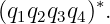
    Then state the corresponding pattern for

    $\displaystyle (q_1q_2q_3q_4)^*. $
  12. Conjugation of a pure quaternion product.

    Let $\mathbf a$ and $\mathbf b$ be pure quaternions.

    Starting from

    $\displaystyle \mathbf a\mathbf b = -\mathbf a\cdot\mathbf b + \mathbf a\times\mathbf b, $

    take the conjugate and show that

    $\displaystyle (\mathbf a\mathbf b)^* = -\mathbf a\cdot\mathbf b - \mathbf a\times\mathbf b.$ (12)

    Then show that this equals

    $\displaystyle \mathbf b\mathbf a. $
  13. Unit quaternion and reverse passive frame map.

    Frame $B$ is obtained from frame $A$ by a positive $90^\circ$ frame rotation about $+\widehat{\mathbf z}$.

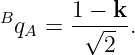
    The PhysicsLibrary passive quaternion is

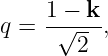
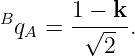
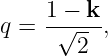
    $\displaystyle {}^{B}q_A = \frac{1-\mathbf k}{\sqrt2}. $

    Compute

    $\displaystyle {}^{A}q_B. $

    State the physical meaning of the conjugate in frame-map language.

  14. Conjugate sandwich reverses the coordinate map.

    Let

    $\displaystyle q = {}^{B}q_A $

    be unit and suppose

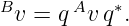
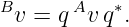
    $\displaystyle {}^{B}v = q\,{}^{A}v\,q^*. $

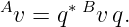
    Starting from this equation, solve algebraically for ${}^{A}v$ in terms of ${}^{B}v$ and $q$.

    Show that the reverse map is

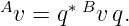
    $\displaystyle {}^{A}v = q^* \,{}^{B}v \,q.$ (13)
  15. $q$ versus $q^*$ is not the same as $q$ versus $-q$.

    For

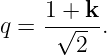
    $\displaystyle q = \frac{1-\mathbf k}{\sqrt2}, $

    write $q^*$ and $-q$.

    Do $q$ and $q^*$ represent the same passive frame map?

    Do $q$ and $-q$ represent the same passive frame map?

    Explain the difference.

  16. Conjugate as a convention diagnostic.

    A software library claims to store the passive frame quaternion ${}^{B}q_A$.

    For a positive $90^\circ$ frame rotation about $+z$, it reports

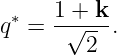
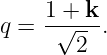
    $\displaystyle q = \frac{1+\mathbf k}{\sqrt2}. $

    Under the PhysicsLibrary convention, determine whether this quaternion more naturally represents ${}^{B}q_A$ or its reverse map ${}^{A}q_B$.

    What simple conjugation operation converts it to the PhysicsLibrary $A\rightarrow B$ passive map?

Solutions

Solution 1: basic conjugation

The quaternion is

$\displaystyle q = 3 - 2\mathbf i + 5\mathbf j - 7\mathbf k. $

Conjugation leaves the scalar coefficient unchanged and changes the sign of the vector part:

$\displaystyle q^* = 3 + 2\mathbf i - 5\mathbf j + 7\mathbf k.$ (14)

The scalar first component columns are

$\displaystyle [q]_{\mathrm{PL}} = \begin{bmatrix} 3\ -2\ 5\ -7 \end{bmatrix}, \qquad [q^*]_{\mathrm{PL}} = \begin{bmatrix} 3\ 2\ -5\ 7 \end{bmatrix}.$ (15)

The scalar component is unchanged.

Solution 2: real and pure special cases

For the real quaternion

$\displaystyle r=5, $

the vector part is zero, so

$\displaystyle r^*=5=r.$ (16)

For the pure quaternion

$\displaystyle v = 2\mathbf i - 3\mathbf j + 4\mathbf k, $

the scalar part is zero. Therefore

$\displaystyle v^* = -2\mathbf i + 3\mathbf j - 4\mathbf k = -v.$ (17)

Thus real quaternions are fixed by conjugation, while pure quaternions change sign.

Solution 3: conjugation as an involution

Write

$\displaystyle q=q_w+\mathbf q. $

Then

$\displaystyle q^* = q_w-\mathbf q. $

Conjugate again:

$\displaystyle (q^*)^* = q_w+\mathbf q = q. $

Therefore

$\displaystyle (q^*)^*=q.$ (18)

For

$\displaystyle q = -2+\mathbf i+3\mathbf j-4\mathbf k, $

we have

$\displaystyle q^* = -2-\mathbf i-3\mathbf j+4\mathbf k. $

Conjugating again gives

$\displaystyle (q^*)^* = -2+\mathbf i+3\mathbf j-4\mathbf k = q. $

Solution 4: conjugate of a sum and real scalar multiple

First,

$\displaystyle p+q = 1+\mathbf i+\mathbf j+2\mathbf k. $

Therefore

$\displaystyle (p+q)^* = 1-\mathbf i-\mathbf j-2\mathbf k. $

Separately,

$\displaystyle p^* = 2-\mathbf i+3\mathbf j $

and

$\displaystyle q^* = -1-4\mathbf j-2\mathbf k. $

Hence

$\displaystyle p^*+q^* = 1-\mathbf i-\mathbf j-2\mathbf k. $

Thus

$\displaystyle (p+q)^* = p^*+q^*.$ (19)

Also,

$\displaystyle -3p = -6-3\mathbf i+9\mathbf j. $

Therefore

$\displaystyle (-3p)^* = -6+3\mathbf i-9\mathbf j. $

Meanwhile,

$\displaystyle -3p^* = -3(2-\mathbf i+3\mathbf j) = -6+3\mathbf i-9\mathbf j. $

Thus

$\displaystyle (-3p)^* = -3p^*.$ (20)

Solution 5: product reversal using basis quaternions

Hamilton multiplication gives

$\displaystyle \mathbf i\mathbf j=\mathbf k. $

Therefore

$\displaystyle (\mathbf i\mathbf j)^* = \mathbf k^* = -\mathbf k. $

Now

$\displaystyle \mathbf i^*=-\mathbf i, \qquad \mathbf j^*=-\mathbf j. $

Hence

$\displaystyle \mathbf j^*\mathbf i^* = (-\mathbf j)(-\mathbf i) = \mathbf j\mathbf i = -\mathbf k. $

Thus

$\displaystyle (\mathbf i\mathbf j)^* = \mathbf j^*\mathbf i^*.$ (21)

If the factor order were not reversed, one would obtain

$\displaystyle \mathbf i^*\mathbf j^* = \mathbf i\mathbf j = \mathbf k, $

which has the wrong sign.

Solution 6: product reversal for general numerical quaternions

Let

$\displaystyle p=(1,[2,-1,3]) $

and

$\displaystyle q=(2,[-1,4,1]). $

Using the Hamilton product,

$\displaystyle pq = 5-10\mathbf i-3\mathbf j+14\mathbf k. $

Therefore

$\displaystyle (pq)^* = 5+10\mathbf i+3\mathbf j-14\mathbf k.$ (22)

Now

$\displaystyle q^* = 2+\mathbf i-4\mathbf j-\mathbf k $

and

$\displaystyle p^* = 1-2\mathbf i+\mathbf j-3\mathbf k. $

Multiplying in the reversed order gives

$\displaystyle q^*p^* = 5+10\mathbf i+3\mathbf j-14\mathbf k.$ (23)

Hence

$\displaystyle (pq)^* = q^*p^*. $

Solution 7: why $p^*q^*$ is generally wrong

Using the same conjugates,

$\displaystyle p^* = 1-2\mathbf i+\mathbf j-3\mathbf k $

and

$\displaystyle q^* = 2+\mathbf i-4\mathbf j-\mathbf k. $

Direct multiplication gives

$\displaystyle p^*q^* = 5-16\mathbf i-7\mathbf j.$ (24)

But from Solution 6,

$\displaystyle (pq)^* = 5+10\mathbf i+3\mathbf j-14\mathbf k. $

These are not equal.

The conjugation rule reverses factor order because quaternion multiplication is not generally commutative.

Solution 8: product with the conjugate

For

$\displaystyle q = 2-\mathbf i+2\mathbf j+2\mathbf k, $

the conjugate is

$\displaystyle q^* = 2+\mathbf i-2\mathbf j-2\mathbf k. $

The scalar part of $qq^*$ is

$\displaystyle 2^2+(-1)^2+2^2+2^2 = 13. $

The vector part cancels.

Therefore

$\displaystyle qq^*=13.$ (25)

Similarly,

$\displaystyle q^*q=13.$ (26)

Both products are the same real quaternion.

Solution 9: derive $qq^*$ in scalar vector form

Let

$\displaystyle q=q_w+\mathbf q $

and

$\displaystyle q^*=q_w-\mathbf q. $

Use the Hamilton scalar vector product.

The scalar part is

$\displaystyle q_wq_w - \mathbf q\cdot(-\mathbf q) = q_w^2+\mathbf q\cdot\mathbf q. $

The vector part is

$\displaystyle q_w(-\mathbf q) + q_w\mathbf q + \mathbf q\times(-\mathbf q). $

The first two terms cancel, and

$\displaystyle \mathbf q\times\mathbf q=0. $

Therefore the vector part vanishes.

Thus

$\displaystyle qq^* = q_w^2+\mathbf q\cdot\mathbf q.$ (27)

Solution 10: conjugate and norm connection

For

$\displaystyle q = 1-2\mathbf i+2\mathbf j-4\mathbf k, $

the sum of the squared components is

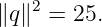
$\displaystyle 1^2+(-2)^2+2^2+(-4)^2 = 1+4+4+16 = 25. $

Therefore

$\displaystyle qq^*=25.$ (28)

This is the squared Euclidean norm of the four component column:
$\displaystyle \lVert q\rVert^2=25.$ (29)

Hence

$\displaystyle \lVert q\rVert=5. $

Solution 11: conjugate of a triple product

Associativity permits us to write

$\displaystyle pqr=(pq)r. $

Take the conjugate:

$\displaystyle (pqr)^* = [(pq)r]^*. $

Using product reversal once,

$\displaystyle [(pq)r]^* = r^*(pq)^*. $

Use it again:

$\displaystyle (pq)^* = q^*p^*. $

Therefore

$\displaystyle (pqr)^* = r^*q^*p^*.$ (30)

Likewise,

$\displaystyle (q_1q_2q_3q_4)^* = q_4^*q_3^*q_2^*q_1^*.$ (31)

Conjugation reverses the entire factor sequence.

Solution 12: conjugation of a pure quaternion product

For pure quaternions,

$\displaystyle \mathbf a\mathbf b = -\mathbf a\cdot\mathbf b + \mathbf a\times\mathbf b. $

The dot product term is real and is unchanged by conjugation.

The cross product term is pure and changes sign.

Therefore

$\displaystyle (\mathbf a\mathbf b)^* = -\mathbf a\cdot\mathbf b - \mathbf a\times\mathbf b.$ (32)

Now reverse the pure factors:

$\displaystyle \mathbf b\mathbf a = -\mathbf b\cdot\mathbf a + \mathbf b\times\mathbf a. $

Because

$\displaystyle \mathbf b\cdot\mathbf a = \mathbf a\cdot\mathbf b $

and

$\displaystyle \mathbf b\times\mathbf a = -\mathbf a\times\mathbf b, $

we obtain

$\displaystyle \mathbf b\mathbf a = -\mathbf a\cdot\mathbf b - \mathbf a\times\mathbf b. $

Hence

$\displaystyle (\mathbf a\mathbf b)^* = \mathbf b\mathbf a.$ (33)

Solution 13: unit quaternion and reverse passive frame map

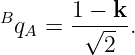
The forward passive frame quaternion is
$\displaystyle {}^{B}q_A = \frac{1-\mathbf k}{\sqrt2}. $

Its conjugate is

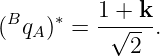
$\displaystyle ({}^{B}q_A)^* = \frac{1+\mathbf k}{\sqrt2}. $

For a unit attitude quaternion,

$\displaystyle {}^{A}q_B = ({}^{B}q_A)^*. $

Therefore

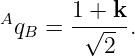
$\displaystyle {}^{A}q_B = \frac{1+\mathbf k}{\sqrt2}.$ (34)

The conjugate reverses the passive coordinate map: it maps $B$ coordinates back into $A$ coordinates.

Solution 14: conjugate sandwich reverses the coordinate map

Start from

$\displaystyle {}^{B}v = q\,{}^{A}v\,q^*. $

Left multiply by $q^*$:

$\displaystyle q^*{}^{B}v = q^*q\,{}^{A}v\,q^*. $

Because $q$ is unit,

$\displaystyle q^*q=1. $

Thus

$\displaystyle q^*{}^{B}v = {}^{A}v\,q^*. $

Right multiply by $q$:

$\displaystyle q^*{}^{B}v\,q = {}^{A}v\,q^*q. $

Again,

$\displaystyle q^*q=1. $

Therefore

$\displaystyle {}^{A}v = q^* \,{}^{B}v \,q.$ (35)

The reverse coordinate transformation uses the conjugate quaternion in the opposite sandwich order.

Solution 15: $q$ versus $q^*$ is not the same as $q$ versus $-q$

Given

$\displaystyle q = \frac{1-\mathbf k}{\sqrt2}, $

the conjugate is

$\displaystyle q^* = \frac{1+\mathbf k}{\sqrt2}.$ (36)

The negative quaternion is

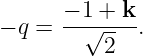
$\displaystyle -q = \frac{-1+\mathbf k}{\sqrt2}.$ (37)

The pair $q$ and $q^*$ generally represents opposite passive frame maps:

$\displaystyle {}^{B}q_A \quad\hbox{versus}\quad {}^{A}q_B. $

They are inverse transformations.

By contrast, $q$ and $-q$ represent the same physical orientation and the same passive frame map.

Thus conjugation changes map direction, while an overall sign change does not change orientation.

Solution 16: conjugate as a convention diagnostic

PhysicsLibrary assigns a positive $90^\circ$ frame rotation about $+z$ the passive $A\rightarrow B$ quaternion

$\displaystyle {}^{B}q_A = \frac{1-\mathbf k}{\sqrt2}. $

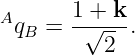
The software reports

$\displaystyle q = \frac{1+\mathbf k}{\sqrt2}. $

This is exactly the conjugate of the PhysicsLibrary $A\rightarrow B$ map.

Therefore it more naturally corresponds to
$\displaystyle {}^{A}q_B = \frac{1+\mathbf k}{\sqrt2}.$ (38)

To convert it to the PhysicsLibrary $A\rightarrow B$ passive map, take the conjugate:

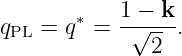
$\displaystyle q_{\mathrm{PL}} = q^* = \frac{1-\mathbf k}{\sqrt2}. $

Compact review

The core identities reinforced by this companion are

$\displaystyle q^* = q_w-\mathbf q,$ (39)
$\displaystyle (q^*)^*=q,$ (40)
$\displaystyle (pq)^*=q^*p^*,$ (41)
$\displaystyle qq^*=q^*q=\lVert q\rVert^2,$ (42)

and, for unit passive attitude quaternions,

$\displaystyle {}^{A}q_B = ({}^{B}q_A)^*.$ (43)

Conjugation is therefore both an algebraic operation and, for unit attitude quaternions, the operation that reverses a frame to frame coordinate map.

Sources and exercise provenance

The exercises and solutions in this companion are newly written or expanded for PhysicsLibrary from the algebra developed in Quaternion Conjugate.

Hamilton is the foundational source for quaternion conjugation. Joly and Kelland–Tait provide classical systematic treatments of conjugates, products, and norms. Sommer and coauthors provide a modern engineering discussion of quaternion convention management and passive frame transformations.

Bibliography

1
W. R. Hamilton, Elements of Quaternions, 2nd ed., edited by C. J. Joly, Longmans, Green, and Co., 1899. Public domain historical source. Internet Archive scan
2
C. J. Joly, A Manual of Quaternions, Macmillan and Co., London, 1905. Public domain historical source. Internet Archive search
3
P. Kelland and P. G. Tait, Introduction to Quaternions, with Numerous Examples, 2nd ed., Macmillan and Co., London, 1882. Public domain historical source. Internet Archive search
4
H. Sommer, I. Gilitschenski, M. Bloesch, S. Weiss, R. Siegwart, and J. Nieto, “Why and How to Avoid the Flipped Quaternion Multiplication,” Aerospace, vol. 5, no. 3, article 72, 2018. Published under CC BY 4.0. Publisher article

License

Unless otherwise noted, this PhysicsLibrary entry is intended for release under the Creative Commons Attribution ShareAlike 4.0 International license.


"example of quaternion conjugate" is owned by bloftin.
(view preamble)
View style:
See Also: quaternion series overview and article guide, Notation Quaternions for Physics and Engineering: Orientation, quaternion definition and basic algebra, example of quaternion definition and basic algebra, quaternion product, example of quaternion product, quaternion conjugate, quaternion norm, example of quaternion norm, quaternion inverse, example of quaternion inverse, Axis Angle Representation and Unit Quaternion, example of Axis Angle Representation and Unit Quaternion, rotating vectors with quaternions, example of rotating vectors with quaternions, composition of rotations and quaternion order, example of composition of rotations and quaternion order, quaternions and direction cosine matrices, example of quaternions and direction cosine matrices, quaternions and Euler angles, example of quaternions and Euler angles, quaternion kinematics and angular velocity, example of quaternion kinematics and angular velocity, relative attitude and error quaternions, example of relative attitude and error quaternions, numerical quaternion propagation and IMU attitude state integration, example of numerical quaternion propagation and IMU attitude state integration, quaternion exercises for physics and engineering

Keywords:  quaternion, conjugate, Hamilton product, scalar part, vector part, anti-automorphism, noncommutative algebra, exercises, worked solutions

This object's parent.

Cross-references: algebraic, identities, dot product, operation, quaternion product, formula, norm, vector product, scalar, vector, conjugation, quaternion, quaternion conjugate
There is 1 reference to this object.

This is version 2 of example of quaternion conjugate, born on 2026-08-28, modified 2026-08-28.
Object id is 1116, canonical name is ExampleOfQuaternionConjugate.
Accessed 19 times total.

Classification:
Physics Classification02.10.Hh (Rings and algebras)
 02.10.Ud (Linear algebra)
Pending Errata and Addenda
None.
Discussion
Style: Expand: Order:

No messages.

Interact
rate | post | correct | update request | add example | add (any)