Euler Angles: Orientation, Notation, and Conventions
Euler angles describe the relative orientation of two three-dimensional reference frames by means of
three successive one axis rotations. They provide a minimal, three parameter description of
orientation and are therefore intuitive and economical, but the same economy also produces
coordinate singularities and convention ambiguities.
The phrase “Euler angles” is used broadly in engineering for both proper Euler sequences, in which
the first and third axes are the same, and Tait–Bryan sequences, in which all three axes are
different. Examples are the 3-1-3 proper Euler sequence and the 3-2-1 yaw–pitch–roll Tait–Bryan
sequence.
A formula involving Euler angles is incomplete unless it states at least:
- the handedness of the coordinate frames;
- whether the operation is an active vector rotation or a passive coordinate
transformation;
- whether the three rotations are intrinsic (moving axis) or extrinsic (fixed axis);
- the axis sequence;
- the direction of the frame to frame coordinate map; and
- the meanings and ordering of the three angle symbols.
This entry establishes the convention used by the PhysicsLibrary Euler angle series.
1 PhysicsLibrary Euler angle convention contract
Unless an article explicitly states otherwise, the PhysicsLibrary Euler angle series uses the
following convention.
PhysicsLibrary Euler angle convention
- All reference frames are right-handed and orthonormal.
- Positive frame rotations follow the right-hand rule.
- Euler sequences are interpreted intrinsically: each successive rotation is about
an axis of the current, already rotated frame.
- direction cosine matrices are used as passive coordinate transformations.
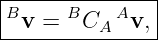
For frames A and B,
so BC
A converts the coordinates of the same physical vector from frame A to
frame B.
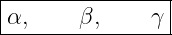
- For a generic intrinsic i-j-k sequence the first, second, and third angles are
denoted by
rather than assuming that ϕ,𝜃,ψ always mean first, second, and third.
- For the aerospace 3-2-1 sequence only, PhysicsLibrary uses
This convention is deliberately explicit because many apparently contradictory Euler angle
formulas differ only by a transpose, a reversed sequence description, or a relabeling of the three
angles.
2 Passive elementary coordinate transformations
Let frame B be obtained from frame A by a positive right-handed rotation of the axes through
angle λ about one coordinate axis. The passive coordinate transformation from A to B is written
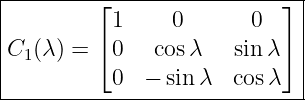
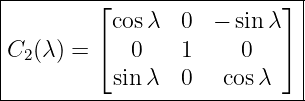
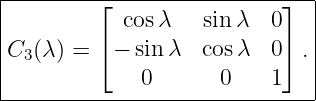
Ci(λ), where i = 1, 2, 3 denotes the x,y,z axis, respectively.
The three elementary transformations are
and
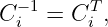
These matrices are orthogonal,
and have determinant +1.
They are the transposes of the matrices commonly written for an active rotation of a vector by the
same positive angle. The sign difference is a consequence of changing the basis rather than moving
the physical vector.
A 90∘ sign check
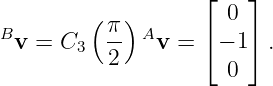
Suppose frame B is obtained by rotating the axes of frame A through +90∘ about +z. A physical
vector with coordinates
has coordinates in frame B
The vector itself has not rotated. The new coordinate axes have rotated, so the coordinates change
with the opposite sign from an active vector rotation.
3 Intrinsic Euler sequences
Consider an original frame A = A0 and a final frame B = A3. An intrinsic i-j-k Euler sequence is
constructed as follows:
Each transformation maps coordinates into the newly rotated frame,
and
Substitution therefore gives the universal PhysicsLibrary rule
for an intrinsic i-j-k sequence.
The rightmost matrix acts first on the coordinate column. This is not a reversal of the physical
sequence: it is the ordinary rule for composition of linear transformations.
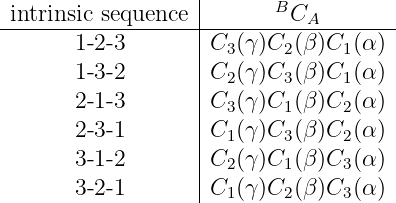
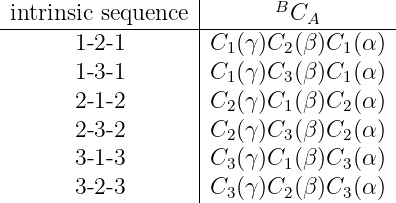
4 The twelve three angle sequences
A valid three angle sequence cannot use the same axis for two consecutive rotations, because two
consecutive rotations about the same current axis would combine into a single rotation. This leaves
twelve standard sequences.
Tait–Bryan sequences
The six Tait–Bryan sequences use three distinct axes.
Proper Euler sequences
The six proper Euler sequences repeat the first axis as the third axis.
The expanded matrices are developed in the individual PhysicsLibrary sequence entries: Euler 123
sequence, Euler 132 sequence, Euler 121 sequence, Euler 131 sequence, Euler 213 sequence, Euler
231 sequence, Euler 212 sequence, Euler 232 sequence, Euler 312 Sequence, Euler 321 sequence,
Euler 313 sequence, and Euler 323 sequence.
5 Intrinsic versus extrinsic descriptions
An intrinsic rotation sequence uses moving axes. An extrinsic sequence uses axes fixed in the
original frame. These are not two different classes of physical orientation; an intrinsic sequence can
be re described as an extrinsic sequence if the axis order and interpretation are reversed
appropriately.
For example, an intrinsic 3-2-1 sequence may be described geometrically as:
The same final orientation can be represented using a corresponding fixed axis description, but
PhysicsLibrary names and derives Euler sequences intrinsically. Whenever formulas from another
source are imported, the source’s intrinsic/extrinsic convention must be checked before comparing
matrix products.
6 Why generic angles are written as α,β,γ
The legacy PhysicsLibrary Euler entries generally used ϕ, 𝜃, and ψ as the first, second, and third
rotation parameters independent of which physical axes were used. That is internally workable, but
it conflicts with the widespread aerospace convention
In a 3-2-1 sequence, the first rotation is yaw and the third is roll. Consequently, the
legacy notation can make a correct matrix appear to have the yaw and roll symbols
interchanged.
PhysicsLibrary therefore uses
for generic first/second/third sequence angles and reserves
for contexts in which the physical meanings roll/pitch/yaw are intended.
7 Aerospace 3-2-1 yaw–pitch–roll specialization
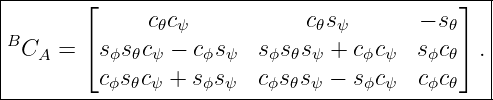
For the intrinsic 3-2-1 sequence,
where ψ is yaw, 𝜃 is pitch, and ϕ is roll. The passive coordinate transformation from the reference
frame A to the final frame B is therefore
Writing
gives
The dedicated Euler 321 sequence entry derives this matrix step by step and discusses inverse
extraction and the singularity at 𝜃 = ±π∕2.
8 Euler angles are coordinates, not vectors
The three numbers in an Euler angle triple are parameters of a nonlinear composition of rotations.
In general,
does not represent the composition of the corresponding orientations. Finite rotations in three
dimensions do not commute, and an Euler angle triple should not be transformed or added as
though it were an ordinary geometric vector.
This distinction becomes especially important in attitude estimation and control, where small
attitude errors may sometimes be approximated by a threecomponent vector even though the finite
Euler angles themselves are not a vector.
9 Coordinate singularities and nonuniqueness
Euler angles provide only a local coordinate chart on three-dimensional orientation. No three
parameter Euler chart is globally nonsingular.
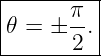
For a Tait–Bryan sequence the singularity occurs when the middle rotation places the first and
third rotation axes in alignment. In the 3-2-1 sequence this occurs at
This loss of one independent rotational degree of freedom in the coordinates is commonly called
gimbal lock. The physical orientation remains perfectly well defined; only the chosen Euler angle
coordinates become singular.
Euler triples are also not globally unique. Angle periodicity and the structure of the
sequence allow more than one triple to represent the same final orientation. Software
interfaces should therefore state the chosen principal ranges for inverse Euler angle
extraction.
10 Relationship to direction cosine matrices
A direction cosine matrix represents the complete orientation without a coordinate singularity,
although it uses nine matrix elements subject to six orthonormality constraints.
Under the convention of this article,
The inverse transformation is
with
A source that writes the transpose of a PhysicsLibrary Euler matrix may therefore
be describing the same physical orientation but mapping coordinates in the opposite
direction.
11 Compatibility with the PhysicsLibrary quaternion convention
The PhysicsLibrary quaternion series uses Hamilton multiplication and writes Aq
B for the
orientation of frame B relative to frame A, with the coordinate map
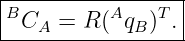
If R(Aq
B) denotes the corresponding matrix that maps B coordinates to A coordinates,
then
The passive Euler matrix used in this article maps in the opposite coordinate direction:
Thus the Euler and quaternion conventions describe the same relative orientation without changing
Hamilton’s quaternion multiplication law. The frame direction is carried explicitly by the notation
rather than hidden in a sign convention.
For the 3-2-1 yaw–pitch–roll orientation,
under the PhysicsLibrary/Hamilton quaternion convention, while
See Quaternions for Physics and Engineering: Orientation, Notation, and Conventions and
quaternions and Euler angles for the quaternion side of the relationship.
12 A minimum Euler angle convention declaration
Any engineering paper, simulation, software interface, or PhysicsLibrary entry that
uses Euler angles should make enough information available to answer the following
questions:
- Are the coordinate frames right-handed?
- What is the positive sense of rotation?
- Is the operation active or passive?
- What coordinate direction does the matrix map?
- Is the sequence intrinsic or extrinsic?
- What is the axis order?
- Which angle is applied first?
- What do the angle symbols mean physically?
- What are the principal angle ranges used for inverse extraction?
If these questions are answered, most apparent Euler angle disagreements reduce to a transpose, an
inverse, an order reversal, or an angle relabeling.
13 Common pitfalls
- Calling a matrix simply “the rotation matrix.” Without a map such as BC
A,
the direction of the coordinate transformation is ambiguous.
- Mixing active and passive matrices. For the same positive geometric rotation,
the active vector rotation matrix and passive coordinate transformation matrix are
transposes of one another.
- Calling a sequence 3-2-1 without saying intrinsic or extrinsic. The axis labels
alone do not completely specify the verbal operation.
- Assuming ϕ,𝜃,ψ always mean first, second, and third rotations. In aerospace
work they normally mean roll, pitch, and yaw, respectively.
- Reading the matrix product from left to right as the order of action on a
column vector. The rightmost factor acts first.
- Treating Euler angles as an ordinary three vector. Finite rotation composition
is nonlinear and noncommutative.
- Ignoring the middle angle singularity. Inverse formulas fail or become nonunique
at gimbal lock.
- Copying quaternion to Euler formulas from another convention. Quaternion
multiplication, frame direction, active/passive interpretation, and Euler sequence must
be converted as one consistent set.
14 Relation to later PhysicsLibrary entries
The present entry establishes the convention contract. The individual sequence entries develop the
twelve matrices in detail. Separate entries treat:
- each of the twelve intrinsic Euler sequences;
- conversion from a direction cosine matrix to Euler angles;
- Euler angle rates and angular velocity;
- quaternion to Euler conversion; and
- examples and exercises.
The 3-2-1 yaw–pitch–roll sequence is treated first because of its importance in aerospace,
navigation, robotics, and rigid-body dynamics.
15 References and convention notes
The matrix convention in this article agrees with the passive direction cosine matrix construction
used in modern reference frame mechanics treatments, where the rows contain the new basis
vectors resolved in the old basis. Henderson’s NASA memorandum is a useful engineering reference
because it tabulates all twelve three-angle transformations and emphasizes the importance of
transformation direction. Diebel provides a broad comparison of Euler angles, rotation matrices,
quaternions, and rotation vectors.
References
- D. M. Henderson, Euler Angles, Quaternions, and Transformation Matrices—Working
Relationships, JSC-12960, NASA Johnson Space Center, July 1977. NASA Technical
Reports Server
- J. K. Moore, Learn Multibody Dynamics, chapter “Orientation of Reference Frames,”
2026 edition, CC BY 4.0. Orientation of Reference Frames
- J. Diebel, “Representing Attitude: Euler Angles, Unit Quaternions, and Rotation
Vectors,” Stanford University, 2006. online PDF