When writing the time independent Schrödinger equation in spherical coordinates, we need to
plug the Laplacian in Spherical Coordinates into the time independent Schrödinger equation. The
Laplacian was found to be
Using the three dimensional Schrödinger equation we then have
We can gain insight into this somewhat ugly equation by rewriting it using the square of the
angular momentum operator in spherical polar coordinates:
This leads to
0.1 Spherically symmetric separable solution
This equation is only exactly solvable if V = V (r), a function without angular dependence. We
then write ψ(r,𝜃,ϕ) = R(r)Y (𝜃,ϕ) leading to the following equation:
 ψ(r,𝜃,ϕ)R(r)Y (𝜃,ϕ) ψ(r,𝜃,ϕ)R(r)Y (𝜃,ϕ) | = ER(r)Y (𝜃,ϕ) | |
|
−  + +  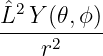 + V (r)R(r)Y (𝜃,ϕ) + V (r)R(r)Y (𝜃,ϕ) | = ER(r)(Y (𝜃,ϕ) | | |
To solve this equation we need to remove the angular dependence. This is simply done by
substituting the eigenfunctions of L2 into the equation. These are known to be the
spherical harmonics, Y lm(𝜃,ϕ). We also know that these have eigenvalues ℏ2l(l + 1),
i.e.
We now substitute this result into the Schrödinger equation and divide through by a common
factor of Y lm(𝜃,ϕ)
This is the radial equation.
References
[1] Griffiths, D. “Introduction to Quantum Mechanics” Prentice Hall, New Jersey, 1995.


![2 [ ( ) ( ) 2 ]
ˆH ψ(r,𝜃,ϕ ) = − ℏ--- 1--∂- r2∂ψ-(r,𝜃,ϕ) + --1----∂-- sin𝜃 ∂ψ-(r,𝜃,-ϕ) + ---1---∂-ψ-(r,𝜃,ϕ) +V (r,𝜃,ϕ)ψ (r,𝜃,ϕ) = E ψ(r,𝜃,
2m r2∂r ∂r r2sin𝜃 ∂𝜃 ∂𝜃 r2sin2 𝜃 ∂ϕ2](https://images.physicslibrary.org/cache/objects/108/make4ht/TimeIndependentSchrodingerEquationInSphericalCoordinates1x.png)



