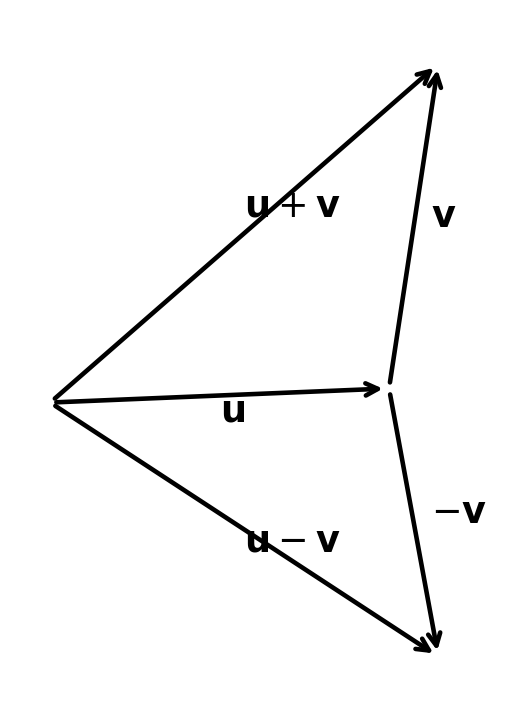
vector subtraction is defined by addition of the negative:
Equivalently,
 is the vector which, when added to is the vector which, when added to
 , gives , gives
 . .
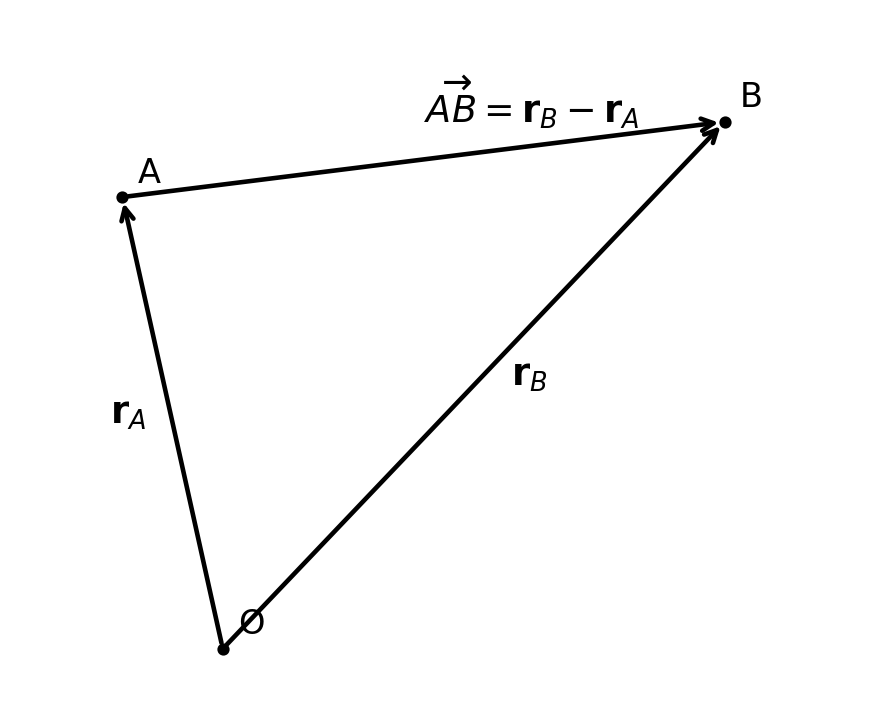
If  is a fixed origin, define the position vectors is a fixed origin, define the position vectors
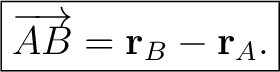
Then the displacement from  to to  is
This relation is fundamental in mechanics: displacement is the difference of position vectors. is
This relation is fundamental in mechanics: displacement is the difference of position vectors.
Figure 5b, modernized: displacement as the difference of position vectors.
The notation and terminology in this modernized article follow standard present-day mechanics and vector-analysis usage, particularly:
- J. R. Taylor, classical mechanics, University Science Books, 2005.
- D. Kleppner and R. Kolenkow, An Introduction to Mechanics, 2nd ed., Cambridge University Press, 2014.
- H. Goldstein, C. Poole, and J. Safko, Classical Mechanics, 3rd ed., Addison–Wesley, 2002.
This article is a modernized restatement of the corresponding Public domain article in Louis Brand, Vectorial Mechanics, John Wiley & Sons, New York, 1930, Chapter I, “Vector Algebra.” The original 1930 edition is the source basis.
|
"vector subtraction and position vectors" is owned by bloftin.(view preamble)