Let (ξ,η,ζ) be a point bearing a mass m, and let (x,y,z) be a variable point. If the
distance between these points is r, we can define the potential of (ξ,η,ζ) at (x,y,z)
as
The relevance of this concept appears from the fact that its partial derivatives
are the components of the gravitational force with which the material point (ξ,η,ζ) acts
on one unit mass at the point (x,y,z), provided that the measure units are chosen
suitably.
The potential of a set of points (ξ,η,ζ) is the sum of the potentials of the individual points, and
therefore may be expressed by an integral.
We determine the potential of all points (ξ,η,ζ) of a hollow ball, where the matter is located
between two concentric spheres with radii R0 and R, with R > R0. The density is assumed to be a
continuous function ϱ = ϱ(r) of the distance r from the center O. Let a be the distance from O to
the point A at which the potential is to be determined. We choose O as the origin and the ray OA
as the positive z-axis.
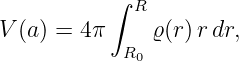
For obtaining the potential at A, we integrate over the spherical shell R0 ≤ r ≤ R. We use
spherical coordinates r, φ, and ψ related to Cartesian coordinates by
The full shell is described by
The law of cosines gives
Thus the potential is
| V (a) | = ∫
R0R ∫
−  ∫
02π
∫
02π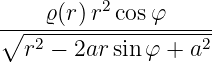 dψ dφdr dψ dφdr | |
|
| = 2π ∫
R0Rϱ(r) r dr ∫
− 
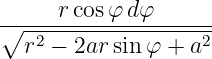 . . | (1) |
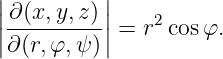
The Jacobian factor is
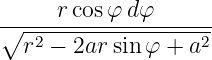
For the remaining angular integral,
Accordingly, there are two cases.
1∘. The point A is outside the hollow ball, i.e. a > R. Then |r − a| = a − r for all r ∈ [R
0,R]. The
value of the integral in (2) is 2r∕a, and (1) becomes
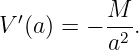
where M is the mass of the hollow ball. Thus the potential outside the hollow ball is exactly the
same as if all its mass were concentrated at the center. The corresponding attractive force is
represented by
2∘. The point A is in the cavity of the hollow ball, i.e. a < R
0. Then |r −a| = r −a throughout the
interval of integration. The value of (2) is 2, and (1) yields
which is independent of a. Thus the potential of the hollow ball, when the density depends only on
the distance from the center, is constant inside the cavity, and the hollow ball exerts no net
gravitational force on a mass inside it.
References
[1] Ernst Lindelöf, Differentiali- ja integralilasku ja sen sovellutukset II, Mercatorin
Kirjapaino Osakeyhtiö, Helsinki (1932).









![[∘ -----------------]
r2 − 2ar sinφ + a2](https://images.physicslibrary.org/cache/objects/250/make4ht/PotentialOfSphericalShell16x.png)


![[(r + a) − |r − a|]](https://images.physicslibrary.org/cache/objects/250/make4ht/PotentialOfSphericalShell20x.png)